

Eid Al-Adha: Breeders of luxury Eid cattle thrive as buyers seek 'beauty,' not the beef

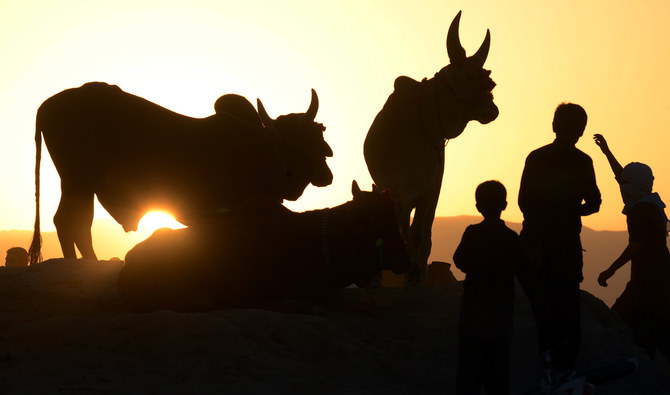
Pakistani youths stand beside the cattle at an animal market set up for the forthcoming sacrificial Eid Al-Adha festival in Quetta on Oct. 3, 2014. Eid Al-Adha, or the Feast of Sacrifice, honors Abraham's willingness to sacrifice his son on the order of God, who according to tradition then provided a lamb in the child's place. (AFP/File)
Short Url
Updated 17 July 2020
Follow

Eid Al-Adha: Breeders of luxury Eid cattle thrive as buyers seek 'beauty,' not the beef

  • Breeds such as the Brahman can reach a weight of between 500 kilograms and a ton, and cost millions of rupees
  • Farmers who keep ordinary cattle fear they will not be able to sell their animals amid coronavirus restrictions on livestock markets 

LAHORE: While bans on livestock markets ahead of Eid Al-Adha have sent shivers through Pakistan’s cattle traders whose annual income often depends on the upcoming holiday, stockmen who keep special and expensive sacrificial breeds of cattle say their animals “sell like hotcakes.” 

Earlier this week, Pakistani authorities banned open-air livestock markets in cities to contain the spread of coronavirus, allowing people to buy and sell animals only at 700 designated marketplaces on the outskirts of urban areas across the country. Farmers who keep ordinary cattle fear they will not be able to sell their stock, but those who raise special Eid animals say their business is thriving despite all restrictions. 

“They sell like hotcakes. I have 125 animals and 30 have already been sold, while people are in contact online for the remaining animals,” Asim Butt, who keeps special cattle breeds, told Arab News.

At his farm in Jaranwala in Punjab, about 110 kilometers from Lahore, Butt raises big beef cattle such as the Brahman, Bhagnari, Dhanni, Cholistani, Rajasthani and Sahiwal that grow to the weight of 500 kilograms and can reach even one ton. 

Every breed has its own specialty. Barahman is the biggest of them all and can sell for millions of rupees. Rajasthani is known for its swiftness and is used in traditional cow racing. Dhanni is famous for its strength, while Bhagnari has long horns, big eyes and a leaner body structure, which livestock aficionados praise for its looks.

The special animals need special care and feed. Butt gives them milk, almonds and butter for their hides to stay shiny, eyes to be bright and ears to grow long, he said, “Their diet is a special mixture of fiber, protein, fat and some steroids that help them gain weight. These breeds attract customers with their beauty and heavy weight.”

“Beauty lovers pay a price many times greater than the value of meat, because of the beauty and weight of the animal.” 

One of Butt’s buyers, businessman Sarim Syed told Arab News that for Eid Al-Adha it is not the meat of the sacrificial animals that matters but its beauty and emotions related to religious observance, for which he is willing to pay a hefty sum of money. 
 
“I love big and beautiful animals to sacrifice in the way of Allah. I can spend 2 million rupees to buy a beautiful animal. We don’t pay for the flesh but for the emotions and love we have for big animals,” he said. 

With loyal customers who seek top quality, Butt’s livestock business, which he started only three years ago, is thriving, especially ahead of Eid Al-Adha. But other breeders, those who cater to less affluent buyers, fear that this year’s Festival of Sacrifice will not bring them bounty.

“Our business is buying small animals a year or six months before Eid Al-Adha raising them at village farms till the ZilHajj moon is sighted. We bring them to the market and sell them. It covers the whole year’s expenses,” said Saif Ali Awan, a livestock seller at the Harbanspura cattle market in Lahore. 

“Now the pandemic has stopped everyone from setting up markets,” he told Arab News, “Our animals remain at farms. I fear big losses and that life next year will be difficult.”


Pakistan reviews austerity measures amid Middle East crisis, urges strict nationwide implementation

Updated 11 March 2026
Follow

Pakistan reviews austerity measures amid Middle East crisis, urges strict nationwide implementation

  • Deputy Prime Minister Ishaq Dar chairs review meeting of austerity steps
  • Officials briefed on salary cuts, school closures, four‑day week, petrol conservation

ISLAMABAD: Pakistan’s government on Wednesday assessed progress on a sweeping set of austerity measures introduced to mitigate the country’s economic strain from sharply rising global oil prices and supply disruptions linked to the ongoing war in the Middle East.

Prime Minister Shehbaz Sharif this week announced a series of austerity steps, including a four‑day work week for government offices, requiring 50  percent of staff to work from home, cutting fuel allowances for official vehicles by half, grounding up to 60  percent of the government fleet and closing all schools for two weeks to conserve fuel amid the global oil crisis.

The measures were unveiled in response to global oil market volatility triggered by the conflict involving the United States, Israel and Iran, which has disrupted supply routes such as the Strait of Hormuz and pushed crude prices sharply higher, straining Pakistan’s heavily import‑dependent energy sector.

“The meeting stressed the importance of strict and transparent adherence to the austerity measures, promoting fiscal responsibility and prudent use of public resources,” Deputy Prime Minister and Foreign Minister Senator Mohammad Ishaq Dar said in a statement.

He was chairing a meeting of the Committee for Monitoring and Implementation of Conservation and Additional Austerity Measures, constituted under the directions of the PM, bringing together federal and provincial officials to review execution of the broad cost‑cutting plan. 

Dar emphasized the government’s commitment to enforcing the PM’s austerity steps nationwide. The committee’s review also covered reductions in departmental expenditure, deductions from salaries of senior officials earning over Rs. 300,000 ($1,120), and coordination with provincial administrations to ensure uniform implementation of the plan.

Participants at the meeting reiterated that all ministries and divisions must continue strict monitoring and reporting, with transparent oversight mechanisms, as Pakistan navigates the economic pressures from the prolonged Middle East crisis and its fallout on global energy and trade markets.