ISLAMABAD: A spokesman for Pakistan’s religion ministry said on Thursday it had reissued instructions that all pending dues be reimbursed to Hajj applicants, saying they should withdraw their dues from banks “as soon as possible.”
Last month, the Pakistan government said it would refund all those who had paid dues to perform the Hajj pilgrimage under a government scheme, following Saudi Arabia’s decision to limit the annual pilgrimage this year due to the coronavirus outbreak.
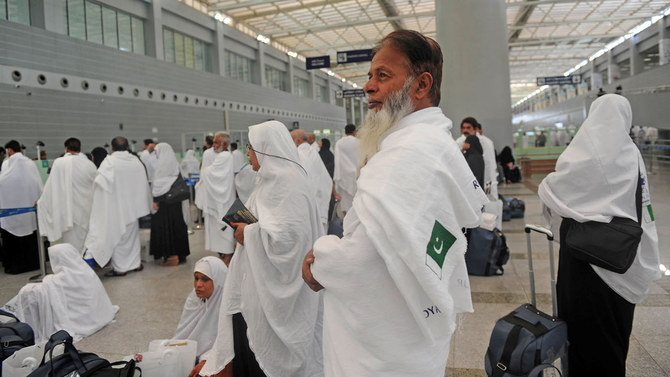
A total of 180,000 Pakistanis were scheduled to perform the Hajj this year, over 107,500 under a government program.
“All nominated banks have been instructed to complete the refund process by July 28,” a spokesman for the religious affairs ministry said in a statement.
He said the ministry had not issued any instructions that the dues be kept in banks or new bank accounts be opened.
“All nominated banks are obliged to pay all dues without deduction,” the statement said. “The ministry is in constant touch with the banks for easy refund of money to all Hajj applicants. In case of any difficulty or concern, users should contact the Religious Affairs complaints number.”

Pakistan’s religion ministry orders banks to refund all Hajj applicants by July 28
https://arab.news/j3kas
Pakistan’s religion ministry orders banks to refund all Hajj applicants by July 28
- A total of 180,000 Pakistanis were scheduled to perform the Hajj this year
- Saudi authorities announced this year’s Hajj will be limited to 10,000 people residing inside the Kingdom
Pakistan, UK discuss regional security, cross-border attacks as senior official visits Islamabad
- British envoy for Afghanistan Richard Lindsay’s visit comes at a time of a surge in militancy in Pakistan’s border regions
- Pakistani diplomat says both sides reviewed broader security challenges, emphasized coordination to address ‘shared concerns’
ISLAMABAD: Pakistani and British officials have discussed regional security challenges and cross-border attacks during talks in Islamabad, a Pakistani diplomat said on Tuesday, during a visit of the United Kingdom’s Afghanistan envoy, Richard Lindsay, to the Pakistani capital.
Pakistan and the UK regularly cooperate on counterterrorism and security, with a focus on intelligence-sharing to combat militant activity. Lindsay’s visit comes at a time of a rise in militancy in Pakistan’s western provinces, which border Afghanistan.
Mohammad Sadiq, Pakistan’s special representative for Afghanistan, said the discussions in Islamabad focused on the regional security situation, particularly the urgent challenge posed by cross-border attacks.
“We also exchanged views on the latest regional security developments and broader security challenges,” he said on X. “We emphasized the importance of continued cooperation and coordination to address shared concerns and promote regional stability.”
Islamabad frequently accuses Afghanistan of allowing its soil and India of backing militant groups, such as the Tehreek-e-Taliban Pakistan (TTP) and the Balochistan Liberation Army (BLA), for attacks against Pakistan. Kabul and New Delhi deny this.
In recent years, Pakistan and the UK have engaged with each other on counterterrorism and cross-border crimes as part of bilateral cooperation.
Both sides held the second round of the Pakistan-UK Counter Terrorism Dialogue in London in February last year, reviewing global and regional threats and exchanging best practices. Over the years, armed forces of both countries have also maintained close cooperation, particularly in counterterrorism efforts and professional military training.