Chinese workers arrive in Pakistan to speed up CPEC projects slowed by coronavirus

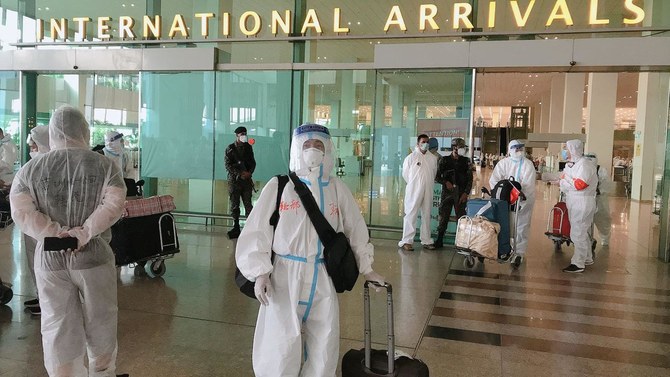
Chinese engineers and workers arrive at Islamabad International Airport, Pakistan, to expedite work on several hydropower projects under the China-Pak Economic Corridor, on July 13, 2020. (China Gezhouba Group Company)
Short Url
Updated 25 July 2020
Follow

Chinese workers arrive in Pakistan to speed up CPEC projects slowed by coronavirus

  • Majority Chinese workers left before Chinese New Year festival and were unable to return to Pakistan after the pandemic started
  • Pakistan and China have signed projects worth more than $12 billion since June 6 this year, including for two hydropower projects

ISLAMABAD/KARACHI: Around 215 Chinese engineers and other staff members have arrived in Pakistan from China this week to expedite work on several hydropower projects under the China-Pak Economic Corridor (CPEC), a spokesman for China Gezhouba Group Company, which is running the projects, said.

Pakistan’s federal government set up the CPEC Authority late last year to expedite work on over $60 billion worth of CPEC projects that have stalled since the government of Prime Minister Imran Khan came to power in 2018. Asim Saleem Bajwa, a retired military general, was appointed to head the body.
Since June 6, Pakistan and China have signed projects worth more than $12 billion, including for two hydropower projects in Pakistan-administered Kashmir, and the rehabilitation and upgrade of a 1,872 KM long colonial-era railway track at an estimated cost of $8.17 billion.
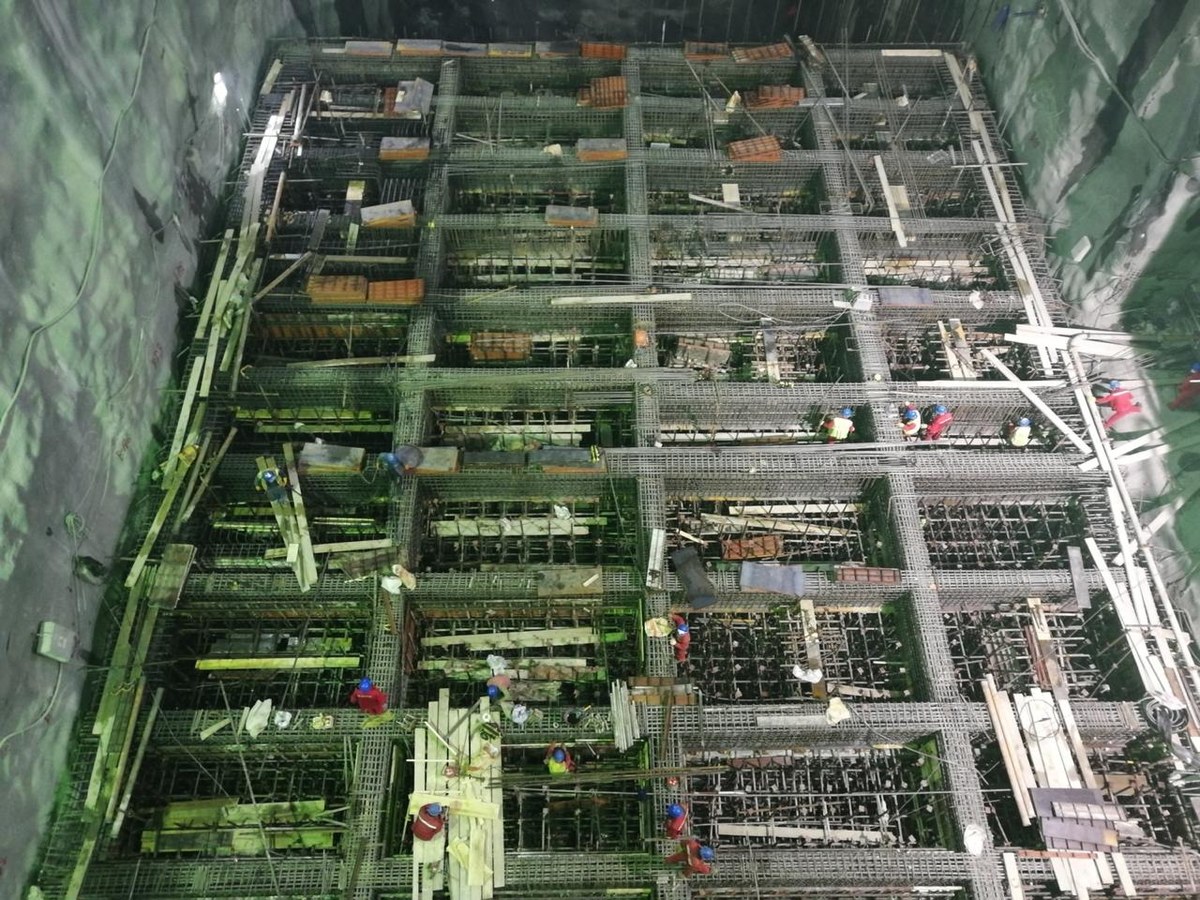


A view of tunnel work at CPEC Suki Kinari Hydropower Project. (Photo courtesy: China Gezhouba Group Company)

Travel restrictions to prevent the spread of the coronavirus, which has now killed more than half a million people, have idled much of the world’s second-largest economy, China, and choked key elements of its signature Belt and Road Initiative (BRI), of which CPEC is a flagship project.
But batches of Chinese staff are arriving in Pakistan once again to kickstart work on projects including the Suki-Kinari, Neelum Jhelum, and Dasu hydropower projects as well as the Mohmand Dam project.
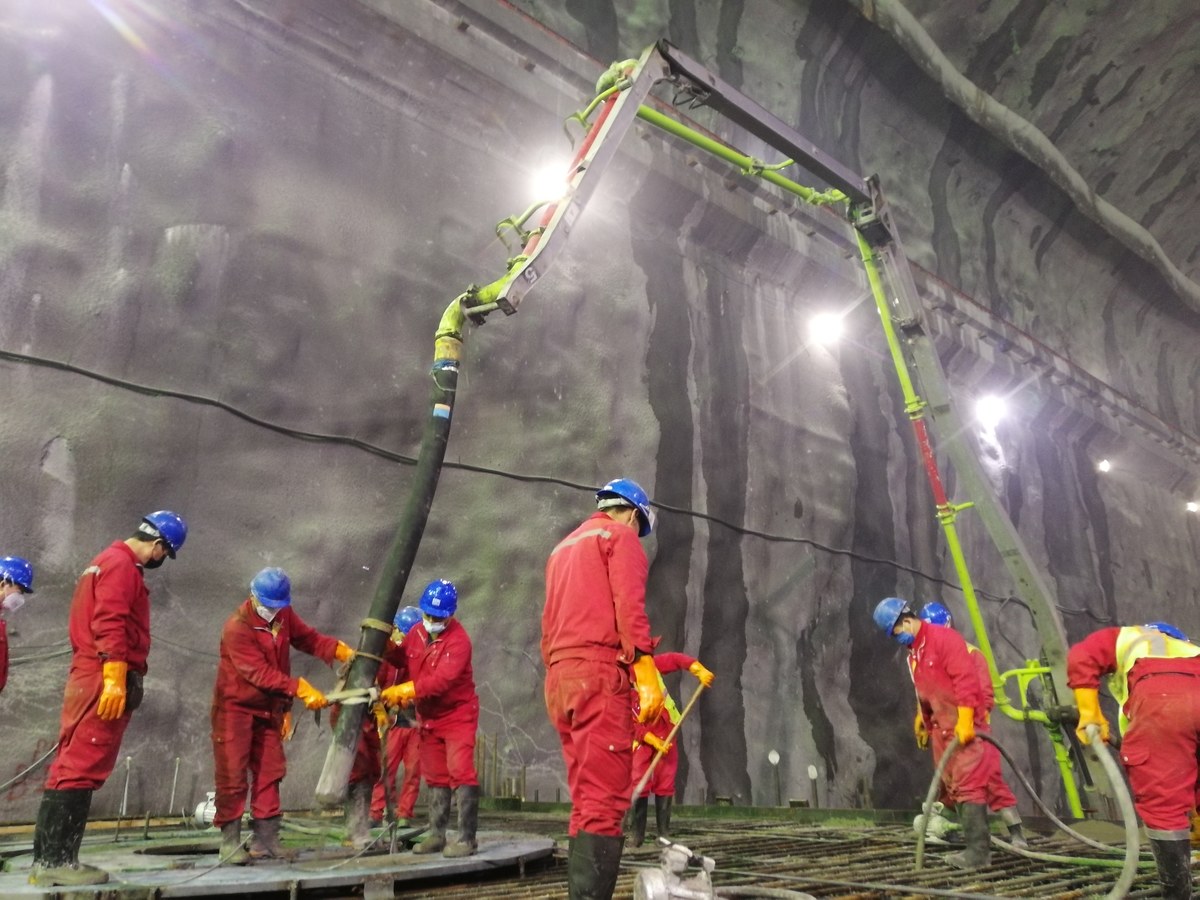


In this undated photo, Chinese construction workers of China Gezhouba Group Company working at a CPEC project site in Pakistan. (Photo courtesy: China Gezhouba Group Company)

A third group of Chinese engineers and other staff members arrived in Islamabad from China’s Sichuan Province on July 13, a press release from state-owned China Gezhouba Group Company said.
“This is the third batch of Chinese CPEC workers returning to Pakistan through charter plane organized by China Gezhouba with assistance from Ministry of Foreign Affairs since the COVID-19 outbreak,” said Mustafa Kamal, spokesman of China Gezhouba Group Company, said. “Majority of the Chinese workers had left Pakistan before the outbreak for the Chinese New Year festival and were unable to return to Pakistan because of the spread of coronavirus that resulted in lockdowns and international flight suspensions.”


China Gezhouba Group Company take a group photo after arriving in Islamabad, Pakistan to restart work on CPEC projects July 13, 2020. (Photo courtesy: China Gezhouba Group Company)


The company is one of the largest publicly owned Chinese entities, executing a number of projects in Pakistan — including under the CPEC umbrella — worth around $9 billion in Pakistan.
The company spokesman said all staff had gone through a compulsory quarantine period of 14 days in China and were tested for coronavirus there. After arrival at Islamabad airport, they had been taken straight to isolation centers established on project sites where they will be quarantined for an additional 14 days.
Two groups of CPEC staffers had arrived in Pakistan earlier, Kamal said, and were safely deputed to work. He said the company roughly had 24,800 local employees and around 14,000 Chinese workers working on various CPEC projects.



Imran Khan not a ‘national security threat,’ ex-PM’s party responds to Pakistan military

Updated 06 December 2025
Follow

Imran Khan not a ‘national security threat,’ ex-PM’s party responds to Pakistan military

  • Pakistan’s military spokesperson on Friday described Khan’s anti-army narrative as a “national security threat”
  • PTI Chairman Gohar Ali Khan says words used by military spokesperson for Khan were “not appropriate”

ISLAMABAD: Former prime minister Imran Khan’s Pakistan Tehreek-e-Insaf (PTI) party on Saturday responded to allegations by Pakistan military spokesperson Lt. Gen. Ahmed Sharif Chaudhry from a day earlier, saying that he was not a “national security threat.”

Chaudhry, who heads the military’s media wing as director general of the Inter-Services Public Relations (ISPR), spoke to journalists on Friday, in which he referred to Khan as a “mentally ill” person several times during the press interaction. Chaudhry described Khan’s anti-army narrative as a “national security threat.”

The military spokesperson was responding to Khan’s social media post this week in which he accused Chief of Defense Forces Field Marshal Asim Munir of being responsible for “the complete collapse of the constitution and rule of law in Pakistan.” 

“The people of Pakistan stand with Imran Khan, they stand with PTI,” the party’s secretary-general, Salman Akram Raja, told reporters during a news conference. 

“Imran Khan is not a national security threat. Imran Khan has kept the people of this country united.”

Raja said there were several narratives in the country, including those that created tensions along ethnic and sectarian lines, but Khan had rejected all of them and stood with one that the people of Pakistan supported. 

PTI Chairman Gohar Ali Khan, flanked by Raja, criticized the military spokesperson as well, saying his press talk on Thursday had “severely disappointed” him. 

“The words that were used [by the military spokesperson] were not appropriate,” Gohar said. “Those words were wrong.”

NATURAL OUTCOME’

Speaking to reporters earlier on Saturday, Pakistan’s Defense Minister Khawaja Asif defended the military spokesperson’s remarks against Khan.

“When this kind of language is used for individuals as well as for institutions, then a reaction is a natural outcome,” he said. 

“The same thing is happening on the Twitter accounts being run in his [Khan’s] name. If the DG ISPR has given any reaction to it, then I believe it was a very measured reaction.”

Khan, who was ousted after a parliamentary vote of confidence in April 2022, blames the country’s powerful military for removing him from power by colluding with his political opponents. Both deny the allegations. 

The former prime minister, who has been in prison since August 2023 on a slew of charges he says are politically motivated, also alleges his party was denied victory by the army and his political rivals in the 2024 general election through rigging. 

The army and the government both deny his allegations.