


Pakistan health institute chief says following SOPs over Eid could make 'real difference'

The National Institute of Health’s executive director, Maj-Gen Aamer Ikram, is giving an exclusive interview to Arab News in Islamabad on July 13, 2020. (AN Photo)
Short Url
Updated 15 July 2020
Follow

Pakistan health institute chief says following SOPs over Eid could make 'real difference'

  • Major General Aamer Ikram says Pakistan not downplaying coronavirus deaths, infections decreasing 
  • Pakistan-made coronavirus test kits not operational yet but under final evaluation, he says

ISLAMABAD: The head of Pakistan’s National Institute of Health warned this week that with the Eidul Azha holiday around the corner, the public needed to continue to strictly follow social distancing rules, wear masks and take a range of other precautions to contain the spread of the coronavirus.

Pakistan, where the first coronavirus case was reported in late February, has so far officially recorded 5,386 deaths and 252,636 infections. 
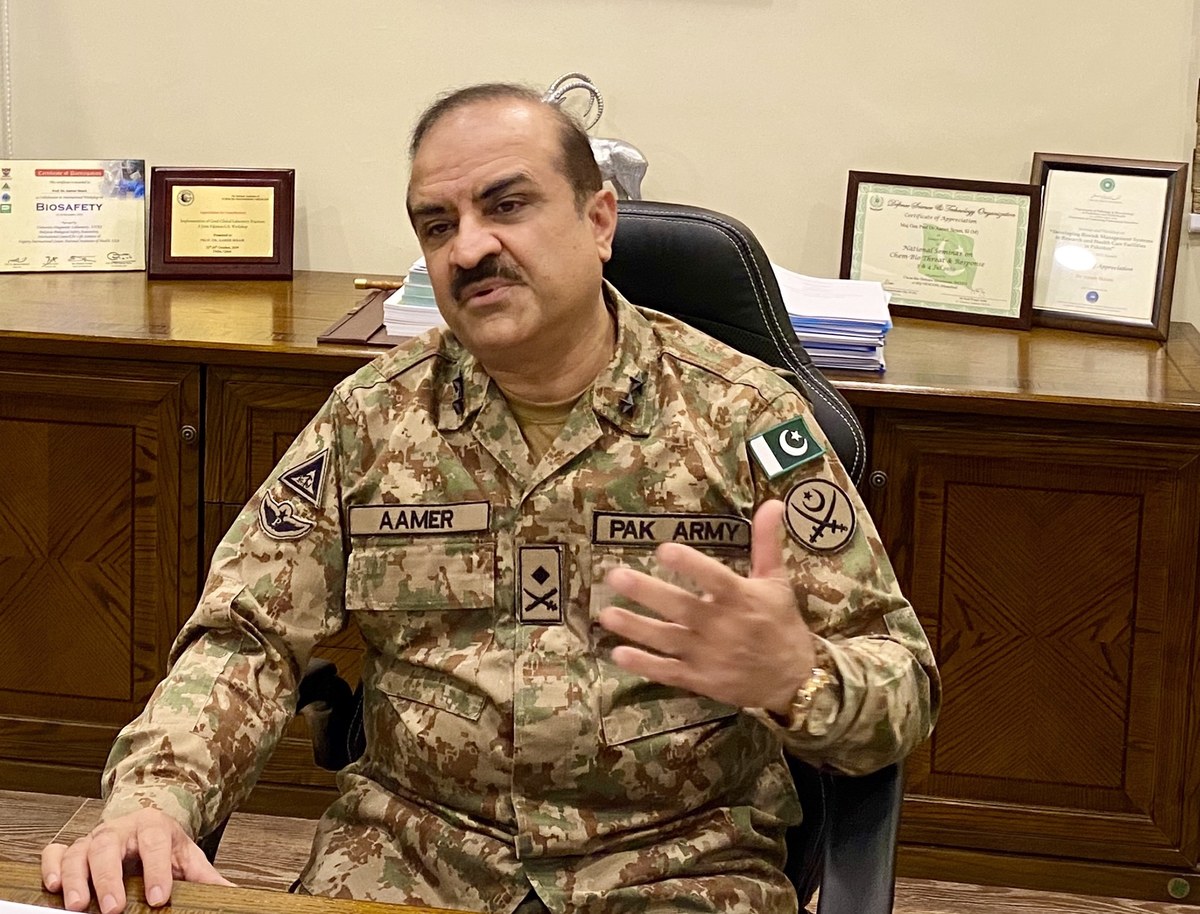


The National Institute of Health’s executive director, Maj-Gen Aamer Ikram, is giving an exclusive interview to Arab News in Islamabad on July 13, 2020. (AN Photo)

Cases spiked in May after the government lifted an almost two-month long lockdown, mostly over its economic and financial impact, and ahead of the Eidul Fitr festival. Instead, the government imposed ‘smart’ lockdowns in selected areas of several cities, saying that it feared COVID-19 cases could multiply eightfold by the end of July and hit 1.2 million.
“After Eidul Fitr, we had witnessed a surge in the COVID-19 positive cases,” Major General Prof. Aamer Ikram, Executive Director of National Institute of Health (NIH), told Arab News in an interview on Monday. “Now Eidul Azha is arriving and by strictly adhering to the SOPs [standard operating procedures] we can make a real difference.”
He said the government was not downplaying the true extent of the country’s COVID-19 death toll, adding that the rate of infections had gone down in the last week and the coronavirus curve had “plateaued.” 
“We cannot hide number of deaths,” Ikram said. “If you see the statistics of the last one week, there is a reduction in number of deaths. There is nothing like hiding the data.”
He said authorities wanted to ensure “data accuracy” and were vigilant in digging out any discrepancies in numbers.
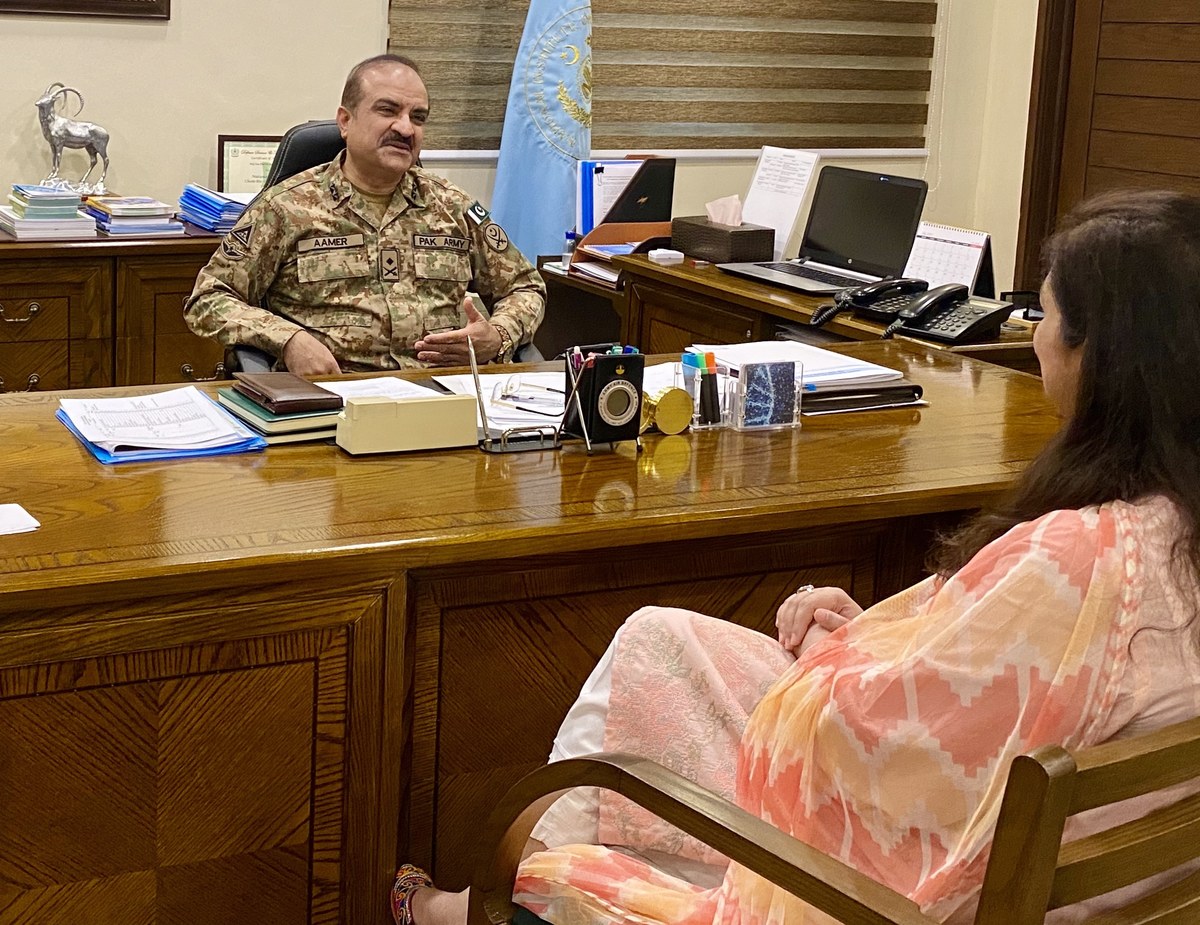


The National Institute of Health’s executive director, Maj-Gen Aamer Ikram, is giving an exclusive interview to Arab News in Islamabad on July 13, 2020. (AN Photo)

The coronavirus curve had flattened in Pakistan, the NIH chief said, and data from the last ten days would show that Pakistan had “attained the plateau and it is coming down now.”
“The government’s strategy of smart lockdown has played a very pivotal role in reducing the number of COVID-19 cases,” he said. 
On Tuesday, Pakistan recorded 1,979 new cases of the coronavirus, following 21,020 countrywide tests in the last 24 hours, marking the lowest number of new infections in weeks. 
However, critics have said the rate of infections had gone down because of decreasing rates of testing. 
“One of the reasons of reduction in tests is that the WHO [World Health Organisation] has changed earlier policy of two mandatory negative tests of recovered patients, 24 hours apart, before discharging them from hospital, which is not required now,” Ikram said, commenting on reduced testing figures in Pakistan. 
Another important reason, he said, was that Pakistan was previously testing all incoming international passengers but now only testing those who showed coronavirus symptoms:  “We are now only screening them, that also reduced the [testing] load”.
The NIH chief said Pakistan was the first country in the region to start COVID-19 Polymerase Chain Reaction (PCR) tests, used to detect the coronavirus, saying the country started out by conducting just 300 tests per day in a few odd labs but now had 135 testing labs nationwide with the capacity to carry out over 150,000 tests per day.
On Wednesday, the government’s coronavirus portal showed 21,749 tests had been conducted in the last 24 hours, while the total tests conducted since March is 1,627,939.
Last month, Pakistan’s minister for science said the country would begin manufacturing testing kits locally from July, but the NIH chief said indigenous kits were still under final evaluation and would be put out for commercial use after all mandatory protocols had been completed. 
He also said the government was already working on preparing a strategy to acquire the vaccine for COVID-19 as soon as it became available anywhere in the world. 


Veon Group invests $20 million in Pakistan’s Mobilink Bank to accelerate digital Islamic banking

Updated 4 sec ago
Follow

Veon Group invests $20 million in Pakistan’s Mobilink Bank to accelerate digital Islamic banking

  • The investment builds on $15 million capital deployed by Veon in January 2025
  • The capital will be used to scale the bank’s micro, small and medium enterprises

KARACHI: Global digital operator Veon Group has announced an investment of $20 million in Pakistan’s Mobilink Bank to support its growth and digital Islamic banking expansion in Pakistan, it said on Friday.

Mobilink Bank is a part of Veon Group, a global digital operator that provides services to over 150 million connectivity customers and over 140 million monthly active digital users. The Nasdaq-listed company operates across five countries that are home to more than 6 percent of the world’s population.

The investment builds on $15 million capital deployed by Veon in January 2025 and underscores its confidence in Mobilink Bank’s growth momentum and its integrated digital financial ecosystem with JazzCash, amid the rapid expansion of Pakistan’s digital banking and microfinance sector, according to Veon Group.

The capital will be used to scale Mobilink Bank’s micro, small and medium enterprises (MSME) financing portfolio, advance its Islamic banking offerings, and strengthen its evolution into a technology-driven, digitally native bank, with a continued focus on expanding regulated financial access for underserved communities.

“This investment will accelerate the expansion of our shariah-compliant Islamic banking offerings, helping small businesses formalize cash flows, access regulated credit, and build long-term financial resilience,” said Haaris Mahmood Chaudhary, president and chief executive officer of Mobilink Bank.

“As a future-ready digital bank, our focus remains on delivering practical, technology-enabled financial solutions that empower entrepreneurs — particularly women and underserved communities — across Pakistan.”

Mobilink Bank’s expanding deposit base and MSME-oriented lending portfolio are enabling small businesses to transition from informal cash usage to regulated banking, while targeted women-centric financial products and green financing initiatives support inclusive growth and resilience in the face of Pakistan’s climate and economic challenges, according to a statement issued by Veon Group.

Mobilink Bank, together with JazzCash, which serves over 57 million customers and is supported by a nationwide network of more than one million merchants and agents, anchors one of Pakistan’s largest digital financial ecosystems. During the year, JazzCash processed gross transaction value exceeding Rs15 trillion ($53 billion), underscoring the scale, resilience, and impact of fintech in advancing financial inclusion, social mobility, and responsible digital innovation across Pakistan.

The investment reflects Veon Group’s broader digital strategy of strengthening high-impact financial ecosystems through technology-led solutions and disciplined capital deployment, positioning Mobilink Bank as a key contributor to Pakistan’s evolving financial sector, according to the global digital operator.

“This continued stream of investment from VEON underscores our long-term commitment to Pakistan and confidence in the structural shift underway in the country’s digital financial services ecosystem,” Veon Group Executive Committee Member and Chairman Mobilink Bank, Aamir Ibrahim, was quoted as saying.

“It strengthens Mobilink Bank and JazzCash’s ability to execute on our strategic priorities, invest in resilient technology infrastructure, and contribute to the development of inclusive and sustainable digital banking.”