

COVID-19 infects Syrians in Lebanon, spreads in refugee camp

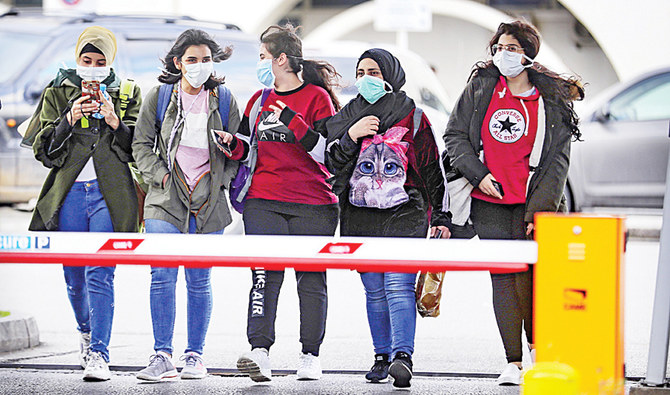
Lebanese women wearing protective masks walk outside Beirut’s Rafik Hariri University Hospital as cases of coronavirus soars on Sunday. (AFP/File)
Short Url
Updated 13 July 2020
Follow

COVID-19 infects Syrians in Lebanon, spreads in refugee camp

  • Health minister: Sunday witnessed ‘an unprecedented peak’; cases will remain high

BEIRUT: The number of coronavirus infections in Lebanon exceeded 2,300 on Sunday after 130 people, mostly Syrians, contracted the disease.
The people work for Ramco, which undertakes waste collection and street sweeping in Mount Lebanon and areas in Beirut. They live in a building in the Metn region that is owned by Ramco and houses 240 workers.
The cases were recorded after a routine temperature check on some workers, a measure undertaken by all Lebanese institutions. Tests recorded 120 Syrians and 11 Lebanese workers as having contracted the virus.
The Lebanese Red Cross said it had transferred 131 people, who were confirmed to have the virus, from Roumieh in Mount Lebanon to a confinement building in Beirut’s Karantina area.
One case was recorded in Nabatieh in southern Lebanon, with the municipality saying that the person had been quarantined and that tests had been carried out on people who had mixed with her.
Three cases were also recorded in Rashidieh Palestinian Camp in southern Lebanon. The Rashidieh people’s committee called on all the camp’s inhabitants to maintain public cleanliness, close down all coffee shops, institutions and internet stores, cancel all summer and recreational activities, keep social distancing, wear masks, use sanitizers, and take extreme precautionary measures inside mosques.
Lebanese Health Minister Hamad Hassan said that the number of infection cases would remain high in the upcoming days and that Sunday witnessed “an unprecedented peak” in the number of infections since Lebanon’s first case was recorded on Feb. 21, 2020.

NUMBER

120 Syrians and 11 Lebanese workers were found to have contracted the virus.

He added that authorities were able to determine the source of the infections, thereby minimizing the possible spread of the disease.
The number of new cases has increased in the past week as many expatriates who returned to Lebanon failed to abide by the precautionary and preventive measures and did not self-quarantine at home until the results of the airport PCR test had been issued.
The minister said that an expatriate who returned to Lebanon did not stay at home. He went to a swimming pool, then participated in a soccer game in a stadium, went to a wedding, and mixed with people even before his PCR test results were released. “Later it turned out that he had contracted the virus while another expatriate, who was infected with the virus, attended a funeral,” Hassan said.
Two Lebanese University students also contracted the virus. One had the disease transmitted to her from her sister who worked as a nurse in a private hospital. The development led the university’s administration to suspend final exams.
Lebanon has witnessed a state of slackness with regards to wearing masks and abiding by general mobilization measures, as only cinemas and theaters remain closed, and public gatherings are still prohibited.
The Ministry of Health intends to endorse measures that keep the economy running, while imposing quarantine on whole buildings or villages.
Dr. Firas Abiad, head of the board of directors and director general of Rafik Hariri University Hospital, said that coronavirus was not an illusion. “Hundreds of thousands have died because of it, and perhaps more people will lose their lives before a medicine is discovered,” he told Arab News. “In order to avoid infection without resorting to full confinement, people should reduce the risks and wear masks, maintain social distancing and wash their hands.”


Syrian army continues advance against Kurdish-held towns despite US calls against it

Updated 4 sec ago
Follow

Syrian army continues advance against Kurdish-held towns despite US calls against it

  • Kurdish forces say Syrian army breached withdrawal deal
  • US envoy meets with Kurdish leaders in Irbil

DEIR HAFER, Syria: The Syrian army continued its push into Kurdish-held territory on Saturday, despite US calls to halt its advance in towns in the area in Syria’s north.

State media said the army took over the northern city of Tabqa and its adjacent dam, as well as the major Freedom dam, formerly known as the Baath, west of the Syrian city of Raqqaa.

Syrian Kurdish authorities had not acknowledged their loss of control over those strategic points, and it was unclear if fighting was still ongoing.

For days, Syrian troops had amassed around a cluster of villages that lie just west of the winding Euphrates and had called on the Kurdish-led Syrian Democratic Forces stationed there to redeploy their forces on the opposite bank of the river. They have been clashing over strategic posts and oilfields along the Euphrates River.

SDF fighters withdrew from the area early on Saturday as a gesture of goodwill — but then accused Syrian troops of violating the agreement by continuing to push further east ‌into towns and oilfields not ‌included in the deal.

Brad Cooper, who heads the US military’s Central Command, said in ‌a ⁠written statement ​posted on ‌X that Syrian troops should “cease any offensive actions in areas” between the city of Aleppo and the town of Tabqa, approximately 160 kilometers further east.

Arab residents rejoice at troops’ arrival

The initial withdrawal deal included the main town of Deir Hafer and some surrounding villages whose residents are predominantly Arab. The SDF withdrew on Saturday and Syrian troops moved in relatively smoothly, with residents celebrating their arrival.

“It happened with the least amount of losses. There’s been enough blood in this country, Syria. We have sacrificed and lost enough — people are tired of it,” Hussein Al-Khalaf, a resident of Deir Hafer, told Reuters.

The Syrian Petroleum Company said that the nearby oilfields of Rasafa and Sufyan had been captured by Syrian troops and could now be brought ⁠back online.

SDF forces had withdrawn east, some on foot, toward the flashpoint town of Tabqa — downstream but still on the western side of the river and near a hydroelectric dam, a ‌crucial source of power.

But when Syria’s army announced it aimed to capture Tabqa next, the ‍SDF said that was not part of the original deal ‍and that it would fight to keep the town, as well as another oilfield in its vicinity.

Syria’s army said four of its ‍troops had been killed in attacks by Kurdish militants, and the SDF said some of its own fighters had been killed, but did not give a number.

US-led coalition planes flew over the flashpoint towns, releasing warning flares, according to a Syrian security source.

The US has had to recalibrate its Syria policy to balance years of backing for the SDF — which fought against the Daesh — against Washington’s new support for Syrian President Ahmed Al-Sharaa, whose rebel forces ousted dictator ​Bashar Assad in late 2024.

Main oilfields are still under Kurdish control

To try to end the fighting, US envoy Tom Barrack traveled to Irbil in northern Iraq on Saturday to meet with both Abdi and Iraqi Kurdish leader Masoud ⁠Barzani, according to two Kurdish sources. There was no immediate comment from Barrack’s spokesperson.

The latest violence has deepened the faultline between the government led by Sharaa, who has vowed to reunify the fractured country after 14 years of war, and local Kurdish authorities wary of his Islamist-led administration.

The two sides engaged in months of talks last year to integrate Kurdish-run military and civilian bodies into Syrian state institutions by the end of 2025, repeatedly saying that they wanted to resolve disputes diplomatically. But after the deadline passed with little progress, clashes broke out earlier this month in the northern city of Aleppo and ended with a withdrawal of Kurdish fighters. Syrian troops then amassed around towns in the north and east to pressure Kurdish authorities into making concessions in the deadlocked talks with Damascus.

Kurdish authorities still hold Arab-majority areas in the country’s east that are home to some of Syria’s largest oil and gas fields. Arab tribal leaders in SDF-held territory have told Reuters they are ready to take up arms against the Kurdish force if Syria’s army issues orders to do so. Kurdish fears have been deepened by bouts of sectarian violence last year, when nearly 1,500 Alawites were killed ‌by government-aligned forces in western Syria and hundreds of Druze were killed in southern Syria, some in execution-style killings.