

Saudi Arabia hosts G20 talks on post-COVID-19 global sustainable finance plan

1 / 3
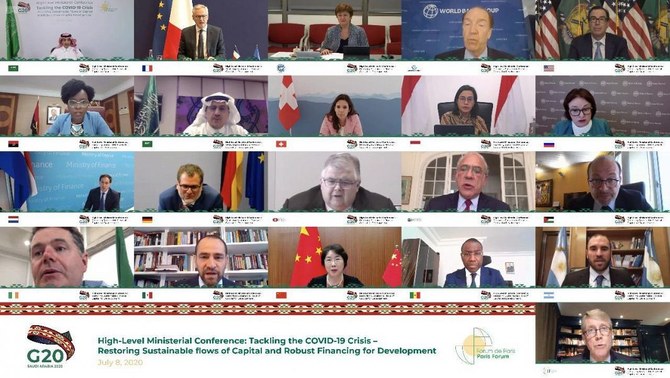
The meeting was co-chaired by Saudi Minister of Finance Mohammed Al-Jadaan and the French Minister of the Economy and Finance Bruno Le Mair. (SPA)
2 / 3
(SPA)
3 / 3
(SPA)
Short Url
Updated 10 July 2020
Follow

Saudi Arabia hosts G20 talks on post-COVID-19 global sustainable finance plan

  • The conference’s outcomes will feed into the discussion of the G20 finance ministers and central bank governors’ meeting to be held virtually on July 18, under the Saudi G20 Presidency.

RIYADH: Plans to tackle global debt and promote sustainable financing for developing countries in the wake of the coronavirus disease (COVID-19) pandemic topped the agenda at a Saudi G20 Presidency and Paris Club virtual conference.

Discussions centered around the challenges posed by international capital flows volatility, and possible policy responses to help restore sustainable flows of capital and mobilize robust financing for development.

The high-level ministerial meeting, which ended on Wednesday, was co-chaired by Saudi Minister of Finance Mohammed Al-Jadaan and the French Minister of the Economy and Finance Bruno Le Mair.

The conference brought together finance ministers, central bank governors, heads of international financial institutions, chief executives of private financial organizations, and prominent scholars.

“In response to the unprecedented health and economic crisis presented by the COVID-19 pandemic, governments and central banks around the world have taken exceptional measures, including unprecedented fiscal, monetary, and financial stability measures,” said a statement issued by the G20 Saudi Secretariat.

“The launch of the historic debt service suspension initiative (DSSI) could provide around $14 billion in immediate and critical liquidity relief by official bilateral creditors alone for the poorest nations in 2020, as estimated by the World Bank Group.

“This global response is delivering results; however, the situation remains challenging. Capital outflows from many emerging and developing countries have reached unprecedented levels, and their ability to draw upon an international pool of capital in a robust manner has been called into question,” the communique added.

In this context, related to financial resilience and debt sustainability, it was important to consider progress on the DSSI as well as on the development finance agenda amid the COVID-19 pandemic, it said.

Addressing delegates, Al-Jadaan said: “G20 countries have implemented unprecedented fiscal, monetary, and financial stability measures and ensured that international financial institutions can provide critical support to developing and low-income countries.

“As the crisis remains unfolding, we will coordinate with G20 member countries to promote sustainable financing for developing countries, support the return of capital flows to emerging markets and developing countries, build resilience, and promote more sustainable sources of financing.”

Le Mair said: “An unprecedented crisis requires extraordinary decisions. The G20 and the Paris Club took a historic step to address the COVID-19 impact by launching the DSSI to the benefit of the poorest countries, in particular in Africa.

“We need to continue working together to ensure its successful implementation. In the next steps, we also need the right tools to support countries suffering from capital outflows. We cannot let this crisis destroy years of efforts to attract investors and support growth.”

The conference hosted in-depth discussions on key issues through three parallel breakout sessions.

The first included talks on the DSSI and explored ways to restore market access for African countries, increase international private flows, and support the African private sector, especially small- to medium-sized enterprises.

Another session focused on the outlook for capital flows, looking at tools to help mitigate capital outflow risks, and the role of the International Monetary Fund in long-term financing.

Speaking at the session, Ahmed Alkholifey, governor of the Saudi Arabian Monetary Authority, said: “Restoring flows of capital is essential to upholding the stability of the global financial system.

“We are working with G20 countries to better understand the drivers of these volatilities and discuss policy responses to mitigate them,” he added.

The third session of talks concentrated on ways to improve emerging and developing countries’ resilience, including through domestic capital markets development, while considering the immediate and medium-term trade-offs between different policies as well as the role of international cooperation.

The conference’s outcomes will feed into the discussion of the G20 finance ministers and central bank governors’ meeting to be held virtually on July 18, under the Saudi G20 Presidency.


Navigating Ramadan as a non-Muslim expat in Saudi Arabia

Updated 5 sec ago
Follow

Navigating Ramadan as a non-Muslim expat in Saudi Arabia

  • Rebecca Cousins: Evenings really come alive, whether you’re out to enjoy an iftar or being welcomed into the home of a friend to break fast with them
  • Lily Moffatt: Whether you’re religious or not, it’s incredibly rare to see an entire city — its rhythm, retail, hospitality, and social life — shift collectively around a spiritual moment

RIYADH: As Ramadan begins, it is the ideal time to embrace Saudi culture, understand the spiritual significance of the holy month, and learn how to navigate it with respect and solidarity in the Kingdom.

“For me, Ramadan is one of the most exciting times of the year to be in Saudi Arabia or the Middle East in general. Yes, the daytime is a little quieter, including the roads, which is a huge plus! But the evenings really come alive, whether you’re out to enjoy an iftar or being welcomed into the home of a friend to break fast with them,” Rebecca Cousins, who has been living and working in the Kingdom for three years, told Arab News. 

To truly support your Muslim friends during Ramadan, it helps to understand its significance.

Ramadan is the ninth and holiest month of the Islamic calendar, observed by Muslims worldwide to commemorate the first revelation of the Qur’an to the Prophet Muhammad, peace be upon him, in 610.

It’s also a period of deep worship, when the usual bustle of business tends to slow down.

During this holy month, Muslims fast from Fajr (dawn) until the Maghrib (sunset) prayer, abstaining from eating, drinking, smoking, and sexual relations during the fasting hours.

It is a time dedicated to self-discipline, spirituality, and charity.

Lily Moffatt, co-founder of the podcast “Saudi Life: Unpacked,” has been living in Saudi Arabia for three years. She underscored the importance of leading with empathy. 

“It can be easy to focus on the inconveniences: altered hours, your favorite cafe opening later, the afternoon energy dip … but this is a month rooted in discipline, reflection, and faith. Fasting, particularly in the late afternoon, requires immense self-control.

“Be mindful about eating or drinking in front of those who are fasting, and be conscious of your tone when discussing the changes Ramadan brings. A little consideration goes a very long way,” she said. 

Highlighting the advice she would give non-Muslim expats experiencing Ramadan for the first time, Frankie Hilton, co-founder of the podcast alongside Moffatt, stated: “My advice would be to embrace every second of it. It’s very easy to feel overwhelmed when something is out of your comfort zone or unknown, but Ramadan is one of the most beautiful moments in the year. Say yes to an iftar or sahoor invite, speak to your friends about the reasons behind breaking your fast with a date, understand what age someone started fasting; it’s a time to learn and embrace something that feels new.”

Often during Ramadan, you may be invited to iftar (breaking the fast) or sahoor (the pre-dawn meal) at a Saudi home.

Cousins encouraged non-Muslims to engage in Ramadan traditions, stating: “I would definitely say yes to every invitation, whether it’s an iftar or sahoor with colleagues at a restaurant, or an invitation to join something more personal and intimate at someone’s home. In both cases, it will be an enlightening experience if it’s your first time, and my recommendation is to fast for the day and share in the enjoyment of that first sip of water and date, too.”

A helpful rule of thumb is to never arrive empty-handed. Simple items to bring include dates, desserts, small biscuits, or sambusas.

If you are a whiz in the kitchen, feel free to bring a Ramadan favorite such as lentil soup, jareesh, harees, or al-habb.

You will often hear people exchanging Ramadan greetings, including “Ramadan kareem,” which is used to wish someone a “generous Ramadan,” and “Ramadan mubarak,” which translates to “Blessed Ramadan.”

The response can be kept simple; it is more about the meaning, your intention, and how you say it rather than the exact words you use.

You can say “Ramadan mubarak” back, or use the phrase “Allah yubarak feek,” which means “May Allah bless you, too.”

Or, keep it simple with something like “Happy Ramadan to you too” or “Ramadan mubarak to you and your family.”

A good rule of thumb is to avoid questions that can be seen as ignorant or inappropriate.

Common examples to avoid include, “Not even water?” or “Who will know if you just sneak a snack?”

You might also avoid comments like, “You must be so lucky, you’ll lose so much weight,” or “I feel so bad eating in front of you.”

These questions and comments can be seen as insensitive, and a quick search online can easily clear up any basic doubts of this sort.

Oftentimes during the fasting period, Muslims engage in deep prayer and dua, even while working or driving around the city.

If you choose to listen to music in the car or at the office, it is best to wear headphones or limit the volume, as loud music can be seen as disruptive during the fasting hours.

Eating and drinking are perfectly fine during Ramadan fasting hours, but be mindful of where you are doing so.

Try to avoid eating in public or in front of coworkers and friends who are fasting. This also includes smoking, which should be done indoors or in private areas.

It is not always a matter of legality, but rather a matter of solidarity, tolerance, and support for those around you.

Among the highlights of Ramadan are the brightness, the strong family ties, and the liveliness of the night markets.

Cities truly come alive after dark with Ramadan tents, bustling souqs filled with special meals, and restaurants hosting unique gatherings.

There is so much to see and do, from the Ramadan festivities in Jeddah’s Al-Balad to the traditional souqs in Riyadh and the Eastern Province.

If you would like to take your Ramadan connection a step further, consider giving back.

A major tradition for families during this month is charity. Ramadan is truly a time for generosity.

Whether you choose to make a donation through the authorized Ehsan platform or host an iftar gathering, giving back is a wonderful way to show solidarity.

Around the time of breaking the fast, you will often see people sharing dates and water with one another.

A kind gesture for a non-Muslim is to keep cold water, dates, or laban in your car to pass out to those on their commute back home.

These small acts of kindness help build bridges, foster friendships, and create greater understanding between everyone in the community.

Ramadan is a reminder of peace and spirituality and a time for family and prayer.

On the topic of dos and don’ts, Hilton stated: “Yes, it’s important to acknowledge the fasting of water and food, but also acknowledge it’s a time to also abstain from negativity and bad thoughts. This is something I always try to embrace in Ramadan — learning to be patient and kind to yourself and those around you.”

Regardless of whether you are Muslim or not, many expats choose to fast during Ramadan, as it is proven to have numerous health benefits, as well as improving spiritual strength. 

Fasting with your fellow Muslim coworkers, neighbors, and friends is also a powerful symbol of support, solidarity, and community.

A final tip is to be open to new experiences. Ramadan is a time for community, spirituality, open-mindedness to new traditions, gatherings with loved ones, and moments of deep reflection, regardless of your faith.

“Pause,” Moffatt advised. 

“Whether you’re religious or not, it’s incredibly rare to see an entire city — its rhythm, retail, hospitality, and social life — shift collectively around a spiritual moment. Ramadan in Saudi Arabia invites you to slow down. Even just slightly.

“Take an evening stroll after iftar when the streets come alive. Accept invitations. Visit Ramadan tents. Notice the generosity, the sense of community.

“It’s a beautiful reminder that life doesn’t always need to move at full speed and that shared moments, especially across cultures, are where the real richness lies.”