

Turkey-Russia cease-fire negotiations for Libya: Any hope for durability?

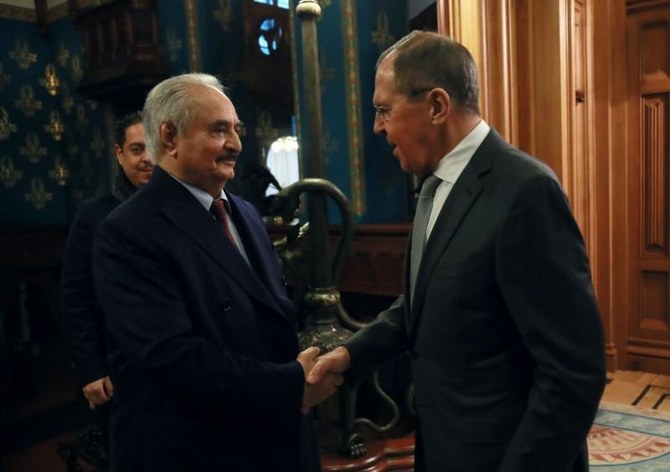
Commander of the Libyan National Army (LNA) Khalifa Haftar and Russian Foreign Minister Sergei Lavrov meet for talks in Moscow, Russia, January 13, 2020. (Reuters)
Short Url
Updated 10 July 2020
Follow

Turkey-Russia cease-fire negotiations for Libya: Any hope for durability?

  • Russian Foreign Minister Sergei Lavrov said the Libyan National Army (LNA), backed by Russia and led by eastern Libyan Commander Khalifa Haftar, is willing to sign a cease-fire document
  • Saturday’s attack targeting the strategic Al-Watiya air base in Libya damaged Turkish air defense systems where Turkey was reportedly planning to establish a permanent presence

ANKARA: As Kremlin announced the ongoing consultations between Turkey and Russia for an immediate cease-fire deal for the longstanding Libyan conflict, the feasibility of such an agreement is being questioned more and more as the two countries support opposing sides.

Russian Foreign Minister Sergei Lavrov said the Libyan National Army (LNA), backed by Russia and led by eastern Libyan Commander Khalifa Haftar, is willing to sign a cease-fire document. Russia expects Ankara to convince the Government of National Accord (GNA) to proceed in the same way.

The ministerial-level talks have been ongoing for a while, with some postponements last month over the technical disagreements.

Samuel Ramani, a Middle East analyst at the University of Oxford, is skeptical about a cease-fire working on the ground.

“The Libyan war is much more complicated than a mere Russia-Turkey proxy war, even though it is often oversimplified to this binary in Western media outlets. The UAE and Egypt will be much more hesitant than Russia about signing a peace deal with Turkey and might not view such as a ceasefire as credible,” he told Arab News.

According to Ramani, Haftar’s military actions in Libya could continue.

“Alternatively, Turkey has powerful interests against a cease-fire at this time and has also escalated tensions with France. Moreover, when Russia says the LNA is on board, there is a question as to whether he means Libyan House of Representatives Chief Aguila Saleh, who might be, or Haftar,” Ramani said.

Experts insist that the spheres of influence in Libya should be clearly outlined to prevent another failed cease-fire.

Regarding the red lines for a cease-fire, Ramani thinks that freezing the conflict areas in and around LNA-held Sirte and Jufra is an immediate priority.

Sirte bears strategic importance as it lies close to key energy export terminals on the Mediterranean shores, while Jufra hosts a strategic military base where Russian aircraft and Wagner mercenaries are reportedly located.

“An escalation from either side in these areas would be a red line. Also, there is a need for assurances from both sides that they won’t restart a broader war if they perceive their rivals as being weak,” Ramani said.

Aydin Sezer, an expert on Turkey-Russia relations, thinks that Russia is concerned about the increasing military support that Turkey gives to the GNA, which further escalates tension in the civil war.

“The only priority right now for Russia is to achieve a lasting peace through a sustainable ceasefire agreement. The same goes for France. Both these countries are also set to bring this issue to the UN Security Council. These latest ceasefire negotiations mean Russia wants to keep the diplomacy doors open for both sides,” he told Arab News.

Saturday’s attack targeting the strategic Al-Watiya air base in Libya damaged Turkish air defense systems where Turkey was reportedly planning to establish a permanent presence. The attack also came a couple of hours after Turkish Defense Minister Hulusi Akar visited Libya.

“After that attack, Ankara felt obligated to be much more cautious regarding the fragile dynamics in Libya. The situation on the ground is complicated and time is not on the Turkish side. Therefore, the cease-fire is necessary for Ankara more than ever,” Sezer said.

For Wolfram Lacher, however, senior associate at the German Institute for International and Security Affairs, Russia and Turkey may well try to broker a ceasefire and thereby become the two key players in Libya, but it is doubtful whether such a cease-fire could succeed.

“Haftar has more room to maneuver with regard to Russia than Turkey has with regard to the GNA because he can still rely on Egyptian and UAE support. So, he may reject the terms of a Russian-Turkish ceasefire,” Lacher told Arab News.

According to Lacher, other powers — including the US, France, Egypt and the UAE — want to prevent a Russian-Turkish arrangement in Libya and instead want ceasefire talks to take place under the UN auspices.

“This competition over the forum for ceasefire talks will also make any cease-fire initiative more difficult,” he said.

On the other hand, Bill Park, senior lecturer in the Department of Defense Studies at King’s College London, thinks Moscow is uncomfortable with the implications of Turkey’s escalation in Libya.

“Russia wants to demonstrate that there might be limits to what it will tolerate,” he told Arab News. “At this stage, Ankara should be willing to take risks while Russia should meet the challenges for a negotiated agreement and manage the hostility between France and Turkey.”


Lebanon signs gas exploration deal with French-Qatari-Italian consortium

Updated 6 sec ago
Follow

Lebanon signs gas exploration deal with French-Qatari-Italian consortium

  • France’s TotalEnergies, Qatar Energy and Italy’s Eni signed for Block 8, planning a 1,200 sq. km 3D seismic survey to assess potential
  • Previous searches in Block 4 and 9 did not yield any discoveries

BEIRUT: Lebanon on Friday signed a gas exploration deal for Block 8 with a consortium comprising France’s TotalEnergies, Qatar Energy and Italy’s Eni, in a ceremony held at the Prime Minister’s Office and attended by Prime Minister Nawaf Salam.

According to Gaby Daaboul, board member at the Lebanese Petroleum Administration, the agreement stipulates that the consortium will carry out a 3D seismic survey in Block 8, which spans 1,200 sq. km, in preparation for exploratory drilling based on analysis of the survey data.

In 2023, Lebanon marked the resumption of oil and gas exploration in its territorial waters, as a consortium that included Qatar Energy drilled an exploratory well in Block 9.

However, all activities were halted, ostensibly due to the lack of oil or gas. The companies’ cessation of operations coincided with the outbreak of hostilities between Israel and Hezbollah.

Earlier hopes were dashed when gas was not found in Block 4, leaving many Lebanese disappointed.

Lebanese Minister of Energy and Water Joe Saddi, who signed the agreement on behalf of the state, described the move as “a confirmation of the consortium’s commitment to continue exploration activities in Lebanon despite all challenges, and a reflection of continued confidence in the petroleum potential of Lebanese territorial waters.

“We look forward to the consortium coordinating and promptly implementing the 3D seismic survey campaign. This will enhance geological and technical understanding of Block 8 and allow for a more accurate assessment of the opportunities available,” the minister said.

He announced the preparation of a file for launching the fourth licensing round, aiming at attracting international companies to invest in open offshore blocks and boost exploration and production activity in Lebanon.

Asked whether there are guarantees that the consortium operating in Block 8 will provide Lebanon with an official technical report, Saddi explained that “for Block 9, an official report was submitted to the Ministry and the Petroleum Sector Administration.” 

He noted that oil companies do not spend tens of millions of dollars without expecting results.

“No oil was found in the Block 9 drilling area, but a full report is available. This highlights the importance of the seismic survey in Block 8 to understand the block’s detailed geology, which will guide future exploration,” he said.

Saddi stressed that regional and domestic stability will be key to accelerating the exploration process.

The agreement was signed by Romain de La Martiniere, managing director of Total Lebanon, on behalf of Total Energies; Ali Abdulla Al-Mana, head of exploration at Qatar Energy; and Andrea Cozzi, managing director for Eni’s Lebanon division.

“Lebanon looks forward to continuing its exploration efforts by promoting non-obligatory blocks, with the aim of intensifying exploration activities and achieving a commercial discovery that will boost the national economy and support sustainable development,” Daaboul said.

Lebanon’s offshore oil and gas exploration centers on 10 blocks in its exclusive economic zone, with Blocks 4, 8, 9, and 10 most relevant near the maritime border with Israel.

A 2022 US-brokered maritime border agreement resolved a long dispute, granting Israel full control of the Karish field while assigning Qana Prospect (Block 9) to Lebanon. However, Israel is poised to receive royalties from any future production there.

Lebanon is racing against time to resume exploration after Total’s 2023 drilling in Block 4 yielded negative results, prompting the company to return the block to the Lebanese state. Meanwhile, Israel began commercial production in the area roughly four months later.

Although the company was expected to resume drilling in Block 4 from a different location, it chose to return the block to the Lebanese state, where it will later be included among the blocks offered for exploration.

In 2018, Lebanon signed its first exploration contracts with three companies — Total, Eni, and Russia’s Novatek — to search for oil and gas in two blocks within its territorial waters, Blocks 4 and 9. Of the 10 blocks Lebanon has designated for oil and gas exploration, three are located in its exclusive economic zone.

Lebanese citizens are pinning their hopes on the exploration, anticipating the discovery of oil wells to help revive the struggling economy.