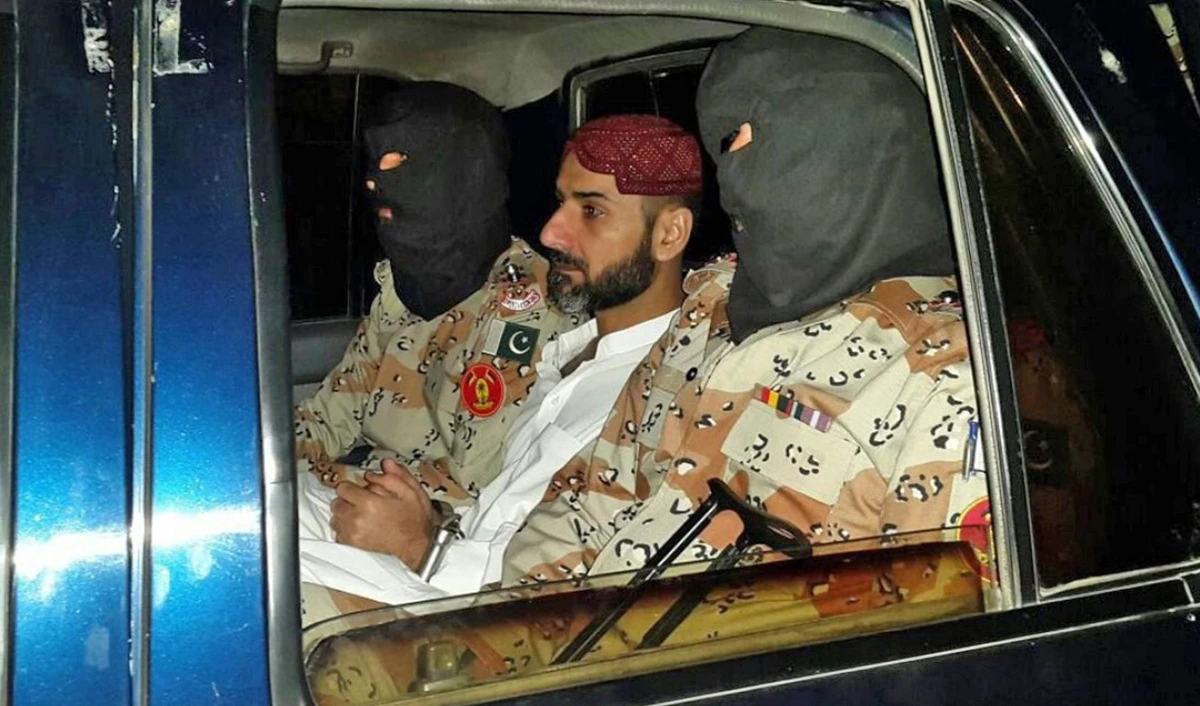
- Uzair Jan Baloch, long on the run from Pakistani authorities, was arrested by Interpol from Dubai in 2014
- Karachi Central Jail correspondence shows a military court convicted Baloch for espionage and sentenced him to 12 years imprisonment this April
KARACHI: An investigation report released by Pakistan’s provincial government in Sindh this week has said a Pakistani ganglord, long suspected of building a business empire through extortion, kidnapping and drugs, had confessed to spying for Iranian intelligence agencies in 2014.
Uzair Jan Baloch was also convicted for spying this April by a military court and sentenced to 12 years in prison, according to a June 13 letter written by the senior superintendent of Karachi Central Jail to an anti-terrorism court that had ordered Baloch to be produced before it. A copy of the letter is available with Arab News, though the Pakistan military could not be reached to confirm if Baloch had indeed been convicted by an army tribunal.
Baloch, for years considered close to politicians within Sindh’s ruling Pakistan People’s Party (PPP), is currently nominated in at least 59 criminal cases, according to police records, and is being held at a makeshift jail at the Karachi office of the paramilitary Rangers force. The PPP denies it currently has any links to the gang leader.
In 2016, Baloch was interrogated by a Joint Investigation Team (JIT) comprising representatives of police, Rangers, and a number of civilian and military intelligence agencies during which officials say he confessed that he had spied for Iran and was involved in 59 acts of murder, kidnapping, extortion and attacks on law enforcement.
According to the report, Baloch had told the investigation team that he obtained a fake Iranian birth certificate in the late 1980s and an Iranian identity card and passport in 2006.
The report details how Baloch met a man named Hajji Nasir in Iran’s Chabahar city in 2014, who offered to arrange his meeting with Baloch and Iranian intelligence officers.
“On the consent of the accused a meeting with Iranian intelligence officers was arranged by Hajji Nasir in which the accused was asked to provide certain information about [Pakistan] armed forces officials,” the JIT report, which is publicly available, said.
It added: “The accused is found involved in espionage activities by providing secret informations/sketches regarding Army installations and officials to foreign agents (Iranian intelligence officers) which is a violation of Official Secrets Act, 1923.”
Ahmad Mohammadi, Consul General of the Islamic Republic of Iran in Karachi, did not comment on the Baloch case in an email sent to Arab News in response to queries for this piece, but said Iran “defined and arranged it’s relationship with Pakistan in accordance with mutual respect and mutual benefits.”
“Tehran emphasises on essential and urgent need of removing any possible misunderstanding which mainly happens due to the deceptive and malicious efforts of third parties. For sure, developing relations between Tehran and Islamabad don’t comply with their desire,” the consul general’s email said.
For years, Baloch thrived in Sindh’s teeming capital of Karachi, a key figurehead in the city’s notorious gang wars. However, in 2006 he fled to Iran to escape an operation against street gangs in Lyari, one of Karachi’s most dangerous neighborhoods at the time.
He returned to Pakistan for a number of years during which he even contested in a local government election but once again escaped to Iran in 2013 when Pakistan’s powerful paramilitary Rangers launched an armed operation to bring down Karach’s soaring crime rates.
Baloch is believed to have also lived in Oman briefly before being arrested by Interpol in Dubai in December 2014.
In January 2016, Rangers announced that they had taken Baloch into custody in Karachi, an arrest that surprised many who had thought he was already in jail after being detained in Dubai.
The JIT report said after Baloch confessed to spying for Iran, he was handed over to the Pakistani military to be tried “under Pakistan Army Act for his Involvement in espionage activities which falls under the Official Secrets Act 1923.”
In a Twitter post on April 12, 2017, the head of the Pakistani military’s media wing said Baloch had been taken into custody under the Pakistan Army Act and the Official Secrets Act. However, the army has not revealed any details of his subsequent trial before a military court, nor made a verdict public.
But a letter written by the senior superintendent of the Karachi Central Prison in response to an anti-terrorism court order that Baloch appear before it for hearings in a number of cases says he was sentenced to 12 years imprisonment in April this year after being convicted for spying.
The letter, dated June 13, said:
“[Uzair Ali] was convicted by the Lt. Col. Commanding Officer 1st (Self Propelled) Medium Regiment Artillery on April, 4, 2020 in Pakistan Army Act section 59 (civil offenses) read with section 3 (penalties for spying) of the Official Secret Act and sentenced to suffer rigorous imprisonment for 12 years.”
Pakistan’s military courts hold secretive trails but verdicts are often publicly announced by the army’s media wing, called ISPR.
Arab News sent written queries to ISPR about Baloch’s conviction but did not receive a response. Sindh Home Secretary Usman Chachar also did not respond to calls and messages seeking comment, and a spokesman for Pakistan’s foreign office did not reply to text messages asking whether Pakistan had taken up the issue of Baloch’s confessed espionage with Iran.