

Indian sentenced to death in Pakistan for spying ‘refused to file review’

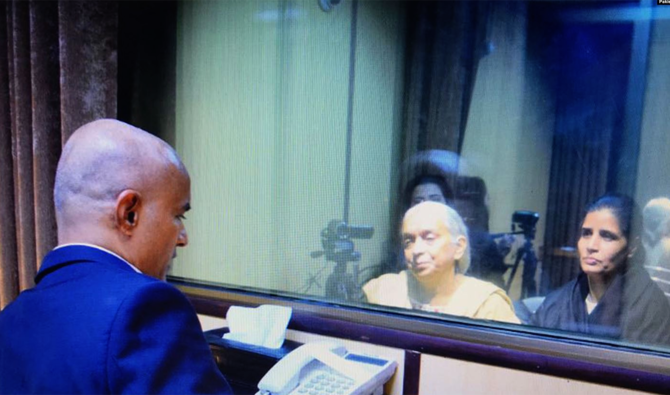
Former Indian navy officer Kulbhushan Jadhav meets his wife and mother at the Ministry of Foreign Affairs building in Islamabad on Dec. 25, 2017. (AP/File)
Short Url
Updated 08 July 2020
Follow

Indian sentenced to death in Pakistan for spying ‘refused to file review’

  • Former naval officer Kulbhushan Jadhav was arrested in Balochistan in March 2016 and convicted the following year
  • The World Court has ordered Pakistan to review the decision to impose the death penalty in the case

ISLAMABAD: Pakistan’s Ministry of Foreign Affairs said on Wednesday that an Indian man convicted of spying and sentenced to death by a Pakistani military court has refused to file a review petition against the verdict.


Kulbhushan Jadhav was arrested in March 2016 in Pakistan’s southwestern Balochistan province, where there is a long-running conflict between security forces and separatists. The following year he was convicted of espionage and planning sabotage, and sentenced to death.


India insists Jadhav is innocent, and last year the World Court ordered Pakistan to review the decision to impose the death penalty.


“On June 17, 2020 commander Jadhav was invited to file a petition for review and reconsideration of his sentence and conviction,” said Zahid Hafeez, Pakistan’s director general for South Asia at the ministry, during a joint press conference with Additional Attorney General Ahmad Irfan.


“Pakistan also offered to assist in legal representation for Jadhav. Exercising his legal rights, Cmdr. Jadhav refused to file a petition for review and reconsideration of his sentence. He instead preferred to follow up on his pending mercy petition.”


Hafeez said that Pakistan has repeatedly invited the High Commission of India to file a petition at Islamabad High Court in connection with the death penalty handed to Jadhav, and that he hopes India will cooperate with the Pakistani courts. 
He added that Pakistan has offered consular access to Jadhav for a second time, in addition to a meeting with his wife and father. 
Jadhav’s wife and mother were granted permission to visit him in 2017, eight months after he was sentenced to death.

According to 
Pakistani authorities, Jadhav confessed that he was ordered by India’s intelligence service to carry out espionage and sabotage in Balochistan, a province that is part of the $60 billion, Chinese-backed Belt and Road Initiative, a multinational development project.


In a transcript released by Pakistan of Jadhav’s confession, the former naval officer is quoted as saying the disruption of Chinese-funded projects was a main goal of his activities.


Emails to Chinese dancers allegedly threatened Australian PM

Updated 3 sec ago
Follow

Emails to Chinese dancers allegedly threatened Australian PM

SYDNEY: A security scare at the Australian prime minister’s residence this week was sparked by a bomb threat against an anti-Beijing Chinese dance troupe, the act’s hosts said Friday.
Prime Minister Anthony Albanese was forced to evacuate his official residence in Canberra, The Lodge, on Tuesday over an unspecified “alleged security incident.”
Police said at the time that they found nothing suspicious in their search and declared there was no threat to the public, without saying what sparked the incident.
“We made the report to the national security agencies, including police,” Lucy Zhao, president of the Falun Dafa Association of Australia and host to the Shen Yun dance group, told AFP.
“We have to take it seriously.”
An email threat was sent two days earlier seeking to stop a performance in Australia by the New York-based dance group which is linked to the Falun Gong spiritual movement, also known as Falun Dafa.
A copy of the Chinese-language email provided to AFP said “large quantities of nitroglycerin explosives” had been placed in the prime minister’s residence.
“If the Shen Yun performance proceeds anyway, the prime minister’s residence will be blown into bloody ruins,” the email warned.
Zhao accused China’s Communist Party of seeking to stop performances by Shen Yun internationally, including by sending threats.
China banned Falun Gong, which it calls an “evil cult,” in 1999 after 10,000 members peacefully demonstrated outside a government building in Beijing.
In Beijing, a foreign ministry spokesperson told reporters this week that it was not aware of the facts behind the security incident.
“China has always opposed various acts of violence,” the spokesperson said.
“It must be pointed out that the so-called Shen Yun performances are not any kind of normal cultural activity, but is a political tool used by the Falun Gong organization to spread cult information and accumulate wealth.”
Founded in 1992, Falun Gong claims nearly 100 million followers and has been subject to “persistent persecution” in China, according to a January 2024 European Parliament resolution.
Despite being banned in China, it has found a global audience with Shen Yun performances around the world generating revenues of $46 million in 2022 alone, according to the ProPublica investigative news site.