

Development of drones to battle locusts in Pakistan 'important milestone' — science minister

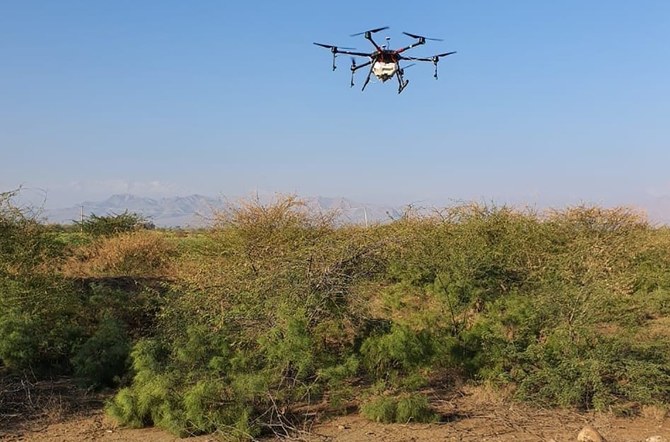
A drone takes off to conduct aerial spraying against locust swarms in Dera Ismail Khan, Khyber Pakhtunkhwa, on Feb. 5, 2020. (Photo courtesy: KP Agriculture Department)
Short Url
Updated 08 July 2020
Follow

Development of drones to battle locusts in Pakistan 'important milestone' — science minister

  • Media reports quoted state-run company as saying it had developed the drone which was now available for sale
  • Massive swarms of locusts entered Pakistan for the first time after 1993 in June last year, government has declared national emergency 

ISLAMABAD: Pakistan has developed agricultural drones that will be used to fight locust swarms that arrived in Pakistan last year and are devastating crops, local media reported on Tuesday, a development the minister of science and technology has called an “important milestone.”

Pakistani media reports quoted the National Radio Telecommunication Corporation, a state-run telecommunication manufacturing company, as saying it had developed the drone which was now available for sale.
“Pakistan’s drone technology is among the world’s most modern,” Federal Minister for Science & Technology Fawad Chuadhry said in a Twitter post while retweeting a video demonstration of the drone. “The development of agricultural drones will be an important milestone.”

Massive swarms of the destructive desert locust entered Pakistan for the first time after 1993 in June last year, with the crop-eating grasshopper expanding its territory to 61 districts in all four provinces of the country, Pakistan’s food security ministry has said.
The invasion of the insects has been declared a national emergency. 
Last month, neighbouring India said it had deployed a helicopter and a dozen drones spraying insecticide to stop desert locusts that have spread to over nine heartland states of the world's second-biggest producer of rice and wheat.
The United Nations has also tested drones equipped with mapping sensors and atomizers to spray pesticides in parts of east Africa battling an invasion of desert locusts that are ravaging crops and exacerbating a hunger crisis.


Pakistan’s Mahnoor Omer named among TIME’s ‘Women of the Year’ for 2026

Updated 01 March 2026
Follow

Pakistan’s Mahnoor Omer named among TIME’s ‘Women of the Year’ for 2026

  • Omer moved a Pakistani court against the so-called ‘period tax’ in Sept. 2025 which has since sparked a national debate
  • Taxes on sanitary pads in Pakistan can add up to 40 percent to retail price, UNICEF says only around 12 percent women use such products

ISLAMABAD: Pakistani women’s rights activist Mahnoor Omer, who fought against taxes on menstrual products, has been named among the TIME magazine’s ‘Women of the Year’ for 2026.

Omer’s efforts have been recognized alongside 16 activists, artists, athletes and businesswomen in the TIME’s Women of the Year 2026 list, including Olympic gold medalist Sydney McLaughlin-Levrone and Oscar-nominated filmmaker Chloe Zhao.

Dissatisfied with the efforts to educate Pakistani girls about sexual violence, Omer founded the Noor Foundation at the age of 14 and held her own workshops with village girls about everything from climate change to menstruation, according to the TIME magazine.

Two years later, a conversation with a domestic worker about the price of pads made her realize that not everyone could afford these essentials. She moved a court against the so-called “period tax” in Sept. 2025 and the case has sparked a national debate on the subject, considered a taboo by many in Pakistan, since its first hearing late last year.

“A decade and one law degree after her interest in activism was sparked, Omer, now 25, is putting her passion and expertise to work in the name of gender equity,” TIME wrote about Omer on its website.

Taxes imposed on sanitary products in Pakistan can add up to 40 percent to the retail price. UNICEF estimates just 12 percent of women in the country use commercially produced pads or tampons. The alternative, using cloth, risks health impacts including rashes and infections, and can make it impossible for girls to attend school while menstruating.

Omer’s suit, which awaits the government response, has sparked a national discussion. She says she spoke about menstruation to her father and male cousins, who thanked her for standing up for their daughters.
The 25-year-old, who is currently enrolled in a master’s degree in gender, peace, and security at the London School of Economics, sees this case as just the first of many.

“I’m not free until every woman is free,” she was quoted as saying by TIME. “I want to leave no stones unturned in terms of what I can do with the next few decades, as a lawyer for the women in my country and gender minorities in general.”