

Export gloom sours Pakistan’s prized mango season

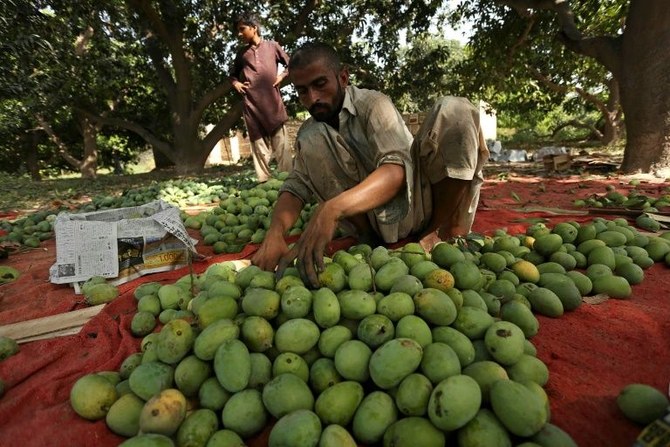
A labourer sorts mangoes before packing them into boxes at a farm in Multan, Pakistan. (AFP)
Short Url
Updated 08 July 2020
Follow

Export gloom sours Pakistan’s prized mango season

  • Pakistan in 2019 exported a record 115,000 tons worth $80 million
  • This year exports have dropped around 40 percent with just a few months left of the season – says farmer

MULTAN, PAKISTAN: Dwindling harvests, drooping demand and export supply chains hit by the coronavirus are biting into Pakistan’s mango industry, with producers of the prized fruit battling to weather a disastrous season.
Across Pakistan’s “mango belt” in Punjab and Sindh provinces, farmers say a long winter and changing rain patterns have slashed production by up to half this year — just as virus shutdowns sparked border restrictions and spiralling export costs.
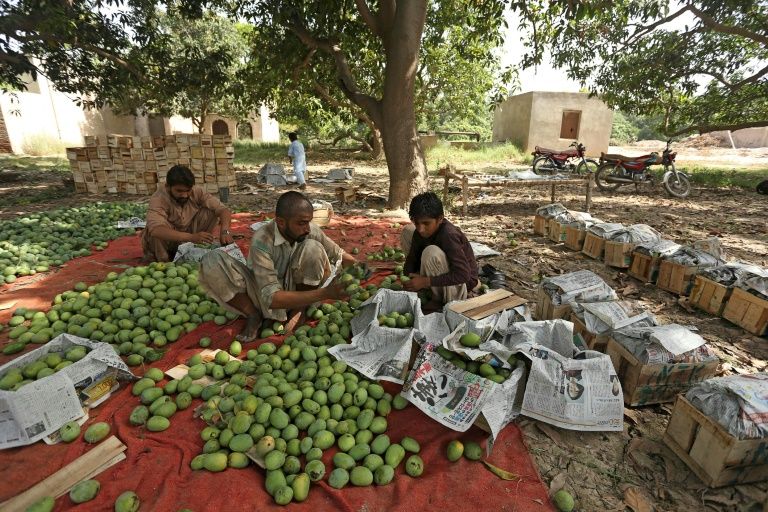


A labourer sorts mangoes before packing them into boxes at a farm in Multan, Pakistan. (AFP)

“There are multiple problems that mango farmers are facing,” said Rana Muhammad Azim, whose family has been producing the fruit in Punjab for generations.
“The situation is extremely worrisome for us. The mangoes are ready, but no exporter is willing to take the risk and place orders,” he said, adding that he was already suffering from a 40 percent decline in the harvest.
Pakistan produced more than 1.5 million tons of mangoes in 2019 — and exported a record 115,000 tons worth $80 million — making it the sixth-largest exporter of the fruit in the world.
But Waheed Ahmed, head of a produce association in Pakistan, said exports have dropped around 40 percent compared to the same period last year, with just a few months left of the season.
Known in South Asia as the “king of fruits,” the mango originated in the Indian subcontinent with two dozen varieties grown in Pakistan.
The country’s most treasured variety is the greenish-yellow Chaunsa, known for its rich, unique flavour and juicy pulp.
The fruit also helps sweeten diplomatic relations, with Pakistan sending crates of its best produce to India’s prime minister every year, regardless of the political climate between the hostile neighbors.
It has also earned a place in recent literary history, with renowned Pakistan author Mohammed Hanif longlisted for the prestigious Man Booker Prize for “A Case of Exploding Mangoes,” a comic novel based on an unexplained 1988 plane crash that killed former president Muhammad Zia ul-Haq.
With much of the world’s air traffic grounded by the coronavirus, exports of the best prime, ripe fruit by plane to the US and Europe have been particularly hard hit, but ground transport has also been badly affected.
Dozens of trucks piled high with the yellow fruit were stranded at the border with Iran last month, their precious cargo rotting in the searing 40-degree heat.
Even where trading has continued via sea to the key Middle East market — which accounts for 70 percent of exports — demand has plunged.
Since the virus took hold shoppers are making fewer outings to supermarkets and are wary of spending on luxury items, while Pakistani migrant workers who relish the fruit have returned home.
The domestic market brings far less revenue.
In one bright spot, harvests were at least spared the ravages of the worst locust plague in 25 years, which wiped out entire vegetable and cotton harvests.
As flights resume and border restrictions are eased, growers hope to increase exports in the second half of the season to avoid a complete lost season.
“The situation has forced us to think of new solutions,” said producer Muhammad Ali Gardezi, who for the first time has taken his business online, delivering door-to-door in the age of social distancing.


At Gulfood expo, minister urges Pakistani firms to boost exports to end reliance on foreign debt

Updated 10 sec ago
Follow

At Gulfood expo, minister urges Pakistani firms to boost exports to end reliance on foreign debt

  • The Dubai expo brought together more than 8,500 exhibitors from 195 countries, showcasing over 1.5 million food and beverage products
  • Planning Minister Ahsan Iqbal says Islamabad is committed to promoting productivity, quality and innovation within the private sector 

ISLAMABAD: Planning Minister Ahsan Iqbal on Thursday urged Pakistani companies participating in the Gulfood food and beverage exhibition in Dubai to expand exports and focus on value-added products, saying it was the only way for Pakistan to end reliance on foreign debt.

Gulfood’s 31st edition, being held in Dubai from Jan. 26 till Jan. 30, has brought together more than 8,500 exhibitors from 195 countries, showcasing over 1.5 million food and beverage products across 12 sectors, making it one of the most influential platforms for global agri-food trade.

Pakistan has made its largest-ever showing at the world’s leading food and beverage trade exhibition, with a total of 142 Pakistani companies participating in the 2026 edition, according to a statement from the Ministry of Information released this week.

On Thursday, Iqbal visited toured various stalls and interacted with exhibitors at Pakistan Pavilion at the exhibition and encouraging them to focus on enhancing exports and value-addition, Pakistan’s Press Information Department (PID) said.

“If we are to permanently free ourselves from reliance on the IMF (International Monetary Fund) and foreign debt, there is only one way forward, promoting and expanding our exports,” he was quoted as saying. “I am particularly encouraged to see that Pakistani exporters are now focusing on value added products.”

Pakistan has struggled with boom-bust cycles for decades and secured 22 IMF bailouts since 1958. The country is currently navigating a long, tricky path to economic recovery under a $7 billion IMF program secured in Sept. 2024.

Pakistan has been increasingly using global trade exhibitions to promote value-added food exports, particularly to Gulf and Middle Eastern markets, which remain among the country’s largest destinations for rice, meat and processed food products.

Of the 142 Pakistani firms, 67 companies are participating under the Trade Development Authority of Pakistan (TDAP), while 75 companies are taking part independently, across four specialized pavilions covering rice, pulses and grains, world food, beverages, and meat and poultry. Notably, 30 rice exporters are participating under TDAP, underlining Pakistan’s position as one of the world’s leading rice suppliers.

Iqbal visited the Biryani Festival stall at Pakistan Pavilion and appreciated the initiative to showcase and promote Pakistani Basmati rice.
“We are committed to promoting productivity, quality, and innovation within the private sector so that ‘Made in Pakistan’ becomes a global symbol of quality, and Pakistani products are visible on every stall, in every shop, and on every shelf across international markets,” he said.