

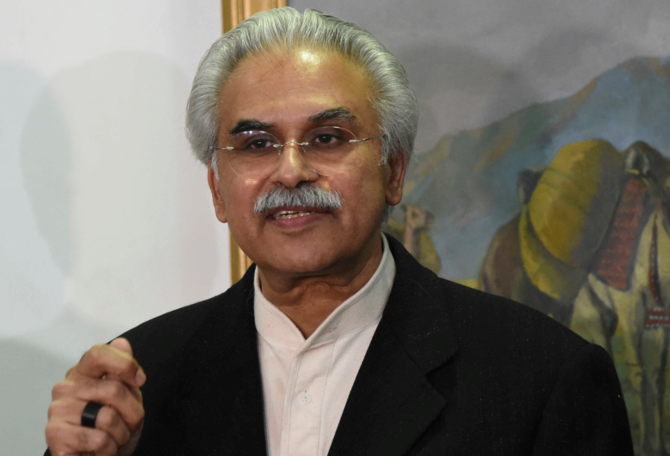
Pakistan’s health chief tests positive for coronavirus

Dr. Zafar Mirza speaks to reporters in Quetta, Pakistan, Feb. 26, 2020. (AP/File)
Short Url
Updated 06 July 2020
Follow

Pakistan’s health chief tests positive for coronavirus

  • Dr. Mirza is among several high-ranking officials to contract the deadly disease 
  • Number of infections cross the 230,000 mark across the country

ISLAMABAD: Pakistan’s Minister of State for Health Dr. Zafar Mirza said on Monday that he had tested positive for the disease.

“I have tested positive for COVID-19. Under med advice, I have isolated myself at home & taking all precautions. I have mild symptoms. Please keep me in your kind prayers,” he tweeted.

“Colleagues, keep up the good work! You are making a big difference & I am proud of you,” he said in a separate post.

Mirza is among several high-ranking officials, cabinet ministers and senior politicians to contract the virus, with Foreign Minister Shah Mahmood Qureshi saying last week that he had tested positive for the disease.

The list includes opposition leader and president of Pakistan Muslim League-Nawaz (PML-N) Shehbaz Sharif, Railways Minister Sheikh Rasheed, Speaker of the lower house of parliament, Asad Qaiser, and former prime minister Shahid Khaqan Abbasi.

As of Monday, Pakistan had reported 231,818 infections and 4,762 deaths from across the country, while more than 3,000 new cases are recorded every day.

This is despite authorities reinstating strict lockdown measures in select areas of several cities last month after the federal government said that the number of infections could multiply eightfold by the end of July and hit the 1.2 million mark.

Pakistan lifted its nationwide lockdown on May 9, citing economic stress, and has since seen infection rates rise from 1-in-10 tests to more than 1-in-5.


Pakistan launches digital cash aid for low-income families during Ramadan, PM says

Updated 6 sec ago
Follow

Pakistan launches digital cash aid for low-income families during Ramadan, PM says

  • Ramadan relief moves from state-run Utility Stores to targeted digital wallet transfers
  • Government to transfer financial assistance through wallets to support sehri, iftar expenses

ISLAMABAD: Pakistan will provide financial assistance to low-income households through digital wallets during the fasting month of Ramadan, Prime Minister Shehbaz Sharif said on Thursday, announcing a government relief initiative aimed at helping families afford daily meals.

The support program comes as many Pakistanis continue to face elevated food and utility costs despite easing inflation, with Ramadan traditionally increasing household spending on staple foods, fruits and energy consumption.

For decades, government-run Utility Stores Corporation outlets were central to Ramadan relief in Pakistan, selling subsidized flour, sugar, ghee and pulses through special “Ramzan packages” that drew long queues in low-income neighborhoods. In recent years, however, authorities have steadily scaled back the system amid mounting losses, corruption complaints and logistical inefficiencies, shifting instead toward targeted cash transfers delivered through digital wallets and banking channels. 

The change reflects a broader policy move away from state-managed commodity distribution toward direct financial assistance intended to give households flexibility while reducing leakages in subsidy programs.

“The Government of Pakistan has launched a Ramadan package under which financial assistance will be transferred to deserving individuals through digital wallets so that households can maintain sehri and iftar meals,” Sharif said in a message issued by his office.

The prime minister said Ramadan encourages compassion and collective responsibility toward vulnerable segments of society, adding that welfare support was part of the state’s duty during the holy month.

Officials say the digital cash transfers approach improves transparency and reduces corruption risks while enabling faster payments nationwide, particularly in urban low-income communities.

But the shift to fully digital assistance also brings challenges. 

Access to smartphones and reliable mobile Internet remains uneven, particularly in rural areas and among older recipients, while many low-income households use SIM cards registered to someone else, complicating verification.