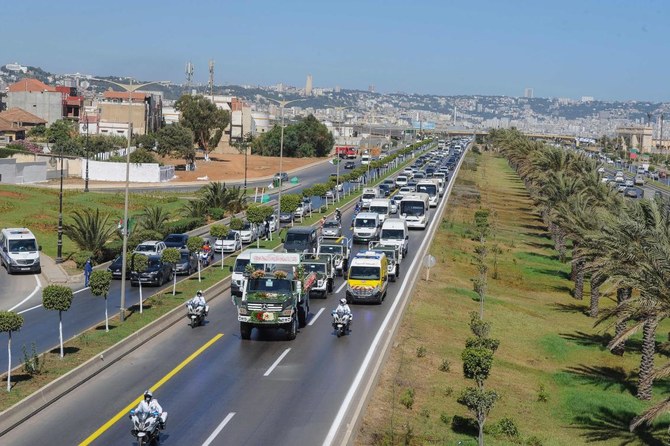
ALGIERS: Algeria on Sunday buried the remains of 24 resistance fighters returned from Paris after more than a century and a half as it marked the 58th anniversary of its independence from France.
The skulls of the fighters, shot and decapitated in the early years of the French occupation, were laid to rest during an emotional ceremony at El Alia cemetery.
The coffins draped with the national flag were lowered into freshly dug graves in the martyr’s square of Algeria’s largest burial ground, alongside national heroes such as top revolt leader Emir Abdelkader.
An elite unit of the Republican Guard presented arms while a funeral march played in the background, an AFP correspondent reported.
President Abdelmadjid Tebboune, who took part in the ceremony alongside other officials, on Saturday said it was time to turn a page on years of frosty relations with France, calling on Paris to apologize for its colonial past.
“We have already had half-apologies. The next step is needed... we await it,” he told news channel France 24 in an interview.
An apology was necessary to “face the problem of memory that jeopardizes many things in the relations between the two countries,” Tebboune said.
It would “make it possible to cool tensions and create a calmer atmosphere for economic and cultural relations,” especially for the more than six million Algerians who live in France, he added.
The skulls, once viewed as war trophies by French colonial officers, were flown into Algiers international airport on Friday and then moved to the Palace of Culture where they were placed on display.
Despite stifling heat, a long queue formed outside the palace and some men and women, waiting to pay their respects, wept, according to footage broadcast by several television stations.
“I came as a fighter, as an invalid from the war of libration, as a citizen who loves his country,” said Ali Zemlat.
The 85-year-old fought in the brutal 1954-1962 war that ended France’s 132 years of colonial rule in Algeria.
The skulls had been stored since the 19th century in the vaults of the Musee de l’Homme in Paris, which specializes in anthropology.
Among the remains were those of revolt leader Sheikh Bouzian, who was captured in 1849 by the French, shot and decapitated, and those of his comrades who had met the same fate.
Algeria had officially asked for their return in 2018, as well as requesting the handover of colonial archives.
The restitution of the skulls has been seen as a sign of a thaw in relations between Algeria and the former colonial power, marked since independence by recurrent tensions.
The French presidency, in a statement to AFP, said the return of the remains was a gesture of “friendship” and part of efforts to “reconcile the memories of the French and Algerian people.”
The repatriation comes amid a global reexamination of the legacy of colonialism, sparked by the May killing of unarmed African American George Floyd by a white police officer.
His murder sparked protests across the world, and UN human rights chief Michelle Bachelet has urged countries to make amends for “centuries of violence and discrimination.”
Emmanuel Macron, the first French president to be born after the 1954-62 independence war in which 1.5 million Algerians died, made his first official visit to Algiers in December 2017.
At the time, he told news website Tout sur l’Algerie that he was “ready” to see his country hand back the skulls.
During his presidential election campaign, Macron had created a storm by calling France’s colonization of Algeria a “crime against humanity.”

Algeria buries remains of anti-French fighters, seeks Paris apology
Short Url
https://arab.news/pbmad
Algeria buries remains of anti-French fighters, seeks Paris apology
- The skulls of the fighters were laid to rest during an emotional ceremony at El Alia cemetery
- The coffins draped with the national flag were lowered into freshly dug graves in the martyr’s square of Algeria’s largest burial ground
Palestinian coach gets hope, advice from mum in Gaza tent
DOHA: Coach Ehab Abu Jazar is guiding a national team that carries on its shoulders all the hopes and sorrows of Palestinian football, but it is his mother, forced by war to live in a Gaza tent, who is his main inspiration and motivation.
The war that broke out following Hamas’s unprecedented attack on Israel on October 7, 2023 put an end to Palestinian league matches, and left athletes in exile fearing for their loved ones in Gaza.
But Abu Jazar’s mother refuses to let the conflict overshadow the sporting dreams of her son, to whom she feeds tactical advice from the rubble of the Palestinian territory by phone.
“She talks to me about nothing but the team. She wants the focus to remain solely on the tournament,” the 45-year-old manager told AFP.
“My mother asks me about the players, who will play as starters and who will be absent, about the tactics, the morale of the players and the circumstances surrounding them.”
The manager, himself a former left-back, says he wants his players to convey the spirit of his mother and Gazans like her.
“We always say that we are a small Palestinian family representing the larger family,” he said.
“Undoubtedly, it puts pressure on us, but it’s positive pressure.”
The Palestinian team are 96th in the FIFA rankings, and their hope of playing in their first World Cup vanished this summer.
But the squad, most of whom have never set foot in Gaza, is within reach of the Arab Cup quarter-finals, keeping their message of resilience alive.
Palestine play Syria in their final Arab Cup group match Sunday, where a draw would be enough to achieve an unprecedented feat for the team.
He said progress would show the world that the Palestinians, if given the right conditions, can “excel in all fields.”
- ‘Genes of resilience’ -
Abu Jazar finished his playing career in 2017 before managing the Palestinian U-23 team and eventually taking the top job last year.
After the war broke out, his family home was destroyed, displacing his mother in Gaza, like most of the territory’s population during the height of the conflict.
He now feels pressure to deliver for them after witnessing from exile the horrors of the war, which came to a halt in October thanks to a fragile US-backed ceasefire.
“At one point, it was a burden, especially at the beginning of the war,” he said.
“We couldn’t comprehend what was happening. But we possess the genes of resilience.
“If we surrender and give in to these matters, we as a people will vanish.”
In her maternal advisory role, Abu Jazar’s mum, who goes by the traditional nickname Umm Ehab, is only contactable when she has power and signal.
But she works around the clock to find a way to watch the team’s matches from Al-Mawasi camp.
“My mother and siblings... struggle greatly to watch our matches on television. They think about how to manage the generator and buy fuel to run it and connect it to the TV,” he said.
This determination is pushing him to give Gazans any respite from the reality of war.
“This is what keeps us standing, and gives us the motivation to bring joy to our people,” he said.
“All these circumstances push us to fight on the field until the last breath.”
The war that broke out following Hamas’s unprecedented attack on Israel on October 7, 2023 put an end to Palestinian league matches, and left athletes in exile fearing for their loved ones in Gaza.
But Abu Jazar’s mother refuses to let the conflict overshadow the sporting dreams of her son, to whom she feeds tactical advice from the rubble of the Palestinian territory by phone.
“She talks to me about nothing but the team. She wants the focus to remain solely on the tournament,” the 45-year-old manager told AFP.
“My mother asks me about the players, who will play as starters and who will be absent, about the tactics, the morale of the players and the circumstances surrounding them.”
The manager, himself a former left-back, says he wants his players to convey the spirit of his mother and Gazans like her.
“We always say that we are a small Palestinian family representing the larger family,” he said.
“Undoubtedly, it puts pressure on us, but it’s positive pressure.”
The Palestinian team are 96th in the FIFA rankings, and their hope of playing in their first World Cup vanished this summer.
But the squad, most of whom have never set foot in Gaza, is within reach of the Arab Cup quarter-finals, keeping their message of resilience alive.
Palestine play Syria in their final Arab Cup group match Sunday, where a draw would be enough to achieve an unprecedented feat for the team.
He said progress would show the world that the Palestinians, if given the right conditions, can “excel in all fields.”
- ‘Genes of resilience’ -
Abu Jazar finished his playing career in 2017 before managing the Palestinian U-23 team and eventually taking the top job last year.
After the war broke out, his family home was destroyed, displacing his mother in Gaza, like most of the territory’s population during the height of the conflict.
He now feels pressure to deliver for them after witnessing from exile the horrors of the war, which came to a halt in October thanks to a fragile US-backed ceasefire.
“At one point, it was a burden, especially at the beginning of the war,” he said.
“We couldn’t comprehend what was happening. But we possess the genes of resilience.
“If we surrender and give in to these matters, we as a people will vanish.”
In her maternal advisory role, Abu Jazar’s mum, who goes by the traditional nickname Umm Ehab, is only contactable when she has power and signal.
But she works around the clock to find a way to watch the team’s matches from Al-Mawasi camp.
“My mother and siblings... struggle greatly to watch our matches on television. They think about how to manage the generator and buy fuel to run it and connect it to the TV,” he said.
This determination is pushing him to give Gazans any respite from the reality of war.
“This is what keeps us standing, and gives us the motivation to bring joy to our people,” he said.
“All these circumstances push us to fight on the field until the last breath.”
© 2025 SAUDI RESEARCH & PUBLISHING COMPANY, All Rights Reserved And subject to Terms of Use Agreement.