NEW DELHI: Indian tech and entertainment firms are looking to capitalize on sudden opportunities arising from a government ban on Chinese owned apps, including the wildly popular TikTok, with one rival video app saying it had added 22 million users in 48 hours. India this week outlawed 59 Chinese-owned apps including TikTok and Tencent’s WeChat, in what was described as a “digital strike” against China by the country’s technology minister.
The move followed a confrontation between India and China at a disputed Himalayan border site, which left 20 Indian soldiers dead.
With 200 million Indians users, TikTok, which features a simple user interface, background music options and various special effects, was a burgeoning force in the nation’s social media scene and the ban left its fans scrambling for options.
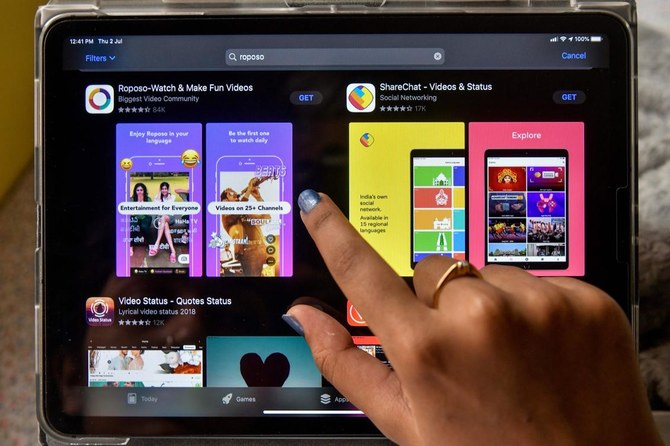
Roposo, an Indian video-sharing social media app similar to TikTok that been around since 2014, saw its user base jump by 22 million in the two days after India banned the Chinese apps, the company’s founder Mayank Bhangadia told Reuters.
“In the last few days I’ve slept for a total of five hours, and it’s the same for our entire team,” Bhangadia said. “The load is so much and we’re just ensuring that the experience is as smooth as possible.”
Roposo’s downloads on Google’s Android now total over 80 million, and Bhangadia expects that to reach 100 million in just a few days. Before the ban, Roposo had roughly 50 million installs on Android devices, which account for a bulk of India’s nearly 500 million smartphones.
Based in the southern Indian tech hub of Bengaluru, the company has just 200 staff now but is planning to hire as many as 10,000 people over the next two years and may take the app global, Bhangadia said.
Other home-grown TikTok alternatives such as Chingari and Mitron are also finding favor with users, with many taking to social media to echo Prime Minister Narendra Modi’s call for “atma-nirbhar” or self-reliant India.
MyGov, the federal government’s citizen engagement website, last month created its account on Roposo.
“We have to create our own ecosystem, every country has done this, this is our atma-nirbhar program,” said a government minister.
New players are also jumping into the fray. Mumbai-based Zee Entertainment Enterprises is set to launch an ad-supported, short-video platform, named HiPi, in the next two months, Rajneel Kumar, the product head for its digital unit Zee5 said.
He hoped that former TikTok users would “find a home within Hipi to be able to continue to enjoy the content they enjoyed.”

Indian video-sharing apps surge in popularity on TikTok ban
https://arab.news/483f2
Indian video-sharing apps surge in popularity on TikTok ban
- Ban follows a confrontation between India and China at a disputed Himalayan border site
- With 200 million Indians users, TikTok a burgeoning force in the nation’s social media scene
AI fuels cyber threats but also offers new defenses, panel tells WEF
- Cyber threats surged in 2025, with Distributed Denial of Service attack records shattered 25 times and a staggering 1,400% rise in incidents involving AI-powered bots incarcerating humans
- Experts agreed that while AI has accelerated new and sophisticated threats, with phishing and impersonation on the rise, it has also improved solutions
DUBAI: Artificial intelligence is making cyberattacks more sophisticated and widespread, but it is also enhancing digital defenses, experts told the World Economic Forum on Wednesday, as they stressed the need for zero-trust systems and robust AI frameworks to reduce vulnerabilities.
Cyber threats surged in 2025, with Distributed Denial of Service attack records shattered 25 times and a staggering 1,400 percent rise in incidents involving AI-powered bots incarcerating humans.
Experts agreed that while AI has accelerated new and sophisticated threats, with phishing and impersonation on the rise, it has also improved solutions.
Michelle Zatlyn, co-founder, president and COO of Cloudflare, pointed to modern solutions organizations can invest in. However, she warned against the digital divide between major financial institutions that have robust cybersecurity measures, and smaller organizations struggling with outdated security solutions.
This divide, she said, necessitates heightened awareness and adaptation to modern security technologies to prevent crises, especially during vulnerable times like weekends.
The panelists stressed international collaboration and intelligence sharing between government agencies, law enforcement and the private sector as the way to tackle cross-border threats and build more resilient societies.
Catherine de Bolle, executive director at Europol, said AI has transformed the policing scene where traditional methods no longer function. She emphasized Europol’s extensive efforts to boost collaboration with the private sector to develop tools to protect the digital ecosystem, enhance crypto tracing and boost financial security.
De Bolle said AI had enhanced the capabilities and outreach of organized crime groups “because it facilitates the business model where you only need a computer and some people who are technically schooled.”
“We predict that in the future, digital crime frauds will be much easier as you gain a lot of money and reach more people without the need of an infrastructure,” she added. Collaboration with the private sector, she said, helps ensure a secure ecosystem that maintains user trust in online platforms.
However, Michael Miebach, CEO of Mastercard, said while AI can help defend against cyberattacks, trust needs to be built first among people to make these technologies fulfill its promises in driving prosperity and growth.
“If we don’t build a trusted layer around these technologies, people will not use it,” he said, pointing out that cyber threats have impacted the geopolitical, societal and corporate aspects of life.
Hatem Dowidar, group CEO of e&, called for more intelligent networks to deploy AI agents that detect and isolate malicious behavior early on to protect digital ecosystems from highly disruptive cyberattacks.
“So you are in some sense more cognizant of malicious hardware being embedded in your system,” he said. However, he warned against the loophole created as more companies implement agentic AI agents that could expose networks. Therefore, he urged the building of zero-trust systems to prevent incursions of new threats coming through these technologies.
He also stressed the need to establish guardrails to monitor AI agents because they are “programmed in plain language and it’s very easy that the programming goes out of context.”
“We never could have relied 100 percent on a human agent to work if there is no supervision and that will hold true for AI,” said Dowidar.
Another challenge the panelists highlighted was the blurred lines between state and non-state actors, with states potentially using organized crime to execute cyber operations.
Europol’s de Bolle said this brings new challenges for traditional policing and necessitates joint efforts across intelligence, defense, and law enforcement sectors.
“State actors are using criminal groups for their own purposes to launch DDoS attacks,” she said, adding that the danger comes from the fact that “states can hide behind and criminals can hide after the state and they don’t have to make the investment because the structure is already there.”
She said such developments make it necessary to think of the future of defense police intelligence services where law enforcement works closely with the private sector to tackle such dangers, while respecting the boundaries of different agencies: “If we do not put the information and intelligence together to tackle this, we will never win the battle.”
Dowidar said information sharing needed to happen on national and international security levels. Nationally, there should be an entity that coordinates between the police, intelligence, network operators and the critical infrastructure companies.
Internationally, there should be security centers that immediately inform other like-minded organizations around the world of any new threat, along with sharing how the problem was solved or whether help is needed from other experts.
Meanwhile, de Bolle said it was the responsibility of the private and public sectors to build societal resilience, boost digital literacy, revamp the education system and develop the critical mindset of the young generation who will use these tools in the future.
Cloudflare’s Zatlyn urged business leaders to understand the basics of new technologies, beyond only relying on technical teams, to keep revenue flowing and minimize risks facing their networks.
She also stressed that CEOs and organizations must consider AI agents as an “extension” of their teams.
“Organizations are concerned that their data will leak with the use of new technologies, but this depends how to train the agents. These are all stoppable issues,” said Zatlyn.


