


World-record seizure of Daesh drugs in Italy

1 / 2
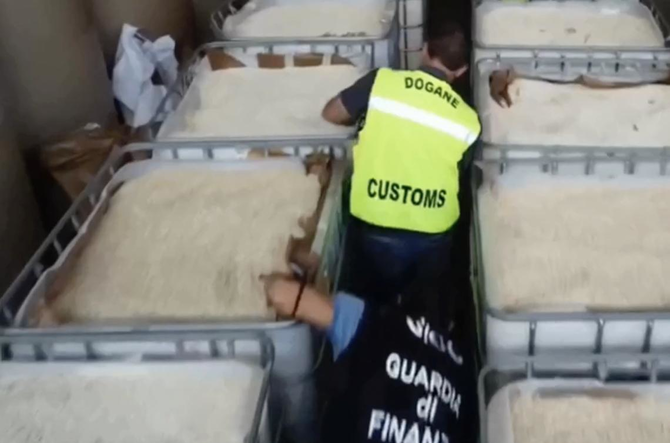
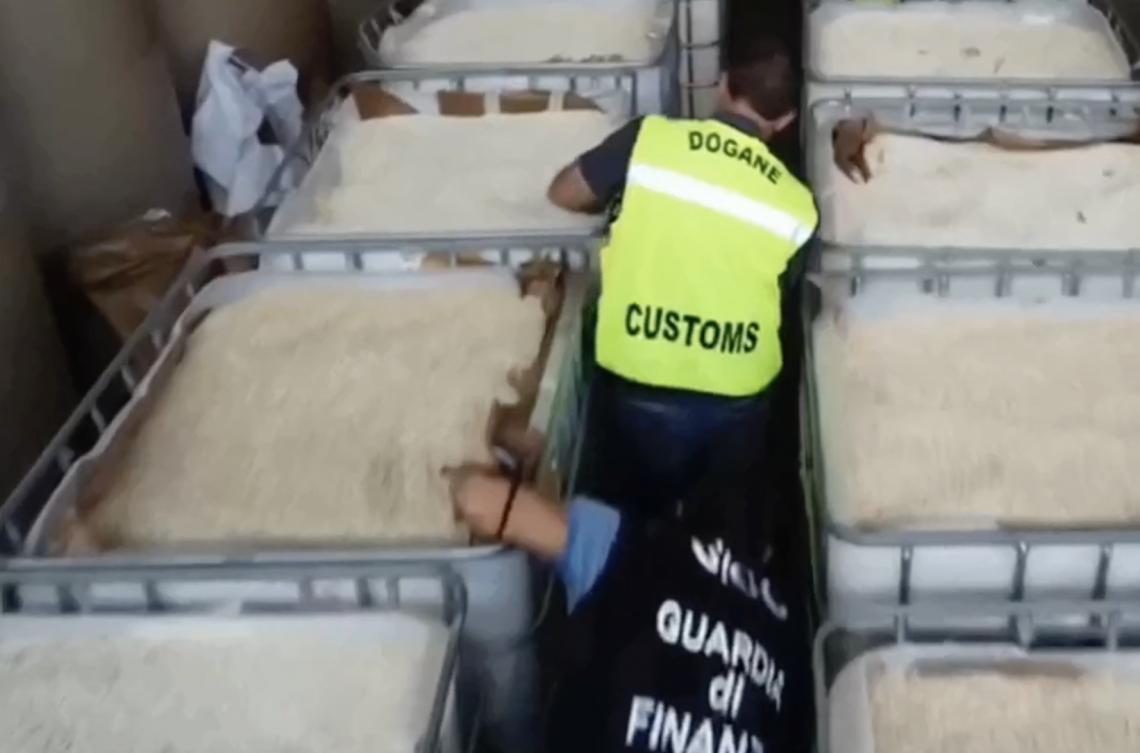
This photo shows a record seizure of 14 tons of amphetamines hidden in three containers found in the port of Salerno, just south of Naples. (AFP)
2 / 2
This image taken from a video shows customs police officers inspecting boxes full of amphetamines pills that were seized at the Salerno harbor, southern Italy, Wednesday, July 1, 2020. (AP)
Short Url
Updated 01 July 2020
Follow

World-record seizure of Daesh drugs in Italy

  • Some 84 million Captagon tablets were found in the containers
  • Dubbed the “jihad drug,” it is produced in Syria and is widely used by Daesh fighters in combat

ROME: Italian police seized 14 tons of amphetamines made by Daesh in Syria that were found in three freight containers in the port of Salerno.
“This is the biggest seizure of amphetamines in the world,” said Naples’s finance police, which carried out the investigation.


Some 84 million Captagon tablets were found in the containers. The tablets were hidden in machinery.
Dubbed the “jihad drug,” it is produced in Syria and is widely used by Daesh fighters in combat. French investigators said Captagon was used by the terrorists who carried out the attack at the Bataclan theater in Paris, where 90 people were killed in 2015.


A spokesman for Naples’s finance police said Daesh “finances now its terrorist activities mainly by trafficking drugs made in Syria, which in the past few years has become the world’s largest producer of amphetamines.”
Investigators in Naples now fear that Daesh may have developed links with powerful Italian criminal organizations such as the Camorra.
“You don’t normally get all those drugs in a port here in (the Italian region of) Campania if the Camorra don’t know at least,” Franco Roberti, the former anti-mafia national chief prosecutor who is now a member of the European Parliament, told Arab News.
“The Camorra have capillary control of the territory, and it’s very hard to believe that any illegal activity may be carried out in the area without their consent,” he added.
“The port of Salerno could’ve become a hub to smuggle Captagon in the biggest European cities, and that could really be worrying.”


Cuba says attacking speedboat had nearly 13,000 rounds of ammunition

Updated 9 sec ago
Follow

Cuba says attacking speedboat had nearly 13,000 rounds of ammunition

  • Firefight took place at a range of 20 meters, Cuba says
  • Incoming crew originally ‌set out on two vessels but ditched one
HAVANA: A commando of Cuban exiles who intended to infiltrate Cuba on a speedboat was armed with nearly 13,000 rounds of ammunition, 13 rifles and 11 pistols, Cuban officials said on Friday, providing new details about Wednesday’s deadly exchange of gunfire at sea. The government in Havana has said 10 Cuban nationals coming from the United States entered Cuban waters and opened fire on a border guard vessel, leading Cuban forces to return fire killing four and wounding six others, who were taken into custody.
In an attempt to dispel doubts about its account to date, senior Cuban Interior Ministry officers displayed the captured armaments from the studio on a special television program, including bins full of at least some of the 12,846 recovered rounds. They also showed pictures of the vessels, each peppered with bullet holes from ‌the firefight they ‌said took place at a range of 20 meters (66 feet).
The confrontation took place ‌at ⁠a fraught moment ⁠in US-Cuban relations, with US President Donald Trump pressuring the island by imposing a virtual oil blockade after capturing and ousting Venezuelan President Nicolas Maduro, a crucial Cuban ally, on January 3.
Cuba has identified the assailants as Cuban exiles, some of whom had been previously placed on a list of accused terrorists, who came from the United States with the intent to sow chaos and attack military units on the Communist-ruled island.
“The intent of this group is to infiltrate, to promote public disorder. To incite the people to unite. To carry out something violent. Attack military units ⁠in order to incite social unrest and to unite the people in order to ‌steal the revolution. That has been duly proven,” said Col. Victor Alvarez ‌of the Interior Ministry.
Cuba says response ‘proportional’
US politicians have expressed skepticism over Cuba’s version of events. Secretary of State Marco ‌Rubio on Wednesday said his government would independently investigate, adding that it was not a US operation and ‌that no US government personnel were involved.
Cuban officers said the infiltrators set out from Marathon in the Florida Keys on two vessels but ditched one at some point due to technical difficulties. They united on one speedboat, which a US official said was reported stolen in Florida. Cuba said it recovered a drone, radios, knives, a portable power plant, bolt cutters and ‌other materiel. They also found emblems of the November 30th Movement and People’s Self-Defense, anti-communist groups that oppose the Cuban government.
Cuba says a patrol of five ⁠border guard members on ⁠a 9-meter boat spotted the incoming vessel shortly after 7 a.m., with some members of the incoming crew in the water, about one nautical mile off a cay on the Caribbean island’s northern coast, about 100 miles (160 km) from Marathon.
The infiltrators opened fire at a distance of 185 meters, striking the captain of the Cuban vessel in the abdomen, Cuba said. Bleeding heavily, the wounded captain remained at the helm and steered toward the enemy vessel, leading to a firefight at a distance of about 20 meters, the officers said.
Cuba called its response “proportional.”
“It is a defensive model that practically never uses firearms, and the use of firearms is proportional to the type of action being carried out against our force,” said Interior Ministry Col. Ybey Carballo.
The captured Cuban nationals were receiving medical care and face charges including armed aggression, illegal entry into national territory, crimes associated with terrorist acts, and arms trafficking, prosecutor Edward Robert Campbell told the program. He said they face prison terms of up to 10 to 15 years for the lesser offenses and 20 to 30 years — or even the death penalty — for the more serious charges.