

Iran issues arrest warrant for Trump, asks Interpol to help
Iran issues arrest warrant for Trump, asks Interpol to help/node/1697266/world
Iran issues arrest warrant for Trump, asks Interpol to help
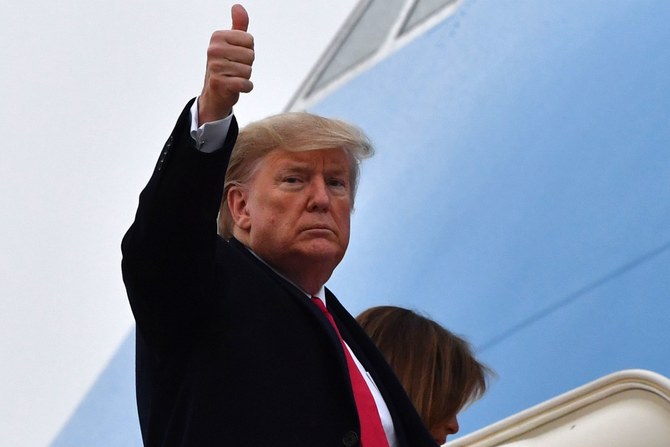
In this file photo, US President Donald Trump gives a thumbs up as he boards Air Force One at Joint Base Andrews in Maryland, January 31, 2020. (AFP/File)
Iran issues arrest warrant for Trump, asks Interpol to help
On Jan. 3, a US drone strike in Iraq killed Gen. Soleimani, leader of the Revolutionary Guards’ Quds Force
US special representative for Iran calls the announcement a ‘propaganda stunt’
Updated 29 June 2020
AP
TEHRAN: Iran has issued an arrest warrant and asked Interpol for help in detaining US President Donald Trump and dozens of others it believes carried out the US drone strike that killed a top Iranian general in Baghdad, a local prosecutor reportedly said Monday.
While Trump faces no danger of arrest, the charges underscore the heightened tensions between Iran and the United States since Trump unilaterally withdrew America from Tehran’s nuclear deal with world powers.
Tehran prosecutor Ali Alqasimehr said Trump and more than 30 others whom Iran accuses of involvement in the Jan. 3 strike that killed Gen. Qassem Soleimani in Baghdad face “murder and terrorism charges,” the state-run IRNA news agency reported.
Alqasimehr did not identify anyone else sought other than Trump, but stressed that Iran would continue to pursue his prosecution even after his presidency ends.
Interpol, based in Lyon, France, did not immediately respond to a request for comment.
Alqasimehr also was quoted as saying that Iran requested a “red notice” be put out for Trump and the others, which represents the highest-level arrest request issued by Interpol. Local authorities generally make the arrests on behalf of the country that requests it. The notices cannot force countries to arrest or extradite suspects, but can put government leaders on the spot and limit suspects’ travel.
After receiving a request, Interpol meets by committee and discusses whether or not to share the information with its member states. Interpol has no requirement for making any of the notices public, though some do get published on its website.
It is unlikely Interpol would grant Iran’s request as its guideline for notices forbids it from “undertaking any intervention or activities of a political” nature. That was something noted by Brian Hook, the US special representative for Iran, who dismissed the announcement during a news conference in Saudi Arabia on Monday.
“It’s a propaganda stunt that no one takes seriously and makes the Iranians look foolish,” Hook said.
The US killed Soleimani, who oversaw the Revolutionary Guard’s expeditionary Quds Force, and others in the January strike near Baghdad International Airport. It came after months of rising tensions between the two countries. Iran retaliated with a ballistic missile strike targeting American troops in Iraq.
Bangladesh’s Hindu minority in fear as attacks rise and a national election nears
Among Hindus, fear has grown more pervasive as the Muslim-majority nation moves toward a national election
Attacks on Hindus in Bangladesh have also inflamed tensions with neighboring India
Updated 2 sec ago
AP
DHAKA: Dipu Chandra Das, a 27-year-old Hindu garment worker, was accused in December by several Muslim colleagues of making derogatory remarks about the Prophet Muhammad. The accusations drew a violent mob to his workplace. He was beaten to death, his body hung from a tree and set on fire. Across Bangladesh, Hindus watched the recorded images on their phones with dread. Protests erupted in Dhaka and other cities, with demonstrators demanding justice and greater protections. The interim government, led by Muhammad Yunus, ordered an investigation, and police said that about a dozen people were arrested. But human rights groups and Hindu leaders say the killing wasn’t an isolated act, but part of a wider surge in attacks on the minority community, fueled by rising polarization, the reemergence of Islamists and what they describe as a growing culture of impunity. Among Hindus, fear has grown more pervasive as the Muslim-majority nation moves toward a national election on Feb. 12. “No one feels safe anymore,” said Ranjan Karmaker, a Dhaka-based Hindu human rights activist. “Everyone is terrified.” Surge in attacks Hindus make up a small minority in Bangladesh, about 13.1 million people, or roughly 8 percent of the country’s population of 170 million, while Muslims make up 91 percent. The Bangladesh Hindu Buddhist Christian Unity Council, an umbrella group representing minority communities, says it documented more than 2,000 incidents of communal violence since the ouster of former Prime Minister Sheikh Hasina in a mass uprising in August 2024. The group recorded at least 61 killings, 28 instances of violence against women — among them rape and gang rape — and 95 attacks on places of worship involving vandalism, looting and arson. It has also accused the Yunus-led administration of routinely dismissing or downplaying reports of such violence. When contacted by The Associated Press for a response, an official from Yunus’ press team declined to comment. The administration headed by Yunus has consistently denied claims that it has failed to ensure adequate protection for minority communities and insisted that most incidents aren’t driven by religious hostility. Previous elections in Bangladesh have also seen increases in violence, with religious minorities often bearing the brunt. But with Hasina’s Awami League party barred from contesting elections and with her living in exile in India, many Hindus fear the worst as they have long been viewed as aligned with Hasina. Karmaker, the rights activist, said that Hindus are often perceived as voting en masse for one side, a perception that heightens their vulnerability. He said that the community was also gripped by fear because of a culture of impunity, and near-weekly incidents, warning that in some parts of the country the Hindu community was facing “an existential crisis.” “The individuals involved in this violence are not being brought under the law, nor are they being held accountable through the justice system. It creates the impression that the violence will continue,” Karmaker said. Islamists reclaim influence The surge in attacks against Hindus has unfolded alongside the reemergence of Jamaat-e-Islami, Bangladesh’s largest Islamist party, and its student wing. After years on the political sidelines because of bans, arrests and sustained crackdowns under Hasina’s government, the party sees the election as an opportunity to reclaim influence. Jamaat-e-Islami anchors a broader Islamist alliance of 11 parties, among them the student-led National Citizen Party, or NCP, whose leaders played a central role in the 2024 uprising. As concerns grow over what its return could mean for religious minorities, Jamaat-e-Islami has moved to recast its public image, even though it advocates Shariah, or Islamic law. It has organized public rallies featuring Hindu participants and nominated a Hindu community leader as one of its candidates. Meanwhile, NCP has pledged to support citizens facing religious discrimination and said that if elected, it would establish a dedicated unit within the Human Rights Commission to protect minority rights. Political analyst Altaf Parvez said that such decisions were largely symbolic. He said that other political parties, including the Bangladesh Nationalist Party, had also failed minorities by nominating only a handful of candidates — a move, he said, that didn’t reflect a genuine political commitment to inclusive politics. Parvez said a systematic pattern of attacks was taking place in rural areas to inject more fear among the minorities before the vote. “It will impact the participation of the voters from the minority communities in the next elections too,” he said. Tensions rise with India Attacks on Hindus in Bangladesh have also inflamed tensions with neighboring India, prompting protests by Hindu nationalist groups and criticism from Indian Prime Minister Narendra Modi’s government. India’s Foreign Ministry recently accused Bangladesh of downplaying a “disturbing pattern of recurring attacks” on Hindus, saying such violence was wrongly blamed on personal or political disputes. Bangladesh, in turn, described India’s criticism as “systematic attempts” to stoke anti-Bangladesh sentiments. The dispute has spilled into diplomacy and sporting events. Both sides have suspended some visa services and accused each other of failing to protect diplomatic missions. Protests in India led cricket officials to bar a Bangladeshi player from the Indian Premier League tournament, followed by Bangladesh’s boycott of this month’s World Cup in India. Sreeradha Datta, a Bangladesh expert at India’s Jindal School of International Affairs, said that India’s concerns were “legitimate.” “Hindus in Bangladesh are a very vulnerable group that can’t defend themselves, and Yunus’ administration is in exit mode and deliberately looking the other way,” she said. Families demand justice For those caught in the violence, the losses have been deeply personal. When word of Das’ killing reached his home village in Bangladesh’s Mymensingh district, disbelief settled in among relatives and neighbors. Many said they watched images of his killing on their phones. “When people say they saw it on their phones, my chest feels like it is going to burst,” his father said. Das was known as a quiet, well-behaved man. He was also the sole breadwinner for his family, relatives said, and his death has left his wife and mother facing an uncertain future. His mother, Shefali Rani Das, said the family is seeking justice for the killing. “They beat him, hung him from a tree, and burned him. I demand justice,” she said.