

IMF chief’s fears over lack of progress in talks to solve Lebanon’s economic crisis

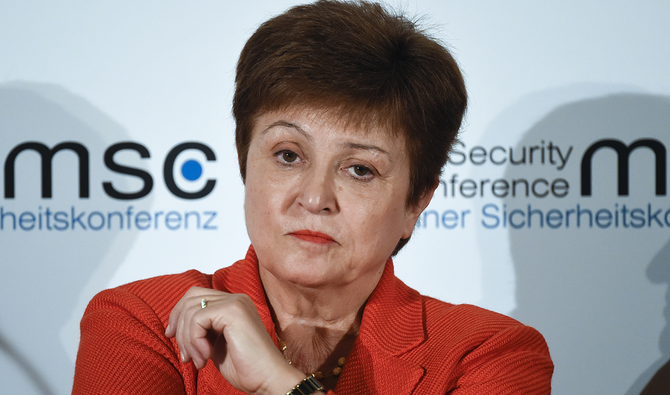
In this Feb. 14, 2020, file photo, Kristalina Georgieva, Managing Director of the International Monetary Fund, attends a session on the first day of the Munich Security Conference in Munich, Germany. (AP)
Short Url
Updated 27 June 2020
Follow

IMF chief’s fears over lack of progress in talks to solve Lebanon’s economic crisis

  • The financial meltdown in the country has seen the Lebanese pound lose 75 percent of its value over the past eight months

BEIRUT: The head of the International Monetary Fund (IMF) has issued a doom-laden forecast over the outcome of crucial talks aimed at solving Lebanon’s financial woes.

Kristalina Georgieva, the IMF’s managing director, said she did not “expect progress in the negotiations with the Lebanese officials” over helping the country out of its economic crisis.

Former Lebanese Interior Minister Ziyad Baroud told Arab News: “What Georgieva said has already been stated for years by the International Support Group for Lebanon (ISG), but her declaration comes at a time when Lebanon is negotiating with the IMF.”

Speaking on Friday, the IMF chief said: “IMF officials are still working with Lebanon, but it is not clear whether it is possible for the country’s leaders, active parties, and society to agree on implementing the reforms needed to stabilize the economy and boost economic growth.”

The financial meltdown in the country has seen the Lebanese pound lose 75 percent of its value over the past eight months.

Georgieva pointed out that “the core challenge is to implement a set of very difficult but necessary reforms.”

She said that the situation in Lebanon was “breaking her heart,” adding that it was a “country which has a strong culture of entrepreneurship, and is hosting refugees from Palestine and Syria to help alleviate a major humanitarian crisis.”

Reaching an agreement with the IMF would require a strong commitment from the Lebanese government to implement a set of structural reforms in public institutions.

The ISG has called for a prompt resolution to problems in the electricity sector, the issuance of a law that guarantees the independence of the judiciary, and new rules controlling public-sector purchasing and tendering by ministries, public institutions, councils, and municipalities.

One of the most urgent issues for Lebanon is to restore the confidence of its citizens, the international community, and international financial institutions.

Economist Issam Al-Jurdi, told Arab News: “There is a prevalent belief in Lebanon that the reform process is limited to simple traditional measures, however what the IMF is asking for is reforms to the public sector that is subject to political control, and it is through these reforms that sectoral and structural reforms could be achieved.

“The reason for refraining from doing these reforms is that they touch to the clientelism and nepotism that is widespread throughout the Lebanese political system, and that is used by the political class as a means to uphold power, embezzle public funds, and ensure appointment of proteges, in the name of the confessional system and sectarian privileges.

“The call for reforms is supposed to extend to vital sectors related to treasury funds such as electricity, communications, water, dams, and transportation.”

Al-Jurdi feared that the Lebanese Parliament “would interfere, under the pretext of unifying the figures of the government bailout plan that was submitted to the IMF, to provide support to the banks at the expense of depositors whose deposits were seized by the banks.”

Baroud said that the call for reforms was “most and foremost a Lebanese one before being an IMF demand, and is dictated by the need for good governance and for the preservation of the national interests of Lebanon.

“When people demand these reforms, they do so because they are popular demands, but it seems that the political class does not want to hear the outcry of the people, which has brought us to the stage where reforms could no longer be mere wishful thinking, but rather an existential necessity for survival.

“Perhaps some parties are not listening to calls for reform on purpose, and we are paying the price. They talk of sacrifices that they are willing to make, but in the end, they are asking the citizens to do sacrifices,” added Baroud.

Al-Jurdi said: “After the global financial meltdown in 2008, the IMF amended its previous policies. It is no longer satisfied with the traditional measures that require reducing the deficit, eliminating subsidies, and floating the exchange rate, but it now demands a social program to support poor and marginalized social groups, as the IMF strict reform measures have severe repercussions on these groups.”

He added that Georgieva knew that Lebanon had huge potential and should not have reached this situation.


Sudanese trek through mountains to escape Kordofan fighting

Updated 3 sec ago
Follow

Sudanese trek through mountains to escape Kordofan fighting

  • For eight days, Sudanese farmer Ibrahim Hussein led his family through treacherous terrain to flee the fighting in southern Kordofan — the latest and most volatile front in the country’s 31-month-old
PORT SUDAN: For eight days, Sudanese farmer Ibrahim Hussein led his family through treacherous terrain to flee the fighting in southern Kordofan — the latest and most volatile front in the country’s 31-month-old conflict.
“We left everything behind,” said the 47-year-old, who escaped with his family of seven from Keiklek, near the South Sudanese border.
“Our animals and our unharvested crops — all of it.”
Hussein spoke to AFP from Kosti, an army-controlled city in White Nile state, around 300 kilometers (186 miles) south of Khartoum.
The city has become a refuge for hundreds of families fleeing violence in oil-rich Kordofan, where the Sudanese army and the Rapid Support Forces (RSF) — locked in a brutal war since April 2023 — are vying for control.
Emboldened by their October capture of the army’s last stronghold in Darfur, the RSF and their allies have in recent weeks descended in full force on Kordofan, forcing nearly 53,000 people to flee, according to the United Nations.
“For most of the war, we lived in peace and looked after our animals,” Hussein said.
“But when the RSF came close, we were afraid fighting would break out. So we left, most of the way on foot.”
He took his family through the rocky spine of the Nuba Mountains and the surrounding valley, passing through both paramilitary and army checkpoints.
This month, the RSF consolidated its grip on West Kordofan — one of three regional states — and seized Heglig, which lies on Sudan’s largest oil field.
With their local allies, they have also tightened their siege on the army-held cities of Kadugli and Dilling, where hundreds of thousands face mass starvation.

- Running for their lives -

In just two days this week, nearly 4,000 people arrived in Kosti, hungry and terrified, said Mohamed Refaat, Sudan chief of mission for the UN’s International Organization for Migration.
“Most of those arriving are women and children. Very few adult men are with them,” he told AFP, adding that many men stay behind “out of fear of being killed or abducted.”
The main roads are unsafe, so families are taking “long and uncertain journeys and sleeping wherever they can,” according to Mercy Corps, one of the few aid agencies operating in Kordofan.
“Journeys that once took four hours now force people to walk for 15 to 30 days through isolated areas and mine-littered terrain,” said Miji Park, interim country director for Sudan.
This month, drones hit a kindergarten and a hospital in Kalogi in South Kordofan, killing 114 people, including 63 children, according to the World Health Organization.
Adam Eissa, a 53-year-old farmer, knew it was time to run. He took his wife, four daughters and elderly mother — all crammed into a pickup truck with 30 others — and drove for three days through “backroads to avoid RSF checkpoints,” he told AFP from Kosti.
They are now sheltering in a school-turned-shelter housing around 500 displaced people.
“We receive some help, but it is not enough,” said Eissa, who is trying to find work in the market.
According to the IOM’s Refaat, Kosti — a relatively small city — is already under strain. It hosts thousands of South Sudanese refugees, themselves fleeing violence across the border.
It cost Eissa $400 to get his family to safety. Anyone who does not have that kind of money — most Sudanese, after close to three years of war — has to walk, or stay behind.
Those left behind
According to Refaat, transport prices from El-Obeid in North Kordofan have increased more than tenfold in two months, severely “limiting who can flee.”
In besieged Kadugli, 56-year-old market trader Hamdan is desperate for a way out, “terrified” that the RSF will seize the city.
“I sent my family away a while ago with my eldest son,” he told AFP via satellite Internet connection, asking to be identified only by his first name. “Now I am looking for a way to leave.”
Every day brings “the sound of shelling and sometimes gunfire,” said Kassem Eissa, a civil servant and head of a family of eight.
“I have three daughters, the youngest is 14,” he told AFP, laying out an impossible choice: “Getting out is expensive and the road is unsafe” but “we’re struggling to get enough food and medicine.”
The UN has issued repeated warnings of the violence in Kordofan, raising fears of atrocities similar to those reported in the last captured city in Darfur, including summary executions, abductions and rape.
“If a ceasefire is not reached around Kadugli,” Refaat said, “the scale of violence we saw in El-Fasher could be repeated.”