Paris-Orly airport reopens after 3-month coronavirus closure

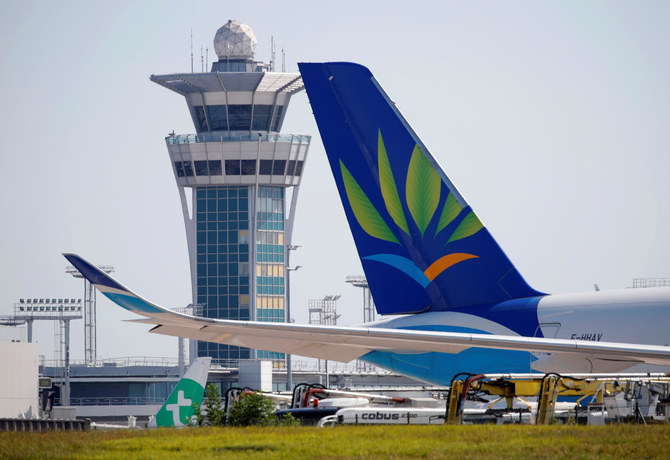
The tail fin of a Air caraibes passenger Airbus A350 aircraft is seen near the control tower at Orly Airport before for its re-opening following the coronavirus disease (COVID-19) outbreak in France, June 24, 2020. (Reuters)
Short Url
Updated 26 June 2020
Follow

Paris-Orly airport reopens after 3-month coronavirus closure

  • On Friday, officials expect around 8,000 passengers, less than 10 percent of the daily pre-virus average of around 90,000
  • A plane operated by low-cost carrier Transavia took off at 04:25 GMT for Porto in Portugal, marking the first commercial flight since the airport south of Paris came to a halt on March 31

ORLY: France: Orly airport serving the French capital Paris reopened on Friday for the first time in nearly three months after air travel collapsed during the coronavirus pandemic but flights will be a fraction of the normal rate.
A plane operated by low-cost carrier Transavia took off at 6:25 am (0425 GMT) for Porto in Portugal, marking the first commercial flight since the airport south of Paris came to a halt on March 31.
Firefighters hosed the plane with a festive “water salute” before it took to the runway.
Airlines including Transavia, Air France, easyJet, Vueling and Air Caraibes account for most of the traffic at Orly, flying to the Caribbean, Reunion Island, Italy, Spain, Portugal, Iceland and Croatia, among others.
On Friday, officials expect around 8,000 passengers, less than 10 percent of the daily pre-virus average of around 90,000.
They will be on more than 70 flights compared to the normal run of 600 per day.
Traffic is due to increase to 173 flights per day in July but it will depend much on whether Algeria, Morocco and Tunisia reopen their borders as well as on whether the virus remains under control.
For nearly three months, all commercial flights from Paris have taken off from the main Charles de Gaulle airport, to the north of the capital, in order to rationalize costs.
To regain the trust of passengers, the airport has taken measures to check the spread of the coronavirus.
Put in place are more than 7,000 posters and stickers to keep people at a safe distance, distributers of hand sanitizer and plexiglass windows at check-in desks and other counters to minimize contact.
Thermal cameras are being used to check the temperatures of passengers.


Somalia warns millions face acute hunger due to drought

Updated 3 sec ago
Follow

Somalia warns millions face acute hunger due to drought

MOGADISHU: About 6.5 million people in Somalia ‌face acute hunger due to drought, the government and the United Nations said on Tuesday, sounding the alarm days after the UN’s food agency warned ​that food aid could grind to a halt by April without new funding.
Somalia declared a national drought emergency in November after years of failed rains, and other countries in the region have also been hit.
More than a third of those facing acute malnutrition are children, Somalia’s government and the United Nations Somalia said in a joint statement. The crisis has forced tens of thousands of ‌people to ‌flee their homes, with many crowding ​into camps ‌in ⁠Mogadishu and ​other ⁠cities.
“The drought ... has deepened alarmingly, with soaring water prices, limited food supplies, dying livestock, and very little humanitarian funding,” George Conway, the UN’s Humanitarian Coordinator for Somalia, said in a statement.
Hawo Abdi said she lost two children to illness after the drought laid waste to her homeland in Somalia’s Bay region.
“When I saw that the suffering ⁠was getting worse, I fled my home and ‌came to ... Mogadishu,” she told Reuters ‌from her shelter on the outskirts of ​the capital.
Last week, the UN ‌World Food Programme put the number of those facing acute hunger ‌at 4.4 million, and said it had already cut back its assistance to just over 600,000 people from 2.2 million earlier this year.
It was not clear whether the new figure reflected a sharp increase in those ‌at risk or different counting methods.
The government and United Nations figures tally with those also released on ⁠Tuesday by ⁠the Integrated Food Security Phase Classification (IPC), which sets the global standard for determining the severity of a food crisis.
While rainfall in the April to June season could offer some relief, some 5.5 million people were expected to remain in the crisis level or worse, with 1.6 million people in the emergency level, the statement said.
Abdiyo Ali was forced to abandon her farm in the Lower Shabelle region.
“Our farms were destroyed, our livestock died, and water sources became too far away. We have nothing left to bring ​with us,” Ali told Reuters ​last week while preparing her food in a displaced people’s camp outside Mogadishu.