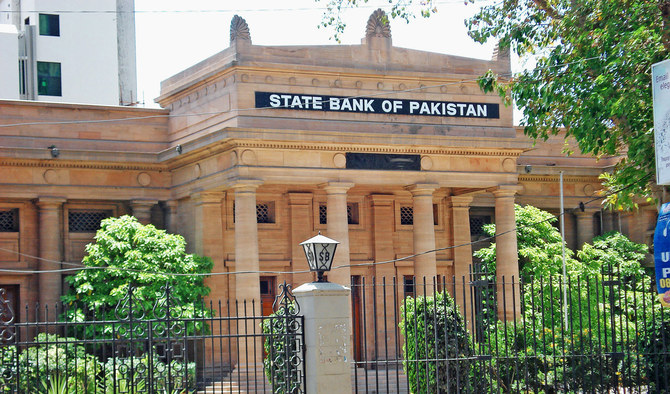
KARACHI: Pakistan’s central bank on Thursday further slashed key policy rate by 100 basis points to 7 percent citing continued economic slowdown and increasing downside risk to country’s growth.
The central bank’s move to cut the interest rates comes in an unscheduled meeting of Monetary Policy Committee which has so far slashed the key interest rate by 6.25 percent from 13.25 percent since March 17, 2020.
“The decision reflected the MPC’s (Monetary Policy Committee) view that the inflation outlook has improved further, while the domestic economic slowdown continues and downside risks to growth have increased,” the State Bank of Pakistan (SBP) said.
The SBP said that priority of monetary policy had appropriately shifted toward supporting growth and employment during these challenging times.
“The MPC re-asserted its commitment to supporting households and businesses through the Covid-19 crisis and minimizing damage to the economy. In this context, the MPC felt that from a risk management point of view, a prompt response to downside risks to growth was called for given the improved inflation outlook,” the statement read.
The central bank noted that with approximately Rs. 3.3 trillion worth of loans due to be re-priced by early July 2020, this was an opportune moment to take action from a monetary policy transmission perspective. “In this way, the benefits of interest rate reductions would be passed on in a timely manner to households and businesses.”
The central bank observed that “the moderation of underlying inflation has continued”. The headline inflation declined further to 8.2 percent in May on the back of the recent cut in diesel and petrol prices.
The fiscal budget 2020-21 is also expected to be neutral for inflation as the freeze on government salaries, absence of new taxes, and lower production cost from reduced import duties should offset the decline in subsidies in some sectors. Given the absence of demand-side pressures, average inflation could fall below the previously announced range of 7-9 percent for next fiscal year.
On the real side, the decline in LSM (Large Scale manufacturing) deepened to 41.9 percent (y/y) in April, when lockdowns were still in place. In May, high-frequency indicators of activity such as cement dispatches, automobile sales, food and textile exports, and POL sales also continued to contract, although mostly at a lower rate than in the previous two months.
Looking ahead, the economy is expected to recover gradually in the current fiscal year supported by easing lockdowns, supportive macroeconomic policies and a pick-up in global growth. However, risks are skewed to the downside and the recovery will depend critically on the evolution of the pandemic both in Pakistan and abroad.
Pakistan’s industrialists, who have been calling for reduction in the key interest rates, have welcomed the move of central bank and called for further cuts in the current pandemic.
“There is more space for the interest rate cuts. Our demand is that the rates should be slashed to 5 percent or below”, Sheikh Sultan Rehman, Vice President of Federation of Pakistan Chambers of Commerce and Industry FPCCI, told Arab News. “The coronavirus has exerted massive negative impacts on our economy and the global economy which means the room to cut the rate still exists and the bank should exercise this option”, he added.
The International Monetary Fund (IMF), in its World Economic Outlook (WEO) released on Wednesday, has further downgraded its 2020 global growth forecast to negative 4.9 percent, 1.9 percentage points lower than in April, and projected a more gradual recovery than previously anticipated.


![]()

State Bank of Pakistan cuts key policy rate by 100bps to 7%
Short Url
https://arab.news/njsbt
State Bank of Pakistan cuts key policy rate by 100bps to 7%
- The surprise move comes amid improved inflation outlook and domestic economic slowdown
- Industrialists demand policy rate to be 5% or below given the global economic meltdown
Latest updates





© 2026 SAUDI RESEARCH & PUBLISHING COMPANY, All Rights Reserved And subject to Terms of Use Agreement.