

On your marks: Saudi gyms gear up to welcome back fitness buffs

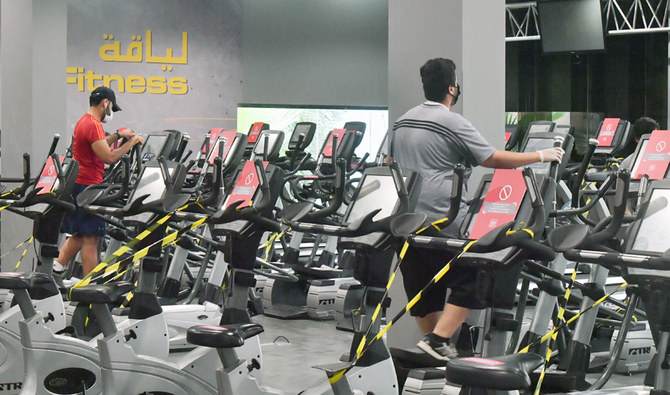
A fitness center in Hail. Coaches and gym owners across the Kingdom have been asked to ensure they have implemented safety measures against the spread of coronavirus disease. (SPA)
Short Url
Updated 23 June 2020
Follow

On your marks: Saudi gyms gear up to welcome back fitness buffs

  • Sports Ministry’s announcement about reopening fitness centers delights coaches and gym-goers
  • COVID-19 has taught me to be adaptive and now a lot of people are preferring online training in the beginning of their journeys

JEDDAH: Many businesses including gyms have resumed operations since the Kingdom lifted a nationwide coronavirus curfew on June 21, and are welcoming back those who felt their fitness fade due to months of lockdown and the difficulty of staying active at home.

The Ministry of Sports’ announcement about reopening gyms and sports centers has delighted coaches and gym-goers alike.
Waleed Al-Baloshi, a customer service operator, was concerned about the preventive protocols in place but believed it was “better to be safe than sorry.” He said he had missed every single thing about going to the gym — the community, the gym environment and pushing his limits.


“It is very difficult to keep fit at home, especially the last two to three weeks, I have really let my fitness go,” he told Arab News.
Coaches and gym owners are making efforts to ensure their safety and that of their clients.

“I am extremely excited, but I am a little anxious given that we stayed home for four months, and now everything is suddenly opening up,” Mai Kholeif, the founder and head coach of MFIT, told Arab News. “I think it is just going to take us sometime psychologically.”

She has a small home gym to stay active regardless of what the situation is, even though she enjoys the studio’s environment. “For me, personally, I always work out alone. So it was more convenient for me to stay at home because I could work out anytime I wanted and we didn’t need to physically commute back and forth.”
Kholeif said that the gym’s online classes had gained popularity during the lockdown and that this success had given her food for thought. “The past four months have been very interesting. We had online classes and we are thinking of continuing this service because, in my opinion, COVID-19 has taught me to be adaptive and now a lot of people are preferring online training in the beginning of their journeys.”
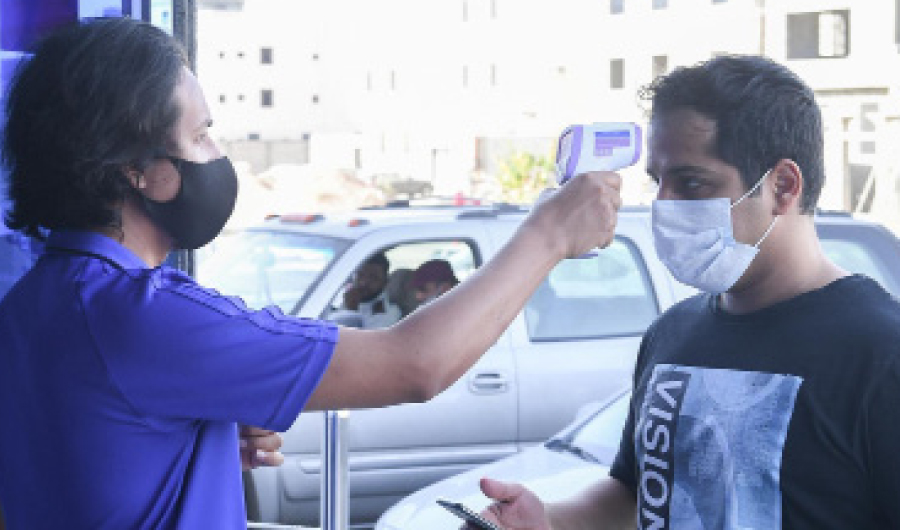
She said that the studio would implement the necessary precautionary measures as instructed by the ministry, including checking people’s temperatures and cutting class attendance by almost 50 percent. “We are working on putting markings on the floor to give people their personal space. We will disinfect the equipment after each session and preferably ask people to disinfect them, too. I can’t wait to go back, but carefully since my clients’ health and safety are my priority.”
Missing the ‘pump’
Najia Fadl, the head trainer of Jeddah’s SheFit, said that the only thing she felt upon hearing the news was a sense of relief as the lockdown had forced her to abandon her workout routine.
“I haven’t worked since the lockdown started,” she told Arab News. “It was the longest period of my professional life that I have gone without working out. Our field requires us to work and be in contact with clients. So having to go virtual (in) a very big market (was hard) and there is a lot of competition.”
Fadl, who specializes in CrossFit and calisthenics, said that going back to the gym would not be a hassle at all. “With the rules and precautions, we know what to do and what not to do. As a coach, I won’t even need to be in physical contact with people, there are verbal cues that people can follow.”
Fahd Naseem said that gyms had always been a big part of his life. While he had done his best to maintain his weight by walking four to five times a week, his muscle mass had been affected. “I can’t wait to go back to the gym and have back those few hours dedicated to my health again,” he told Arab News. “The thing I missed the most, and my fellow gym rats will agree, is ‘the pump’ after a good workout.”
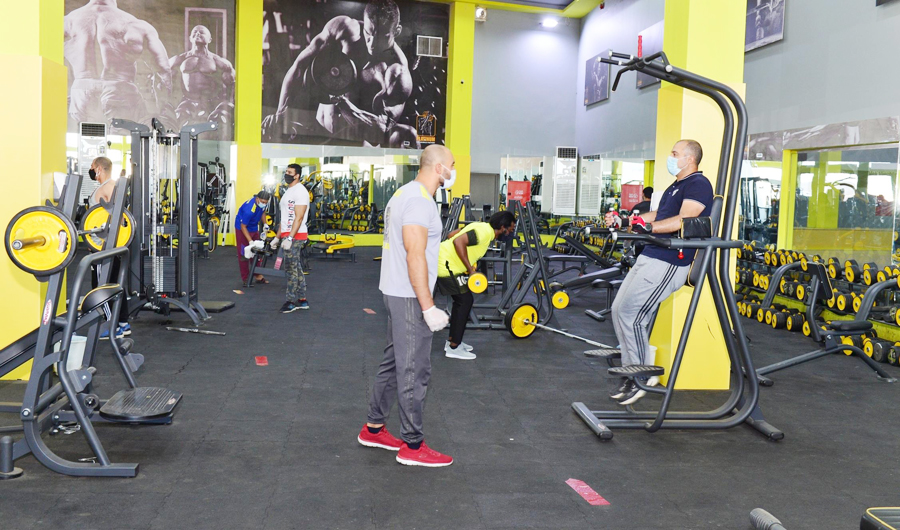
He said that he would do his best to clean the gym equipment before using it and make sure to wear a mask if he was working out next to someone else.
Reham Kamal, the founder of Jeddah’s RKfit Studio, advised people who were rejoining gyms to be more cautious than ever. “This is not like we are going back,” she told Arab News. “I feel like we are moving forward to the next stage that requires us to be more conscious to (protect) ourselves and our loved ones.”


Prince William’s visit signals ‘importance of relationship with Saudi Arabia to UK,’ ex-envoy tells Arab News

Updated 4 sec ago
Follow

Prince William’s visit signals ‘importance of relationship with Saudi Arabia to UK,’ ex-envoy tells Arab News

  • Simon Collis: ‘Saudi Arabia is the most significant Arab country, the most significant regional country, but it’s also a global power’
  • Ties between the royal families are ‘almost 100 years old’ and run at a ‘longer wavelength than the day-to-day politics’

LONDON: Prince William’s three-day visit to Saudi Arabia this week reflects deep British interest in the “expectation of an important future” with the Kingdom, a former ambassador told Arab News on Monday.

Ties between the two royal families are “almost 100 years old, and it’s the kind of relationship that runs at a sort of deeper and longer wavelength than the day-to-day politics,” said Simon Collis, ambassador to Saudi Arabia from 2015 to 2020.

“Prince William’s grandmother, the late Queen Elizabeth, visited Saudi Arabia and hosted several of the kings of Saudi Arabia on their state visits to the UK.

“King Charles, as prince of Wales, visited Saudi Arabia many times — over a dozen times — and actually his last visit came shortly after I arrived in Riyadh as ambassador.

“When Crown Prince Mohammed bin Salman visited London in 2018, he had lunch with the queen, the late queen, and dinner, and that was at Buckingham Palace. He had dinner at Clarence House with Charles as prince of Wales, and William was there at that dinner.”

Similarities between the two heirs apparent on a personal level could also spur deeper diplomatic ties, Collis said.

“They have a lot in common: environmental interests, green energy interests, a lot of the things that have expanded in Saudi Arabia over the last 10 years in particular … as the economic transformation has moved forward under Vision 2030,” he added.

“So, areas like the core (interests), which were always there — these issues like defense, security, and energy — but what has opened up as a result of the changes in Saudi Arabia much more are other areas like education, culture, healthcare, environmental issues, heritage, sports ... all of these kind of soft power issues.”

Since King Salman assumed the throne in 2015, more than a dozen UK prime ministers and foreign secretaries have come and gone, Collis said, highlighting the “continuity” that William’s royal status can bring to the bilateral relationship.

“Links between the royal families are something special, and the fact that the prince of Wales is now visiting at the request of the British government clearly sends a signal of the importance of the relationship with Saudi Arabia to the UK,” he added.

Through a little-known government body, the Royal Visits Committee, William will have been briefed on the nature of the British-Saudi relationship, and how he can use his royal leverage to develop ties with a “priority” partner, Collis said.

“All official visits by members of the British royal family involve advice from the government about the priorities.”

The RVC meets and brings together No. 10, the Foreign Office and other relevant government departments with the staff at Buckingham Palace and the other royal households.

“They review together the countries that have been visited recently, both inward and outward visits: What are the countries that are a priority for a visit? Prince William hasn’t made a lot of these visits yet … King Charles was taking the lead on that for a long time,” Collis said.

“It’s not surprising that Saudi Arabia was seen as a priority for an early visit by Prince William as prince of Wales,” he added.

“The decision to prioritize the Kingdom for a visit reflects the overall bilateral importance to each other, the regional significance of Saudi Arabia and its position as a global player, increasingly so as Vision 2030 moves forward and as the country opens up,” Collis said.

“Saudi Arabia is the most significant Arab country, the most significant regional country, but it’s also a global power; it’s one of what people call the middle powers.

“Its views — not just on regional issues but on the global agenda, climate change, security, all of these global issues — matter.”

The pace of change in Saudi Arabia is so fast that Western observers are still playing catch-up, Collis said.

The direction of travel between the two countries means that although differences in traditions may exist, “values have certainly become closer than they were historically,” he added.

“When I arrived here (in 2015), there were religious police still on the streets, music in public places was banned and women were under the guardianship system ... The Western headline was always ‘they can’t drive.’ Women couldn’t travel, they couldn’t get a job, they couldn’t even access healthcare without the approval of a male guardian.

“Under the leadership of King Salman and of the crown prince, all of that has changed; it’s been completely transformed.”

The individual and personal nature of the visit presents an opportunity to help the two peoples develop their mutual interests, Collis said, highlighting the popularity of the UK as a destination for Saudi university students.

“You (also) see that in the growing number of British companies entering Riyadh, putting their regional headquarters in Riyadh,” he added.

“You can see that movement happening in so many ways across so many sectors. I think this visit is an opportunity to recognize, celebrate and draw attention to all of that.”