

Arrests of Lebanese activists continue

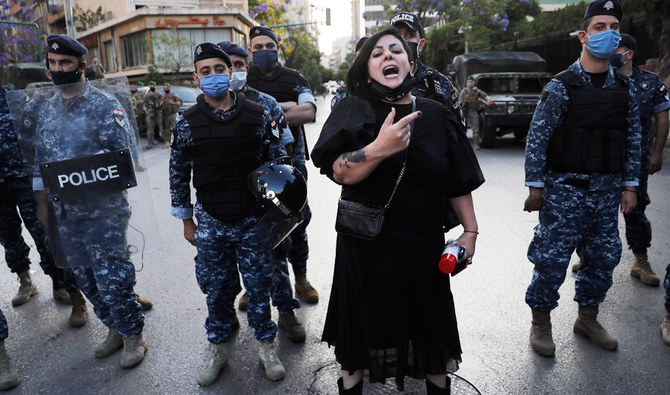
An anti-government protester shouts slogans in front of riot policemen during a protest in Beirut, Lebanon, Friday, May 29, 2020. (AP)
Short Url
Updated 20 June 2020
Follow

Arrests of Lebanese activists continue

  • Crackdown decried as assault on freedom of expression amid mounting criticism of govt

BEIRUT: An increasing number of activists in Lebanon are being arrested amid mounting criticism on social media of the government’s handling of the country’s worsening economy.

In the latest such incident, activist Michel Chamoun was arrested on Thursday by state security for writing comments on social media that were deemed humiliating to President Michel Aoun.

Dozens of protesters blocked the main road linking Beirut to Jbeil and Tripoli, demanding the immediate release of Chamoun and chanting slogans and insults against Aoun and Free Patriotic Movement leader Gebran Bassil.

This led to clashes with security forces before army commandos and military police intervened. An army officer and a number of protesters were injured.

On Thursday evening, Chamoun was released after Melhem Khalaf, head of the Beirut Bar Association, intervened.

Chamoun said he was released due to pressure from the protesters, and prior to his release he had “to sign a pledge not to insult the president of the republic anymore.” But he insisted: “I will criticize anyone I want as we live in a democratic republic.”

After his release, Chamoun headed with Khalaf to join the protesters on Jounieh highway. Then the protesters opened the road for traffic.

Lawyer Hassan Bazzi, a member of the Lawyers’ Committee to Defend Protesters in Lebanon, told Arab News: “Freedom of expression in Lebanon is sacred, as stressed by the Bar Association. It’s protected by the Lebanese constitution.”

But, he said, “what activists on social media don’t know is that there are limits to criticism, and the law forbids insulting the president of the republic.”

Bazzi added: “People can no longer stand the pressure they live under due to the dire financial and economic situation, which has made them lose faith in the country.”

FASTFACT

Dozens of protesters blocked the main road linking Beirut to Jbeil and Tripoli, chanting slogans and insults against President Aoun and Free Patriotic Movement leader Gebran Bassil.

It is “unacceptable for the political authority to try to intimidate activists, or to threaten them with arrest unless they delete their comments,” he said.

“This is something to be done only upon a ruling by a judge upon the request of the public prosecutor. However, all security agencies try to intimidate opponents.”

The whereabouts of activist Kinda Khatib and her brother Bandar are still unknown after she was arrested by state security for publishing comments on social media. A campaign was launched on social media accusing her of being an Israeli agent.

“In Lebanon, whoever insults the president is sentenced to two years’ imprisonment, while whoever insults God Almighty is sentenced to only one year in prison,” said Bazzi.

“Parliament doesn’t intend to amend these laws for it runs against the interests of the political authority, which fears the mounting criticism of the people and protests on the streets.”

Communication officer of the Samir Kassir Foundation Jad Shahrour said during the last three years, repression in Lebanon has increased and public freedoms have diminished, especially after the demonstrations that erupted in October 2019.

“There were more than 95 violations of the rights of media professionals and activists, including 18 cases that were referred to court trial,” he added.

“This aims to make people aware that whoever expresses something that might annoy the political authority would be subject to arrest and interrogation.”

The law on freedom of expression “is more than 30 years old, and doesn’t take into consideration that concepts and values have changed, and that methods of expression have evolved,” Shahrour said. “Yet the state is seizing the opportunity to proceed with its oppression.”


Inaction over UAE’s role is prolonging ‘worst proxy war in the world,’ Sudan justice minister says

Updated 58 min 44 sec ago
Follow

Inaction over UAE’s role is prolonging ‘worst proxy war in the world,’ Sudan justice minister says

  • Had international community characterized it as ‘military rebellion’ and countered Emirati sponsorship of ‘terrorist militia’ it would not have endured, he tells UN Human Rights Council
  • He accuses paramilitary Rapid Support forces of ‘targeting basic infrastructure, strategic facilities and public services,’ and ‘atrocities beyond our capacity to describe’

NEW YORK CITY: Sudan’s justice minister on Wednesday blamed the prolongation of the near-three-year conflict in his country on what he described as the failure of the international community to properly label the war as a rebellion.

He also accused the UAE of sponsoring and arming a militia, the Rapid Support Forces, he said was responsible for widespread abuses.

“The war has outstayed its welcome and it should not have gone on for this long had the international community, and particularly the UN and its bodies, fulfilled their responsibility in rightly characterizing this military rebellion,” said Abdullah Mohammed Dirif, “and had they called a spade a spade and countered the Abu Dhabi government, which sponsored this terrorist militia and provided it with high-tech arms and provided it with mercenaries.”

Speaking during the high-level segment of the 61st session of the UN Human Rights Council in Geneva, he warned that “the misleading characterization of this war has given a green light for the militia to keep its flagrant violations.”

The minister, who said he was speaking “on behalf of the government of Sudan and its people,” described the conflict between the Sudanese Armed Forces and the RSF, which began in April 2023, as “one of the worst proxy wars in the world,” which had “targeted the very existence of Sudan and its people.”

The RSF has “continued its methodic targeting of basic infrastructure and strategic facilities and all public services,” Dirif said, adding that “the aim is to displace civilians against whom it has committed atrocities beyond our capacity to describe them.

“The violations and crimes of the militia are going unabated. Yesterday it invaded Moustahiliya region in northern Darfur. It targeted civilians, killed them. It looted. It scorched villages and cities.”

Sudan’s military was “conducting its constitutional responsibility by standing up to the militia, protecting the civilians, preserving the unity of the country and the rule of law,” he said, and it remains “committed to international humanitarian law and the rules governing military engagement, and taking into account proportionality principles in order to protect civilians.”

Khartoum remains “open to genuine efforts which aim to end the war and the rebellion” based on a road map presented by the president of the Transitional Sovereignty Council, and a peace initiative submitted by the prime minister to the UN Security Council on Dec. 22, he added.

Dirif stressed his government’s commitment to continued “cooperation and coordination with human rights mechanisms in Sudan,” including the presence of the UN’s Office of the High Commissioner for Human Rights in the country and the UN special rapporteur on the human rights situation in Sudan.

“We recall, nationally, that achieving justice and redress to victims and ensuring impunity is a top priority for us,” he said, adding that authorities had made progress by investigating violations of national laws and international humanitarian laws.

He also underscored Sudan’s “commitment to continue facilitating and expediting delivery of humanitarian assistance to those affected by the war, including those under the control of the rebellious militia.”

Later, Sudan’s representative to the UN in Geneva exercised his right of reply and responded to prior remarks by the representative from the UAE.

“This is not a mere accusation, it is a well-known fact that is predicated on a number of evidence and documented proofs,” he said, referring to the UAE’s sponsorship of the RSF.

He cited in particular a report by a UN panel of experts on Sudan published on Jan. 15, 2024, which he described as “an official document of the Security Council” that referred to “lines of transferring weapons from Abu Dhabi International Airport” based on “clear-cut evidence.”

Other major international organizations and Sudan’s national commission of inquiry have provided further proof, he added, and Khartoum had submitted “a number of complaints, with proof, to the Security Council of the proven sabotage by the Abu Dhabi authority.”

The Sudanese representative continued: “It is paradoxical that the same authority that is sponsoring criminal militia, that the whole world is seeing and is attesting to its crimes, is now talking about peace in the Sudan. Peace is a noble value, that you have to be full of peace before you talk about it.

“The people of Sudan are only requesting this country stop sponsoring this criminal militia that is killing the innocent people in my country on a daily basis.”

The UAE has denied accusations that it provides military support to armed groups in Sudan, and says it supports efforts to achieve a peaceful resolution to the conflict.