From the horror of Aleppo to the UK’s COVID-19 front line — a Syrian doctor’s journey

1 / 4
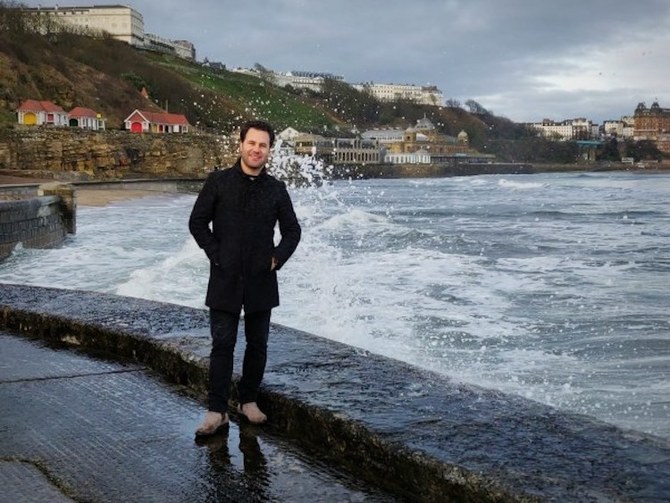
Dr. Mohamad Kajouj is one of a number of refugees working in British hospitals during the coronavirus pandemic. (Courtesy Mohamad Kajouj)
2 / 4
Mohamad’s only choice after fleeing Syria was to travel from Turkey to Greece in a rubber dinghy. (Courtesy Mohamad Kajouj)
3 / 4
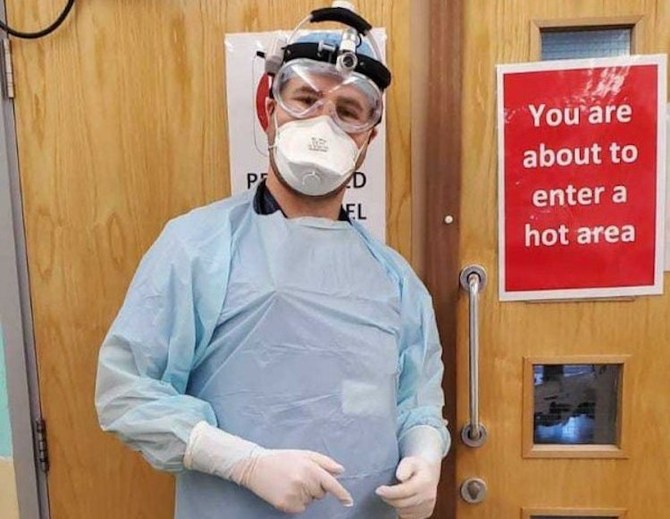
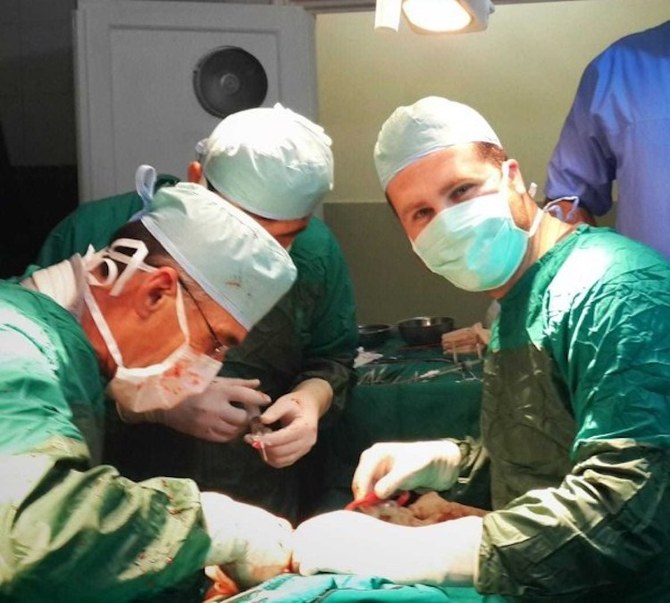
Dr. Mohamad Kajouj is one of a number of refugees working in British hospitals during the coronavirus pandemic. (Courtesy Mohamad Kajouj)
4 / 4
Dr. Mohamad Kajouj is one of a number of refugees working in British hospitals during the coronavirus pandemic. (Courtesy Mohamad Kajouj)
Short Url
Updated 22 June 2020
Follow

From the horror of Aleppo to the UK’s COVID-19 front line — a Syrian doctor’s journey

  • A refugee who experienced the horrors of Aleppo is now fighting on the UK’s COVID-19 frontline
  • Granted asylum in Britain despite not speaking English, the young doctor set about rebuilding his medical career

LONDON: Six years ago, Dr. Mohamad Kajouj was working in a war zone, treating the horrific injuries of Syrian civilians. Today he finds himself on another front line — helping UK hospitals in the struggle to save COVID-19 victims.
Kajouj’s journey, in which he fled his war-ravaged home country, and reached Greece on a rubber raft is nothing short of incredible. But it didn’t end when he arrived in Europe.
Granted asylum in Britain despite not speaking English, the young doctor set about rebuilding his medical career.
He is one of a number of refugees working in British hospitals during the coronavirus pandemic. After the traumas that he witnessed, he can go about his work with a cool head and steady hand.
Originally from the city of Hama, he was in his fifth year as a medical student in Aleppo when the war in Syria started in 2011.
As the fighting intensified in 2012, Aleppo, once Syria’s main commercial hub, became divided between rebel and regime control. Kajouj, who was working as a junior resident in private hospitals in the government-held areas, was shocked at the suffering of civilians on the rebel side at the hands of President Bashar Assad’s forces, and took a decision that would change his life.
“All doctors in the rebel-held areas ran away and a lot of people were getting injured, so I decided I’m going to stand with those people and help them as much as I can,” he said.
“The Syrian government wasn’t happy for doctors to work for the other side and they were questioning, investigating and arresting them.”
By 2014, the situation in the city deteriorated rapidly. Rebel-held Aleppo was under heavy shelling with whole neighborhoods being destroyed, and the hospital where Kajouj worked was flooded with casualties.
Kajouj fled Syria in 2014 for Turkey, where he worked for Médecins Sans Frontières (Doctors Without Borders) along the Syrian/Turkish border, before taking the dangerous journey to Greece in a five meter-long rubber dinghy packed with more than 40 people.
“Some people had panic attacks, shouting and screaming, so reassurance was helpful, but it was a very stressful situation, very dangerous. Every time there were any high waves in the sea, everyone would get very panicked and stressed,” he said.
Kajouj was able to help some of the refugees on board, but he was also concerned that if the boat were to sink, he would lose his only valued possessions — his documents.
Kajouj studied medicine in Arabic, and also in German, although when he was granted asylum in the UK in 2015 he did not speak English. With the help of Refugee and Asylum Seekers Center for Healthcare Professionals Education (REACHE) North West, Kajouj was able to enter a program to prepare for his exams and, subsequently, job interviews.
He passed the International English Language Testing System (IELTS) exam and qualified with distinction for his medical degree in English in less than a year — something that would normally take more than two years to accomplish.
Kajouj has been working at York Teaching Hospital NHS Foundation Trust, in the north of England, as an Ear Nose and Throat (ENT) specialist and resident surgeon since March 2019.
When the COVID-19 outbreak escalated and his regular appointments were put on hold, Kajouj volunteered to work in the accident and emergency department.
His specialism now places him at the forefront of the coronavirus pandemic, something for which he is well prepared after working in a war zone.
“When I compare Syria to the UK, I can tell the huge difference between the two health care systems,” the 30-year-old ENT specialist told Arab News. “I worked in Syria during the war and there was no means of personal protective equipment (PPE); there was a huge lack of medications.”
However, the UK’s National Health Service has been stretched by the crisis, with nurses and doctors losing their lives to the disease and hospitals suffering a lack of PPE.
The UK is a “great country … considered one of the best countries around the world, in terms of quality of life, and the quality of care,” Kajouj said. “It was surprising to me by not being able to provide PPE in the right time for all the medical staff.”
“ENT is a risky specialty because you get the maximum exposure of droplets, saliva and patient secretions, so we stopped examining patients throats and we moved to treating, depending on symptoms, rather than examinations, because of the lack of PPE,” Kajouj said.
Kajouj described the UK’s response to the pandemic as “delayed” and said that action should have been taken a week or two earlier.
Kajouj is now in a better situation than he could possibly have imagined when he was witnessing the horrors of the Syria conflict.
His family back in Aleppo are happy he is safe, and he is grateful for the support he received from the medical community. While he misses his home country, he plans to continue working in the UK.
“I feel like I have a lot of duties to this country, because of the way I was treated here, it’s much better than the way I was treated in my country as a doctor.”
“Anyone would like to go back to their home, regardless of the situation,” he said. “It is not safe at the moment, but that doesn’t mean I don’t want to go back to Syria anymore. I would love to see Syria as a safe country one day, sooner rather than later, and by the time it becomes a safe country, it’s a big decision that I need to take.”


Rising energy prices from the Iran war could help Russia pay for fighting in Ukraine

Updated 8 sec ago
Follow

Rising energy prices from the Iran war could help Russia pay for fighting in Ukraine

  • Prices for Russia’s oil exports have risen from under $40 per barrel as recently as December to about $62 per barrel
  • The halt in production of ship-borne liquefied natural gas, or LNG, by major supplier Qatar will sharply increase global competition for available cargoes — including those from Russia

FRANKFURT: The Iran war’s disruption of Middle East oil and gas supplies and soaring prices are strengthening Russia’s ability to profit from its energy exports, a pillar of the Kremlin’s budget and a key to paying for its own war in Ukraine.
Prices for Russia’s oil exports have risen from under $40 per barrel as recently as December to about $62 per barrel — first on fears of war and then due to interruption of almost all tanker traffic through the Strait of Hormuz, the conduit for some 20 percent of the world’s oil consumption.
Russian oil still trades at a considerable discount to international benchmark Brent crude, which has risen above $82 from the closing price of $72.87 on Friday, the eve of the attack on Iran by the US and Israel. However, Russian crude is now above the benchmark of $59 per barrel that was assumed in the Russian Finance Ministry’s budget plan for 2026. Oil and gas tax revenues account for up to 30 percent of the Russian federal budget.
Additionally, the halt in production of ship-borne liquefied natural gas, or LNG, by major supplier Qatar will sharply increase global competition for available cargoes — including those from Russia.
A change in fortunes
Russia had seen state oil and gas revenue fall to a four-year low of 393 billion rubles ($5 billion) in January and the budget shortfall of 1.7 trillion rubles ($21.8 billion) for that month was the biggest on record, according to Finance Ministry figures.
The lower revenue was due to weaker global prices and to deep discounts fueled by US and European Union hindrance of Russia’s “shadow fleet” of tankers with obscure ownership used sell oil to its biggest customers, China and India, in defiance of a Western-imposed price cap and sanctions on Russia’s two biggest oil companies, Lukoil and Rosneft.
Economic growth has stagnated as massive military spending has leveled off. President Vladimir Putin has resorted to tax increases and increased borrowing from compliant domestic banks to keep state finances on an even keel in the fifth year of the war.
“Russia is a big winner from the war-related energy turmoil,” said Simone Tagliapietra, energy expert at the Bruegel think tank in Brussels. “Higher oil prices mean higher revenues for the government and therefore stronger capability to finance the war in Ukraine.”
Amena Bakr, head of Middle East and OPEC+ insights at data and analytics firm Kpler, writes: “With Middle East barrels facing logistical disruption, both India and China face strong incentives to deepen reliance on Russian supply.”
Additionally, the price of future delivery of natural gas has skyrocketed in Europe, raising questions about EU plans to put an end to imports of Russian LNG by 2027 — reviving bad memories of a 2022 energy crunch after Moscow cut off most supplies of pipeline gas due to the war.
Length of strait’s closure is the key factor
Much depends on how long the Strait of Hormuz remains closed to most ship traffic, said Alexandra Prokopenko, an expert on the Russian economy at the Carnegie Russia Eurasia Center in Berlin.
A quick exit from the conflict would return Brent prices to roughly $65 per barrel and “a short-lived spike would not fundamentally change” Russia’s budget picture, she said. A middle scenario in which some shipping resumes and oil stabilizes at around $80 per barrel would give Russia “some fiscal relief,” depending on how long the higher prices last.
A long-term closure with Iranian strikes damaging refineries and pipelines could send oil to $108 per barrel, accelerate inflation and push Europe to the edge of recession. “This scenario would bring the largest windfall to Russia,” she said.
Even several weeks of interruption in Gulf LNG could lead to calls in Europe to suspend plans to ban new Russian supply contracts after April 25, said Chris Weafer, CEO of Macro-Advisory Ltd. consultancy.
“The EU is under even more pressure to work with the US to find a solution to the Ukraine conflict and, very likely, to consider easing the plan for a total block for Russian oil and gas imports,” he said. “Countries such as Hungary and Slovakia and those who have been big buyers of Russian LNG, will press for that review.”
In any case “the Russian federal budget will have a much better result in March,” Weafer said, due to lower discounts on Russian oil and “because there are eager buyers of Russian oil and oil products.”
Putin says European leaders have only themselves to blame
Putin said European governments were to blame for their energy predicament.
“What is happening today on the European markets, is, of course, above all the result of the mistaken policies of European governments in the energy sphere,” Putin said Wednesday on state TV.
He said that “maybe it would be more beneficial for us to halt (gas) supplies now to the European market, and leave for the markets that are opening and get established there,” adding that “it’s not a decision, but in this case what’s called ‘thinking out loud.’”
Putin said he would have the government to look into the issue.
Russia’s Deputy Prime Minister Alexander Novak said Wednesday that Russian oil was “in demand” and that Russia was ready to increase supplies to China and India, the Tass news agency reported.
The head of Russia’s sovereign wealth fund, Kirill Dmitriev, took a dig at European Commission President Ursula von der Leyen and EU foreign policy chief Kaja Kallas, writing on X that “surely the wise Ursula and Kaja have a backup LNG plan. Or maybe not.”
Belgium, France, the Netherlands and Spain have continued to import around 2 billion cubic meters of Russian LNG per month, and on top of that Hungary imports 2 billion cubic meters a month through the Turkstream pipeline across the Black Sea, Tagliapietra said. That would amount to 45 billion cubic meters in 2026, 15 percent of total gas demand for this year.
It’s “not easy to replace this in case the LNG market gets tighter with continued shutdowns in Qatar,” he said.