

Pakistan’s mango exports down 15% as coronavirus shrinks demand 

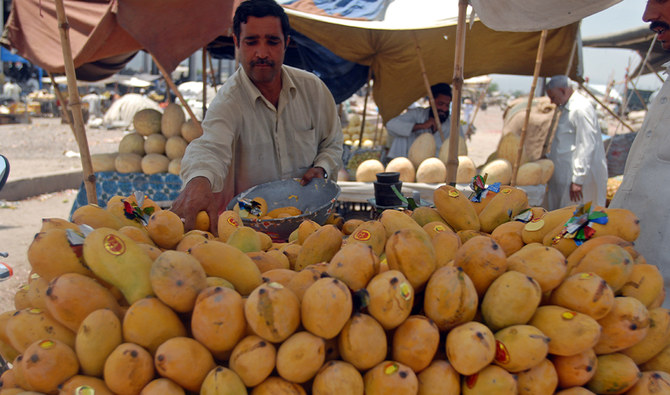
A Pakistani fruit vendor sells mangos in a main fruit market in Islamabad on July 4, 2009. (AFP)
Short Url
Updated 18 June 2020
Follow

Pakistan’s mango exports down 15% as coronavirus shrinks demand 

  • Suspension of international flights, restrictions on border movement, rising freight charges amid the virus outbreak hit exports
  • Exporters fear 40 percent decline in total mango exports by end of season, export revenue expected to decline from $90 million to $50 million 

KARACHI: Pakistani producers of mangoes have been hit by falling international demand amid the coronavirus pandemic, an industry representative said on Wednesday, as exports of the ‘king of fruits’ declined by 15 percent as of mid-June.
Pakistan is the fifth-largest producer and third-largest exporter of mangoes in the world. On Wednesday, the country had upwards of 150,000 confirmed coronavirus cases. 
“So far around 20,000 containers of mango have crossed the country’s frontiers, which is 15 percent lower compared to last year,” Waheed Ahmed, the patron-in-chief of the All Pakistan Fruit and Vegetable Exporters, Importers and Merchants Association, told Arab News. 
The export of Pakistan’s mangoes started on May 20 this year and exporters fear there could be a 40 percent decline in total exports by the time the season comes to an end. 
“The export target is limited this year keeping in view the current situation,” Ahmed said. “The export target of the mango is set at 80,000 metric ton as compared to 130,000 ton of last year. Export revenue generated through the mango export was $90 million, which is feared will decline to $50 million this year.”
Suspension of international flights, restrictions on movement on the Iran and Afghanistan borders, rising freight charges and shrinking demand globally are some of the reasons for lower exports, industry experts say. 
“The demand world over is not normal as people don’t go to the markets as often as they used to, which is one of the reasons behind demand contraction,” Ahmed said.
Exporters say airlines which were charging freight charges of Rs175 per kilo last year are now charging Rs565 per kilo for exports to Europe, while the freight charge of Rs80 per kilo to Gulf countries has increased to Rs240 per kilo. 
“We are negotiating with the government to cut freight charges to a reasonable level and facilitate speedy exports at borders,” Ahmed said. 
Another problem is the availability of workers due to a climate of fear and as coronavirus lockdowns have led to restrictions in movement in many parts of the country.
“Laborers fear coming to the farms to pick and package fruits and vegetables due to the coronavirus,” said Malik Asghar, the president of the Fruit Association of Punjab. “Our crops are ready but due to shortage of laborers, growers have wasted their ready crops, causing them huge financial losses.”
Pakistan’s mango crop production is also expected to suffer a blow his year due to climate change.
“This year the cold spell persisted longer than usual which has impacted the production of the mango, particularly of the Sindhari variety in Punjab,” said Dr. Hameed Ullah, the director of the Mango Research Institute.

“Though final figures will be known after the end of season, it is estimated that production would be around 1.5 million tons as compared to 1.8 million tons last year.
He said the coronavirus outbreak had also seriously affected the marketing and export of mangoes to Iran, a major market of the Pakistani mango. 
Pakistan exports between 30,000-35000 metric tons of mangoes annually to its neighbors Iran and Afghanistan.


Pakistan killed over 80 militants in strikes on TTP camps in Afghanistan — official

Updated 29 min 55 sec ago
Follow

Pakistan killed over 80 militants in strikes on TTP camps in Afghanistan — official

  • Saturday’s airstrikes followed a series of attacks inside Pakistan amid a surge in militancy
  • The Afghan Taliban authorities accuse Pakistani forces of killing civilians in the airstrikes

ISLAMABAD: Pakistan’s airstrikes in Afghanistan destroyed seven Tehreek-e-Taliban Pakistan (TTP) camps and killed over 80 militants, a Pakistani security official said on Sunday, with the Afghan Taliban accusing Pakistani forces of killing civilians in the assault.

Saturday’s airstrikes followed a series of attacks inside Pakistan amid a surge in militancy. Authorities say the attacks, particularly in Khyber Pakhtunkhwa province and the Pakistani capital of Islamabad, were carried out by the TTP and allied groups that Islamabad alleges are operating from sanctuaries in Afghanistan. Kabul denies this.

According to Pakistan’s information ministry, recent incidents included a suicide bombing at a Shiite mosque in Islamabad, separate attacks in Bajaur and Bannu, and another recent incident in Bannu during the holy month of Ramadan, which started earlier this week. The government said it had “conclusive evidence” linking the attacks to militants directed by leadership based in Afghanistan.

“Last night, Pakistan’s intelligence-based air strikes destroyed seven centers of Fitna Al-Khawarij TTP in three provinces of Nangarhar, Paktika and Khost, in which more than eighty Khawarij (TTP militants) have been confirmed killed, while more are expected,” a Pakistani security official, who spoke on condition of anonymity, told Arab News.

An earlier statement from Pakistan’s information ministry said the targets included a camp of a Daesh regional affiliate, the Islamic State Khorasan Province (ISKP), which claimed a suicide bombing at an Islamabad Shiite mosque that killed 32 people this month.

In an X post, Afghan government spokesperson Zabihullah Mujahid said Pakistani forces had violated Afghan territory.

“Pakistani special military circles have once again trespassed into Afghan territory,” Mujahid said. “Last night, they bombed our civilian compatriots in Nangarhar and Paktika provinces, martyring and wounding dozens of people, including women and children.”
 
The Afghan Taliban’s claims of civilian casualties could not be independently verified. Pakistan did not immediately comment on the allegation that civilians had been killed in the strikes.

In a post on X, Afghanistan’s foreign ministry said it had summoned Pakistan’s charge d’affaires to Afghanistan Ubaid-ur-Rehman Nizamani and lodged protest through a formal démarche in response to the Pakistani military strikes.

“IEA-MoFA (The Islamic Emirate of Afghanistan’s Ministry of Foreign Affairs) vehemently condemns the violation of Afghanistan’s airspace and the targeting of civilians, describing it as a flagrant breach of Afghanistan’s territorial integrity & a provocative action,” it said in a statement.

“The Pakistani side was also categorically informed that safeguarding Afghanistan’s territorial integrity is the religious responsibility of the Islamic Emirate of Afghanistan; henceforth, the responsibility for any adverse consequences of such actions will rest with the opposing side.”

Tensions between Islamabad and Kabul have escalated since the Afghan Taliban returned to power in 2021. Pakistan says cross-border militant attacks have increased since then and has accused the Taliban of failing to honor commitments under the 2020 Doha Agreement to prevent Afghan soil from being used for attacks against other countries. The Taliban deny allowing such activity and have previously rejected similar accusations.

Saturday’s exchange of accusations marks one of the most direct confrontations between the two neighbors in recent months and risks further straining already fragile ties along the volatile border.