

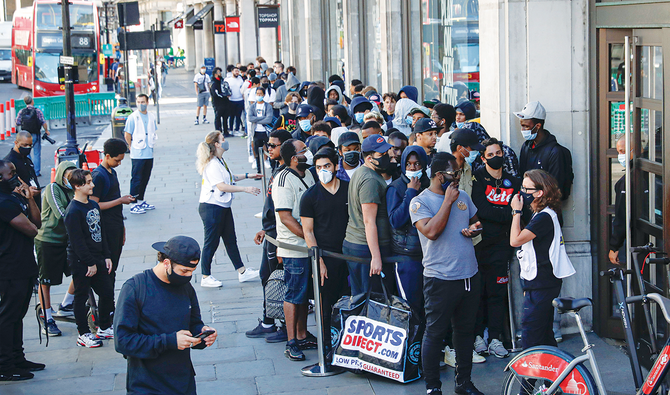

LONDON: Large queues formed outside shops across England on Monday as they opened their doors to customers for the first time in nearly three months after coronavirus lockdown measures were eased.
In London, crowds congregated outside the Nike store on Oxford Street, while Primark clothing stores in major cities such as Birmingham and Liverpool also saw long lines.
“I’m happy to be able to shop again after all this time,” said Precious, an 18-year-old student.
Visitors also returned to zoos and safari parks, places of worship were open again for private prayers, and some secondary school pupils returned to the classroom.
In the capital, commuters were forced to cover their faces on public transport network, while budget airline easyJet took off again for its first flights in 11 weeks.
Britain’s government has adopted a cautious approach to reopening but hopes that retail spending will boost the economy, with predictions of a recession looming.
Finance Minister Rishi Sunak acknowledged anxieties, after a recent survey suggested just 40 percent of people were comfortable about going back into stores.
“It’s a slightly different experience,” he said on Sunday. “But it is a safe environment and we should all be able to go out knowing that we should be able to shop in confidence.”
Prime Minister Boris Johnson, touring a shopping center in east London on Sunday, said people should “shop, and shop with confidence.”
All sites are having to comply with social distancing rules, which require people to keep at least two meters apart, and wear face coverings when indoors.
Stickers reminding people of the rules to keep apart have been placed on pavements, footpaths widened, and streets cleaned.
Inside stores, layouts have been reconfigured to keep people apart, including restrictions on using changing rooms.
Masks and hand sanitizer have been made available, perspex screens put up at tills, and many outlets have insisted on no cash, to help reduce the risk of close-contact transmission.
Thelma Brennan, 60, emerged from Primark on Oxford Street laden with bags of summer clothes for her grandchildren.
“It’s fine. You have to queue,” she said but once inside, “you can circulate.”
But Alexander Hoyte, 31, said he was not happy at having to wait in such a large crowd to buy a new pair of Nike trainers — and they were sold out of his size.
“After so long being in lockdown, you allow people to queue, anyone can catch the virus like that,” he added.
Shops in Northern Ireland reopened on Friday. The devolved administrations in Scotland and Wales have not yet decided when to follow suit.
The nonessential retail sector employs some 1.3 million people and contributes £46.6 billion ($58.4 billion) to the British economy every year.
But last week, official data showed the economy shrank by a fifth in size because of stay-at-home measures imposed on March 23.
Nearly 42,000 people have died after testing positive for COVID-19 in Britain, a number third only to the US and Brazil in the global pandemic.
But the toll is coming down, and on Sunday the government reported only 36 deaths in 24 hours — the lowest total since March 21.
Getting Britain back on track is seen as vital for Johnson and his government, which has been repeatedly criticized for its handling of the outbreak.
The phased reopening in England started with outdoor markets and car showrooms earlier this month, and some younger children returned to school.
Pubs, bars and restaurants are expected to reopen from July 4.
Ministers have faced criticism for failing to ensure that all primary school children return before the summer break in July, and pressure about relaxing the two-meter rule.
Business leaders want the distance reduced in line with other countries.
Johnson said the situation would be kept under review but said he did not want to jeopardize gains made in tackling the virus.


