

Pakistan and Bangladesh air force veteran who fought in Jordan and Iraq passes away

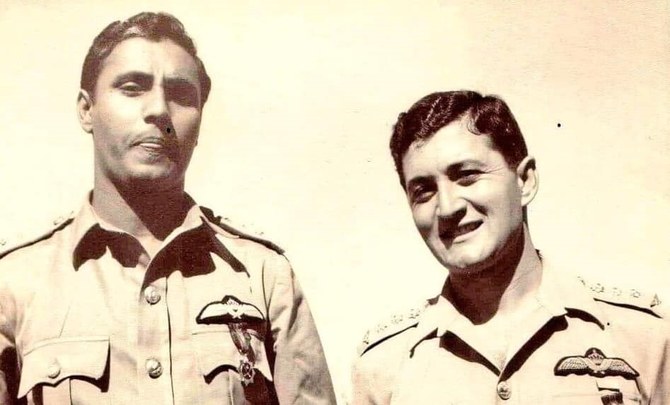
Group Captain (Retd.) Saif-ul-Azam (left) who served in the air forces of both Pakistan (from 1960 to 1971) and Bangladesh (from 1971 to 1979). (Photo courtesy: Social Media)
Short Url
Updated 15 June 2020
Follow

Pakistan and Bangladesh air force veteran who fought in Jordan and Iraq passes away

  • Group Captain (Retd) Saif-ul-Azam had served both the Pakistan and Bangladesh air forces and died in a Dhaka hospital on Sunday
  • He had fought in four wars in Pakistan, Bangladesh, Jordan and Iraq and shot down three Israeli aircraft during the 1967 Arab-Israel war

ISLAMABAD: The chief of the Pakistan Air Force chief, Mujahid Anwar Khan, on Monday paid tribute to Group Captain (Retd) Saif-ul-Azam who had served in both the Pakistan and Bangladesh air forces during an illustrious career and died in a Dhaka hospital on Sunday.
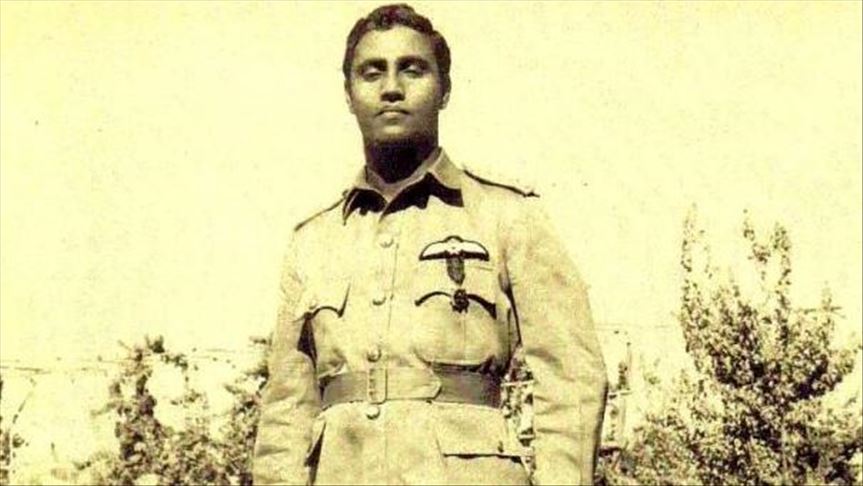


Group Captain (Retd.) Saif-ul-Azam who served in the air forces of both Pakistan (from 1960 to 1971) and Bangladesh (from 1971 to 1979). (Photo Courtesy: Social Media)

Bangladesh used to be part of Pakistan and was formerly known as East Pakistan, after the end of British colonial rule in 1947. But nationalists led a successful war of independence from what was then West Pakistan in 1971, when East Pakistan became an independent nation called Bangladesh.
“While paying rich tributes to Group Captain (Retd.) Saif-ul-Azam, the air chief acknowledged his heroic deeds during the 1965 Indo-Pak and 1967 Arab-Israel wars,” the Pakistan Air Force (PAF) said in a statement on Monday.
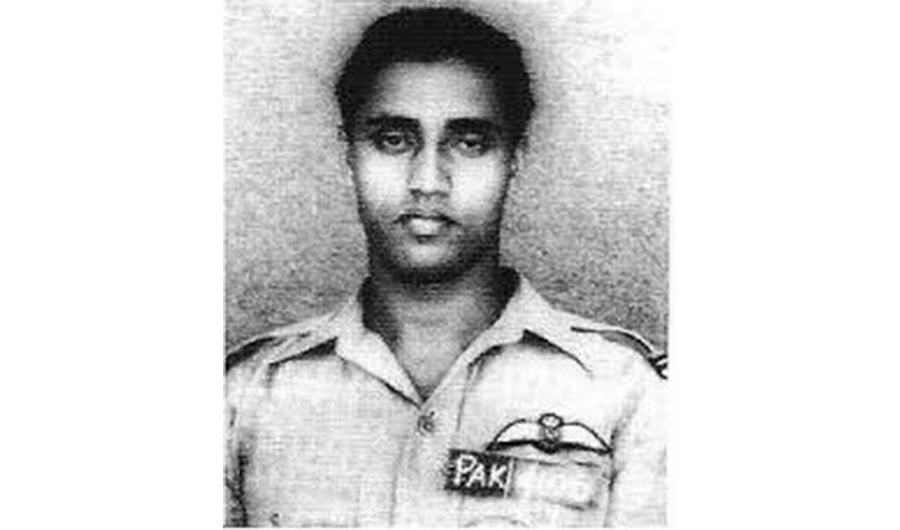


 An undated photo of Group Captain (Retd.) Saif-ul-Azam who served in the air forces of both Pakistan (from 1960 to 1971) and Bangladesh (from 1971 to 1979). (Photo courtesy: Pakistan Air Force)

The legendary fighter pilot came to global attention when he shot down three Israeli aircraft during the 1967 Arab-Israel war. He was the only fighter pilot in the world to destroy fighter jets of both India and Israel and who had fought in wars in Jordan and Iraq.
“In recognition of his heroic contributions he was honored with military awards by the governments of Jordan and Iraq,” the statement said, in addition to receiving the “Living Eagle” title from the United States government in 2001.
Born in 1941 in the Pabna District of East Bengal, Azam was commissioned as a fighter pilot in October 1960 and served in the No.17 Squadron at the PAF base in Sargodha during the 1965 war.
“Apart from inflicting heavy damage to Indian forces in the 12 ground-attack missions, Azam also had one IAF (Indian Air Force) aircraft kill to his credit as well,” the statement added.
For his courage and devotion to duty during the 1965 war, Azam was honored with the “Sitara-i-Jura’at” (Star of courage) award by the Pakistan government. He is survived by his wife and their three children.


Pakistan’s Balochistan establishes threat assessment center amid surge in militant attacks

Updated 14 sec ago
Follow

Pakistan’s Balochistan establishes threat assessment center amid surge in militant attacks

  • Provincial Intelligence Fusion and Threat Assessment Center brings police, CTD, intelligence agencies together on one platform, says official
  • Says center helps disrupt terror financing, narcotics trafficking, organized crime and enables action against unregulated communication networks

ISLAMABAD: The government in Pakistan’s southwestern Balochistan province has established a state-of-the-art threat assessment center to strengthen early warning and prevention against “terrorism” incidents, a senior official said on Monday amid a surge in militant attacks recently. 

Balochistan Additional Chief Secretary Hamza Shafqaat wrote on social media platform X that the Provincial Intelligence Fusion and Threat Assessment Center (PIFTAC Balochistan) brings police, the counter-terrorism department (CTD), intelligence agencies and civil administration together on one platform for real-time information sharing and joint analysis. 

“PIFTAC strengthens early warning and prevention against terrorism, helps disrupt terror financing, narcotics trafficking, and organized crime, and enables coordinated action against illegal spectrum and unregulated communication networks,” he wrote.

“Information that was once scattered is now shared and acted upon in time, allowing the state to move from reacting after incidents to preventing them before they occur.”

https://x.com/beyondfiles/status/2010444397163532547

The development takes place amid a steep rise in combat-related deaths in Pakistan during 2025. According to statistics released by the Pakistan Institute for Conflict and Security Studies (PICSS) last month, combat-related deaths in 2025 rose 73 percent to 3,387.

These deaths included 2,115 militants, 664 security forces personnel, 580 civilians and 28 members of pro-government peace committees, the local think tank said. 

Pakistan military spokesperson Lt. Gen. Ahmed Sharif Chaudhry last week highlighted Pakistan’s counter-terrorism efforts in 2025, saying that security forces had conducted 75,175 intelligence-based operations (IBOs) and killed 2,597 militants last year. He also said Pakistan reported 5,397 “terrorism incidents” last year. 

Pakistan frequently accuses Afghanistan of allowing militant groups, including the Tehreek-e-Taliban Pakistan (TTP) and the separatist Balochistan Liberation Army (BLA) to operate from its soil, charges Kabul has repeatedly denied.

Islamabad also accuses India of backing these militant groups against Pakistan. New Delhi rejects the allegations.