

Mass virus testing in Beijing after new cluster triggers lockdowns

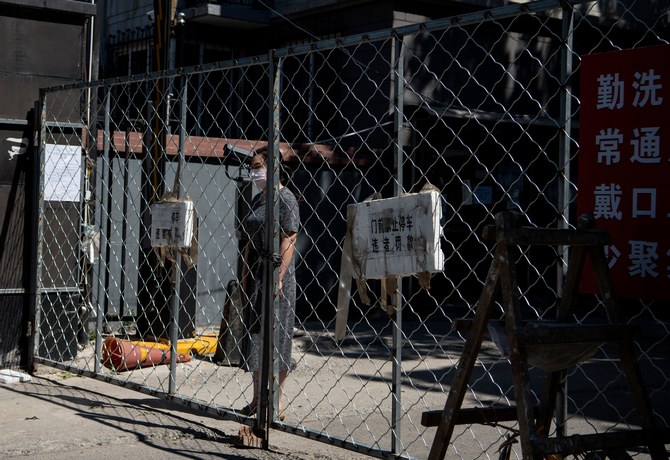
A woman stands behind a fence in the Yilanyuan residential area which is under lockdown after a new COVID-19 coronavirus outbreak near the closed Xinfadi Market in Beijing. (AFP)
Short Url
Updated 14 June 2020
Follow

Mass virus testing in Beijing after new cluster triggers lockdowns

  • The new outbreak of infections has been linked to a wholesale food market in the Chinese capital
  • Virus breakouts linked with food markets have raised questions over the hygiene of the food supply chain in China

BEIJING: Beijing carried out mass testing for the coronavirus on Sunday after a new outbreak in the city that prompted travel warnings across the country amid fears of a resurgence of the disease.
The deadly contagion had been brought largely under control in China through strict lockdowns that were imposed early this year but have since been lifted.
But a fresh cluster linked to a wholesale food market in the capital has sparked widespread alarm and raised the spectre of a return to painful restrictions.

The National Health Commission (NHC) reported 57 new infections on Sunday, of which 36 were local transmissions in Beijing, all linked to the Xinfadi market.
Another two domestic infections were in northeastern Liaoning province and were close contacts of the Beijing cases.
The 19 other infections were among Chinese nationals returning from abroad.
Liaoning was among several provinces to advise residents against traveling to Beijing due to the new outbreak — along with cities such as nearby Tianjin and several in Hebei province, which surrounds Beijing.
Some local authorities said people entering from Beijing would have to quarantine, state media reported.
In the capital, lockdowns have been imposed on a very small part of the city that includes 11 residential estates near the market which supplies most of the city’s fresh produce.
Officials said Sunday they planned to carry out virus tests on 46,000 residents in the area surrounding the market and had set up 24 testing stations.
Everyone who works at Xinfadi also has to undergo testing.
So far 10,881 people have been tested in the area with another eight cases diagnosed on Sunday. They were not included in the NHC’s tally earlier in the day that covered the previous 24 hours.
“I went to Xinfadi market so I want to confirm that I am not infected,” a 32-year-old woman surnamed Guo told AFP as she queued in scorching heat at a stadium waiting for a virus test.
“We were told that after the tests... if it is positive, we will be taken directly to the hospital.”
One of Sunday’s new cases was a 56-year-old man who works as an airport bus driver and had visited the Xinfadi market in early June before later falling ill, state-run People’s Daily reported.
The meat section of the huge, sprawling market was closed Sunday and AFP reporters saw hundreds of police officers and security personnel plus dozens of paramilitary police blocking access.
Efforts to trace those who had visited the market have begun, with companies and neighborhood communities messaging staff and residents across the city to ask about their recent movements.
A vegetable market adjacent to Xinfadi was open Sunday and trucks were arriving to deliver or collect stock.
“Afraid? Not really” a delivery driver surnamed Zhang told AFP.
“But anyway I have no choice — I am part of the lowest class of society. So I have to keep working in order to make a living.”
In nearby streets, residents were under lockdown and restaurants closed.
Some people used a wooden stepladder propped against the gated entrance to one community to pass supplies to loved ones.
A resident surnamed Chen told AFP he had made several trips with his car to the front gate of his compound to deliver food.
“As soon as I finish delivering the supplies to my family members, I will go upstairs to join them,” he said.
“After that I won’t be able to get out.”
COVID-19 first emerged late last year and one of the first clusters was from a market in the central city of Wuhan that sold wild animals for meat.
The latest outbreak in Beijing has turned the spotlight on the hygiene of the city’s food supply chain.
State-run media reported that the virus was detected on chopping boards used to handle imported salmon, and that major supermarkets had removed the fish from their stocks.
Beijing authorities ordered a city-wide food safety inspection focusing on fresh and frozen meat, poultry and fish in supermarkets, warehouses and catering services.
One trader surnamed Sun, selling tomatoes and cherries at a central food market, told AFP there were fewer customers than normal.
“People are scared,” he said.
City authorities have closed nine schools and kindergartens near Xinfadi, while sporting events and cross-provincial tour groups have been stopped.


Afghanistan says it thwarted Pakistani airstrike on Bagram Air Base as fighting enters fourth day

Updated 51 min 53 sec ago
Follow

Afghanistan says it thwarted Pakistani airstrike on Bagram Air Base as fighting enters fourth day

  • The fighting has been the most severe between the neighbors for years
  • Pakistan accuses Taliban government of harboring militant groups that stage attacks against it

KABUL: Afghanistan thwarted attempted airstrikes on Bagram Air Base, the former US military base north of Kabul, authorities said Sunday, while cross-border fighting between Pakistan and Afghanistan stretched into a fourth day.
The fighting has been the most severe between the neighbors for years, with Pakistan declaring that it’s in “open war” with Afghanistan.
The conflict has alarmed the international community, particularly as the area is one where other militant organizations, including Al-Qaeda and the Daesh group, still have a presence and have been trying to resurface.
Pakistan accuses Afghanistan’s Taliban government of harboring militant groups that stage attacks against it and also of allying with its archrival India.
Border clashes in October killed dozens of soldiers, civilians and suspected militants until a Qatari-mediated ceasefire ended the intense fighting. But several rounds of peace talks in Turkiye in November failed to produce a lasting agreement, and the two sides have occasionally traded fire since then.
On Sunday, the police headquarters of Parwan province, where Bagram is located, said in a statement that several Pakistani military jets had entered Afghan airspace “and attempted to bomb Bagram Air Base” at around 5 a.m.
The statement said Afghan forces responded with “anti-aircraft and missile defense systems” and had managed to thwart the attack.
There was no immediate response from Pakistan’s military or government regarding Kabul’s claim of attempted airstrikes on Bagram or the ongoing fighting.
Bagram was the United States’ largest military base in Afghanistan. It was taken over by the Taliban as they swept across the country and took control in the wake of the chaotic US withdrawal from the country in 2021. Last year, US President Donald Trump suggested he wanted to reestablish a US presence at the base.
The current fighting began when Afghanistan launched a broad cross-border attack on Thursday night, saying it was in retaliation for Pakistani airstrikes the previous Sunday.
Pakistan had said its airstrike had targeted the outlawed Pakistani Taliban, also known as Tehreek-e-Taliban Pakistan, or TTP. Afghanistan had said only civilians were killed.
The TTP militant group, which is separate but closely allied with Afghanistan’s ruling Taliban, operates inside Pakistan, where it has been blamed for hundreds of deaths in bombings and other attacks over the years.
Pakistan accuses Afghanistan’s Taliban government of providing a safe haven within Afghanistan for the TTP, an accusation that Afghanistan denies.
After Thursday’s Afghan attack, Pakistani Defense Minister Khawaja Mohammad Asif declared that “our patience has now run out. Now it is open war between us.”
In the ongoing fighting, each side claims to have killed hundreds of the other side’s forces — and both governments put their own casualties at drastically lower numbers.
Two Pakistani security officials said that Pakistani ground forces were still in control on Sunday of a key Afghan post and a 32-square-kilometer area in the southern Zhob sector near Kandahar province, after having seized it during fighting Friday. The captured post and surrounding area remain under Pakistani control, they added. The officials spoke on condition of anonymity, because they weren’t authorized to speak publicly.
In Kabul, the Afghan government rejected Pakistan’s claims. Deputy government spokesman Hamdullah Fitrat called the reports “baseless.”
Afghan officials said that fighting had continued overnight and into Sunday in the border areas.
The police command spokesman for Nangarhar province, Said Tayyeb Hammad, said that anti-aircraft missiles were used from the provincial capital, Jalalabad, and surrounding areas on Pakistani fighter jets flying overhead Sunday morning.
Defense Ministry spokesman Enayatulah Khowarazmi said that Afghan forces had launched counterattacks with snipers across the border from Nangarhar, Paktia, Khost and Kandahar provinces overnight. He said that two Pakistani drones had been shot down and dozens of Pakistani soldiers had been killed.
Fitrat said that Pakistani drone attacks hit civilian homes in Nangarhar province late Saturday, killing a woman and a child, while mortar fire killed another civilian when it hit a home in Paktia province.
There was no immediate response to the claims from Pakistani officials.