

Sudan airport to stay closed until June 28

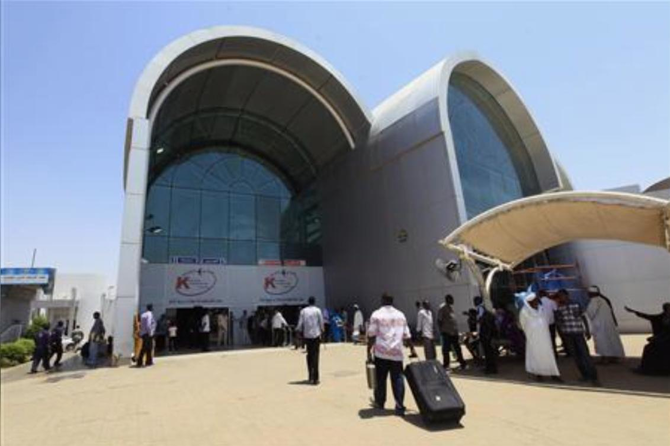
Passengers arrive at Khartoum's international airport September 13, 2012. (Reuters)
Short Url
Updated 15 June 2020
Follow

Sudan airport to stay closed until June 28

  • Sudan shut the airports in March as part of measures to curb the spread of the coronavirus pandemic

KHARTOUM: Sudan will keep its airports closed to international and internal scheduled commercial flights for another two weeks until June 28, a spokes-
man for Sudan Civil Aviation Authority (SCAA) told Reuters on Sunday.
Sudan shut the airports in March as part of measures to curb the spread of the coronavirus disease (COVID-19) pandemic. It has been reviewing the closure every two weeks.
Airports are open only for flights transporting cargo, humanitarian aid, oil organizations’ workers or evacuating foreigners, said Abdul Hafiz Abdul Rahim, the SCAA spokesman.
Sudan had reported 7,007 coronavirus infections as of Thursday, including 447 deaths, the Health Ministry said. The number of recoveries in the country is 2,556.
The first flight of the European Humanitarian Air Bridge to support Sudan arrived in Khartoum last week to tackle the impact of the COVID-19.

SPEEDREAD

• Sudan had reported 7,007 coronavirus infections as of Thursday, including 447 deaths.

• The number of recoveries in the country is 2,556.

A Radio Dabanga report quoted Sudan’s health minister as saying the “actual number of COVID-19 cases in the country is higher than the official data.” So far, the highest number of cases has been reported in Khartoum.
The transitional civilian government, which runs Sudan under a power-sharing deal with the army, ordered most businesses, markets, schools and mosques to shut and imposed travel restrictions nearly two months ago.
The government says the lockdown, extended again in the capital Khartoum until June 18, has helped to curb the pandemic. The daily infection rate, at around 200, is much lower than, for example, in neighboring Egypt.


UN chief condemns Israeli law blocking electricity, water for UNRWA facilities

Updated 01 January 2026
Follow

UN chief condemns Israeli law blocking electricity, water for UNRWA facilities

  • The agency provides education, health and aid to millions of Palestinians in Gaza, the West Bank, Jordan, Lebanon and Syria

United Nations Secretary General Antonio Guterres condemned on Wednesday a move by Israel to ban electricity or water to facilities owned by the UN Palestinian refugee agency, ​a UN spokesperson said.
The spokesperson said the move would “further impede” the agency’s ability to operate and carry out activities.
“The Convention on the Privileges and Immunities of the United Nations remains applicable to UNRWA (United Nations Relief and Works Agency for Palestine Refugees in the Near East), its property and assets, and to its officials and other personnel. Property used ‌by UNRWA ‌is inviolable,” Stephane Dujarric, spokesman for the ‌secretary-general, ⁠said ​while ‌adding that UNRWA is an “integral” part of the world body.
UNRWA Commissioner General Phillipe Lazzarini also condemned the move, saying that it was part of an ongoing “ systematic campaign to discredit  UNRWA and thereby obstruct” the role it plays in providing assistance to Palestinian refugees.
In 2024, the Israeli parliament passed a law banning the agency from operating in ⁠the country and prohibiting officials from having contact with the agency.
As a ‌result, UNRWA operates in East Jerusalem, ‍which the UN considers territory occupied ‍by Israel. Israel considers all Jerusalem to be part ‍of the country.
The agency provides education, health and aid to millions of Palestinians in Gaza, the West Bank, Jordan, Lebanon and Syria. It has long had tense relations with Israel but ties have deteriorated ​sharply since the start of the war in Gaza and Israel has called repeatedly for UNRWA to ⁠be disbanded, with its responsibilities transferred to other UN agencies.
The prohibition of basic utilities to the UN agency came as Israel also suspended of dozens of international non-governmental organizations working in Gaza due to a failure to meet new rules to vet those groups.
In a joint statement, Canada, Denmark, Finland, France, Iceland, Japan, Norway, Sweden, Switzerland and the United Kingdom said on Tuesday such a move would have a severe impact on the access of essential services, including health care. They said one in ‌three health care facilities in Gaza would close if international NGO operations stopped.