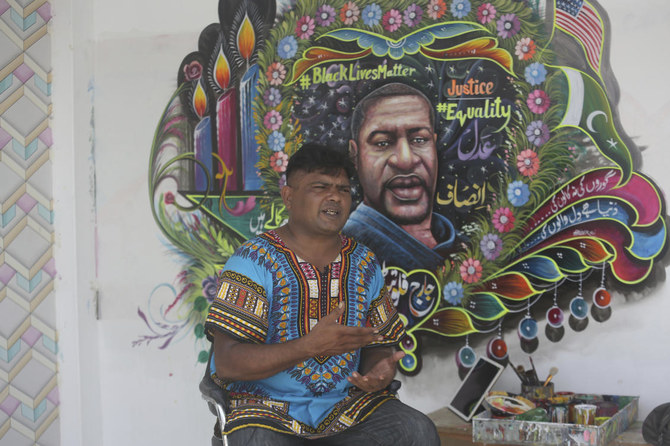
KARACHI: The brutal killing of George Floyd by police in the United States has sent shock waves across the world, even reaching Pakistan’s southern Sindh province where a truck artist has painted a large mural of the slain African American on a wall of his home.
The 40-year-old artist, Haider Ali, depicted Floyd surrounded by a colorful heart-shaped garland of flowers, with slogans such as #Black Lives Matter on one side and #justice and #equality on the other.
“This is a message of peace and love to all,” Ali told The Associated Press on Friday, as he put the finishing touches on the mural. “It’s not from an individual, this message of love is from all of Pakistan.”
The mural stands out as a burst of color on Ali’s porch wall in the southern port city of Karachi. On one side of the portrait, Ali painted candles burning in memory of Floyd and in the upper right-hand corner, an American and Pakistani flag next to one another.
Floyd, a black man, gasped for breath in Minneapolis while being pressed under the knee of a white police officer for several minutes. His death sparked protests in the US and elsewhere, challenging activists from all backgrounds to rise up against abuse of police power, racism and inequality.
Ali, who said he was in tears when he watched the video of Floyd’s killing, makes his living as a truck artist in Sindh and often takes to the road, catching truckers in moments of rest, when they take a break and park their trucks at truck stops and on wide open fields by the roadside.
Truck painting is popular in Pakistan and Ali said he plans to paint more pictures of Floyd on the back of trucks sometime soon. For now, he has been staying at home fearing he could be exposed to the new coronavirus if he mingles too much with the truckers.
Karachi and the entire Sindh province have been badly affected by the virus. The province alone has reported over 46,800 cases of the virus so far, including 776 deaths from COVID-19, the illness caused by the virus. In all of Pakistan, authorities have said there are more than 125,000 cases, and 2,463 deaths.
Ali said he believes that Floyd’s killing is not a reflection of the American society as a whole but of the individuals who committed the horrific slaying. “I did not know that there are still a few people in America who can be involved in this kind of brutality,” he said.
He said he has visited 40 states in the US, making the trip for the first time when he was 21. “I never faced any discrimination because I am a Muslim or a Pakistani,” he said of the trips.
Being dark-skinned himself, Ali said he has been aware all his life of the many prejudices against people with dark skin in his own homeland.
“Racism is more dangerous than coronavirus,” he said.
Still, Ali says he dreams of a better world, which is why he chose to include the words of a popular Indian song that inspired him and write them in his language, Urdu, on Floyd’s mural:
“Hum kaalay hain toh kia hua, dilwale hain (So what if we are dark-skinned. We have got big hearts)” and “Goron ki na kaalon ki, dunya dil walon ki (This world doesn’t belong to white or black people, it belongs to the ones with heart).”
He also has his own take on skin color:
“Black people are like the sky. You will never be able to see the stars and moon if the sky is white,” Ali said. “You see shining stars and the moon only when there is a black sky.”


![]()
![]()
![]()

Pakistani truck artist paints George Floyd mural on his home


Short Url
https://arab.news/g99dv
Pakistani truck artist paints George Floyd mural on his home
- Ali, who said he was in tears when he watched the video of Floyd’s killing, makes his living as a truck artist in Sindh
- Truck painting is popular in Pakistan and Ali said he plans to paint more pictures of Floyd on the back of trucks sometime soon


Latest updates


© 2026 SAUDI RESEARCH & PUBLISHING COMPANY, All Rights Reserved And subject to Terms of Use Agreement.