

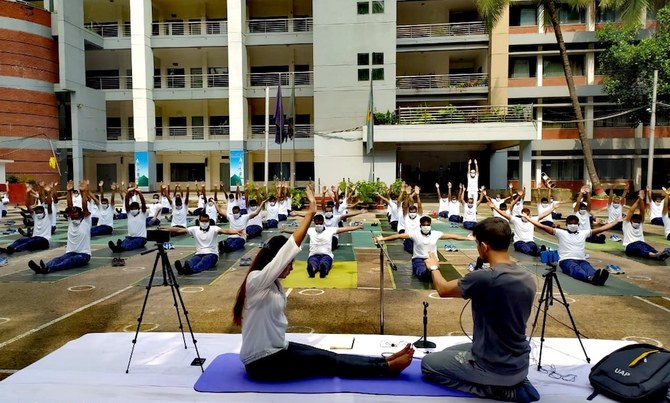
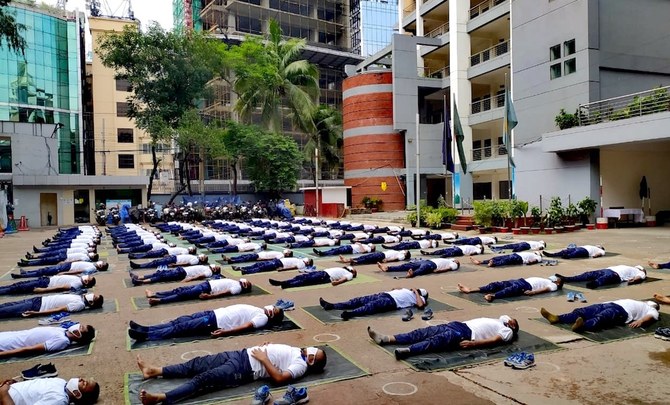

DHAKA: At the police barracks at Dhaka’s Gulshan area in the diplomatic zone, members of the force began their day on Thursday with yoga sessions.
This new approach by the diplomatic security division of Dhaka Metropolitan Police (DMP) aims to boost the mental health of the police force amid the coronavirus.
Dressed in white T-shirts and black trousers, all members of the diplomatic division, from high-ranking officials to constables, take part in yoga sessions under the supervision of two professional trainers.
“Since the outbreak of the COVID-19 pandemic, around 200,000 of our personnel were working round the clock to limit the spread of the deadly virus by enforcing lockdown and helping people for any emergency need,” Rajon Kumar Saha, assistant police commissioner of the diplomatic security division of DMP, told Arab News. “While delivering duties as a frontline fighter, many of our members became infected with the coronavirus, which created a concern for the top management of the police force,” he said.
Despite the efforts of management, it was found that many of the force members were not doing well in mental health as they undertook tasks such as burying the bodies of COVID-19 victims and taking coronavirus-infected people to hospital.
“In this situation, deputy commissioner Ashraful Islam of the diplomatic security division came up with the innovative idea of yoga sessions to boost the mental health as well as the physical fitness of the unit members,” Saha said.
The yoga classes began on Sunday and will cover all 1,200 members of the unit in the next two months, with three sessions a week.
About 150 members participate in each of the sessions, which continue for up to two hours.
“While running the yoga sessions we have ensured enough social distancing to contain the spread of the virus and we designed the sessions in a way that allows the participants to enjoy a holiday on the day of receiving the yoga tasks,” Saha said.
Evergreen, a professional training organization that has offered yoga classes since 2017, is conducting the sessions.
“We are coaching the police members on three basics of yoga — meditation, asana (body postures) and pranayama (breathing exercises). If the participants practice these three things regularly it will help them a lot in achieving good mental health and having good control of the breathing process,” Shantonu Biswas Bappa of Evergreen told Arab News.
“I noticed a few of the police personnel in a dull and distressed mood, which is very obvious amid this coronavirus pandemic. The yoga sessions are designed in such a way that will definitely help the participants in dealing with such mental issues,” Bappa said.
He said that the yoga sessions would also help police to “beat” obesity as many of them faced this problem during their career.
The police were very “enthusiastic” about the training and many of them had “follow-up queries” through the online platform, Bappa said.
“It’s a totally new thing to me. The breathing exercises which I learned in yoga sessions are very effective as I need to have good physical fitness for delivering my services as a police member,” said a sub-inspector who did not wish to be unnamed as he is not authorized to speak to the media.
“The other exercises that we do regularly mainly concentrate on our physical fitness. But these yoga sessions are focusing on both physical and mental health, which is undoubtedly a great support for me,” said another of the participants who completed their first training session on Sunday.
The authorities are now considering extending the yoga classes to other units.
“We are at the pilot stage now. If we receive a good result after the completion of two months of sessions, we may expand it for other unit members,” Saha said.
About 65 members of the diplomatic security division have contracted the coronavirus to date, with 63 of them recovering.
As of Wednesday, at least 6,826 Bangladeshi police personnel have tested positive for the coronavirus and 21 of them had died from the disease, according to a statement issued by the country’s police.


