

Pakistani charity arranges free plasma for COVID-19 patients

1 / 3
Dr. Tahir Shamsi, Chairman National Institute of Blood Diseases, speaking at the inaugural ceremony of Passive Immunization Service by Al-Khidmat Foundation in Lahore on Wednesday June 10, 2020. (Photo courtesy: Alkhidmat health services)
2 / 3
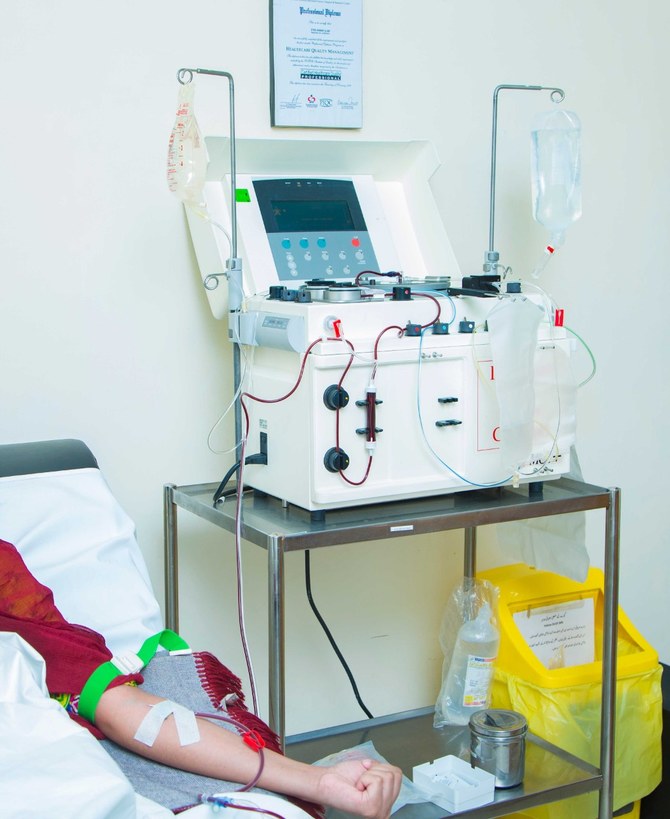
A coronavirus survivor donating plasma at Al-Khidmat COVID-19 lab on Thursday, June 11, 2020. The man is one of the 1500 patients who recovered from the infectious disease according to Al-Khidmat lab record. (Photo courtesy: Alkhidmat health services)
3 / 3
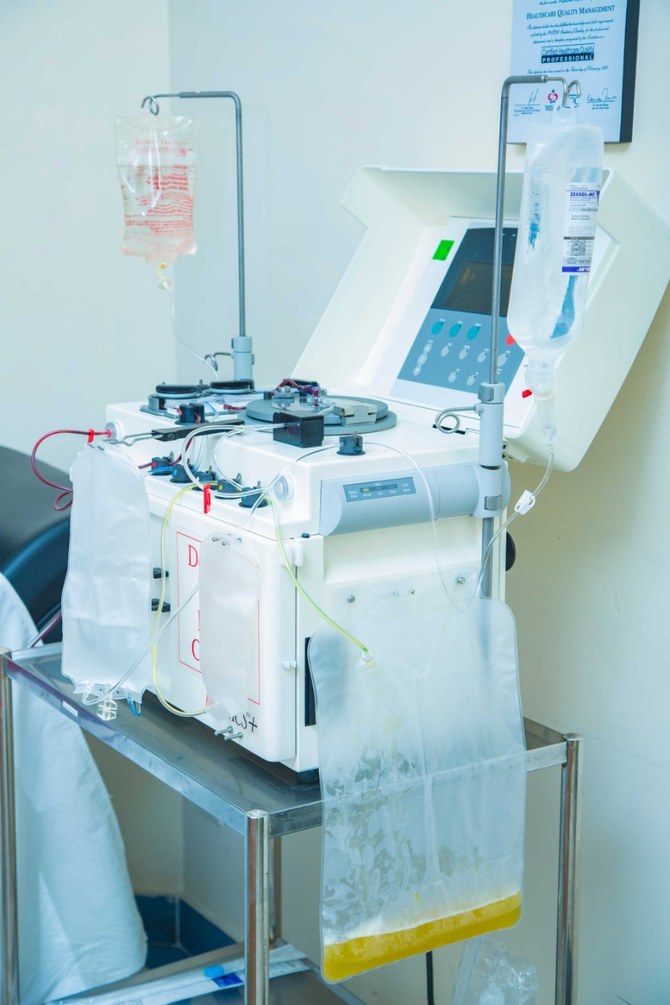
Image of the machine used to extract plasma at Al-Khidmat lab. (Photo courtesy: Alkhidmat health services)
Short Url
Updated 11 June 2020
Follow

Pakistani charity arranges free plasma for COVID-19 patients

  • Al-Khidmat Foundation is the first non-governmental entity providing such facility to virus patients
  • Around 1500 people have contacted the charity for donations after recovering from coronavirus, charity official says

LAHORE: A Pakistani charity organization, Al-Khidmat Foundation, has stepped up to beat the coronavirus pandemic by starting free blood plasma donation service for virus patients to introduce passive immunity against the disease.
The facility became operational on Thursday in the eastern city of Lahore which has over 11,000 reported cases.
“We are the first welfare organization in the country in non-governmental sector that has started plasma service for COVID 19 patients free of cost,” Abdul Shakoor, head of Al-Khidmat Foundation, told Arab News on Thursday, adding that Dr. Tahir Shamsi, Chairman of the National Institute of Blood Diseases, was supervising the project.
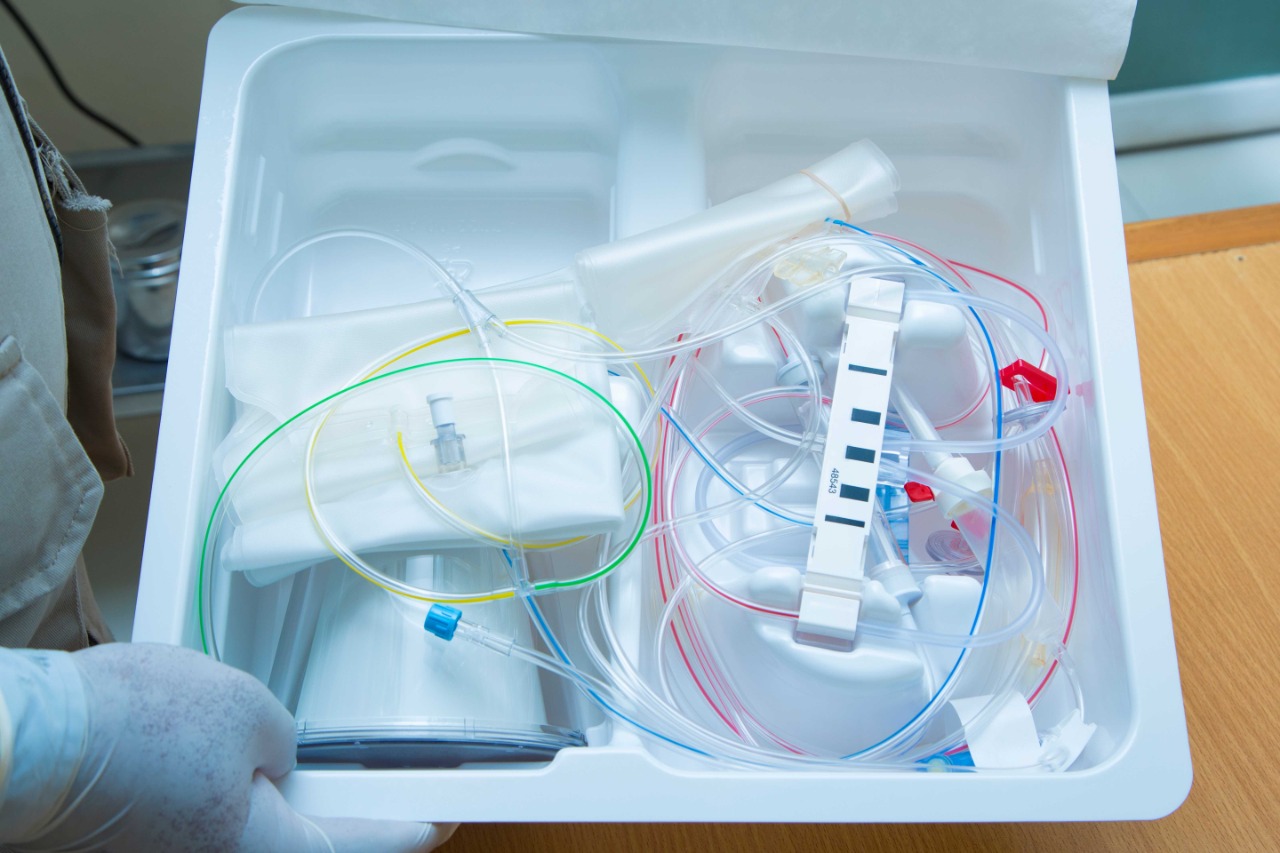


The kit being used by Al-Khidmat lab to extract plasma from the donor’s blood. (Photo courtesy: Alkhidmat health services)

There is no formal treatment for COVID-19 and blood plasma therapy is a tried and tested method to treat such diseases, Dr. Shamsi said. “It is like treating the Hepatitis B infected people or rabies or the snake bite infected persons.”
“Plasma therapy enables the medics to extract plasma from the blood of the people recovered from the disease and transfuse it into the body of critically-ill patients to provide them passive immunity to fight this deadly virus. In COVID 19, this is the effective procedure to cure the patients”, Dr. Shamshi said while speaking at the inauguration ceremony on Wednesday, a day before the commencement of formal operations.
This service is currently only available in Lahore but not limited to the patients under treatment at Al-Khidmat centers.
“Any patient admitted at any health facility – PLKI (Pakistan Liver and Kidney Institute), Mayo Hospital or any other hospital would be served free of cost by Al-Khidmat,” Shakoor said.
The service will be extended to other cities like Karachi, Peshawar, and Faisalabad as soon as the organization’s COVID-19 labs started their operations in these cities, he added.
The Foundation has the data of people who have successfully recovered from COVID-19 and contacts them for donating their blood plasma to other virus patients.
“We have the data of all the people who got themselves checked at our COVID-19 center and tested positive for coronavirus. They later defeated the disease and tested negative. We are contacting those people and convincing them for donation of plasma. On the first day, we contacted 20 people and only two agreed to donate,” Tariq Waheed, Manager Health Services at Al-Khidmat Blood Lab told Arab News.
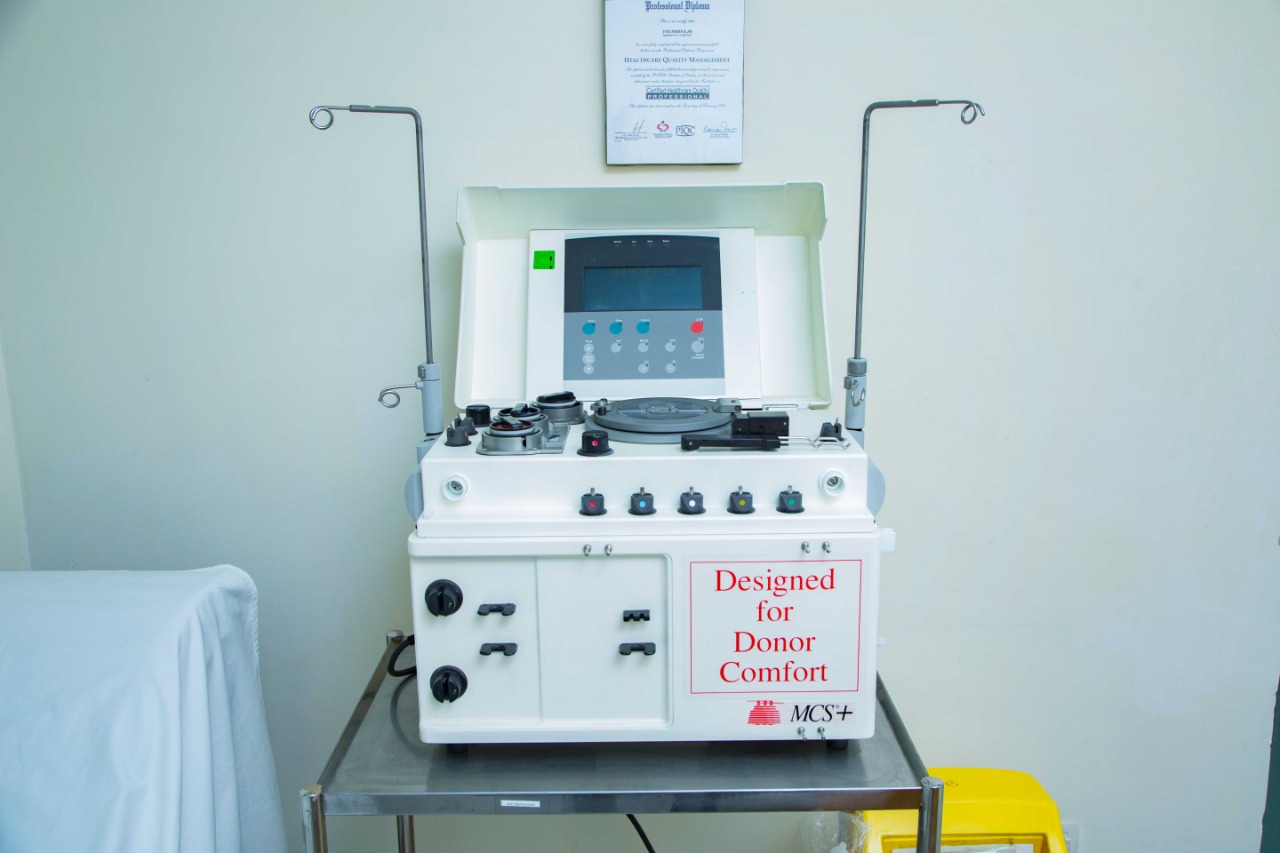


Image of the machine used to extract plasma at Al-Khidmat lab. (Photo courtesy: Alkhidmat health services)

The lab is conducting over 300 COVID-19 test every day. “As per our data there are more than 1500 people who have recovered from Coronavirus since we started the testing facility and we will contact them all,” Waheed said.
Currently with only two cell separator machines installed, the lab has the daily capacity of preparing plasma for 16 people. “It takes one and half hour to extract plasma from one person. We are able to extract plasma for 16 people per day with two cell separator machines,” Syed Anwar Alam, Project Manager of Al-Khidmat Lab, told Arab News.
Shoaib Hashmi, media manager of the charity said: “It cost Rs30,000 for one bag in the market but Al-Khidmat is providing the service completely free of cost to serve humanity.”
Pakistan’s national tally on Thursday reached 123,201 with 2,410 deaths reported countrywide and 38,547 patients having recovered thus far, according to health ministry’s national dashboard for COVID-19. 


Pakistan killed over 80 militants in strikes on TTP camps in Afghanistan — official

Updated 29 min 55 sec ago
Follow

Pakistan killed over 80 militants in strikes on TTP camps in Afghanistan — official

  • Saturday’s airstrikes followed a series of attacks inside Pakistan amid a surge in militancy
  • The Afghan Taliban authorities accuse Pakistani forces of killing civilians in the airstrikes

ISLAMABAD: Pakistan’s airstrikes in Afghanistan destroyed seven Tehreek-e-Taliban Pakistan (TTP) camps and killed over 80 militants, a Pakistani security official said on Sunday, with the Afghan Taliban accusing Pakistani forces of killing civilians in the assault.

Saturday’s airstrikes followed a series of attacks inside Pakistan amid a surge in militancy. Authorities say the attacks, particularly in Khyber Pakhtunkhwa province and the Pakistani capital of Islamabad, were carried out by the TTP and allied groups that Islamabad alleges are operating from sanctuaries in Afghanistan. Kabul denies this.

According to Pakistan’s information ministry, recent incidents included a suicide bombing at a Shiite mosque in Islamabad, separate attacks in Bajaur and Bannu, and another recent incident in Bannu during the holy month of Ramadan, which started earlier this week. The government said it had “conclusive evidence” linking the attacks to militants directed by leadership based in Afghanistan.

“Last night, Pakistan’s intelligence-based air strikes destroyed seven centers of Fitna Al-Khawarij TTP in three provinces of Nangarhar, Paktika and Khost, in which more than eighty Khawarij (TTP militants) have been confirmed killed, while more are expected,” a Pakistani security official, who spoke on condition of anonymity, told Arab News.

An earlier statement from Pakistan’s information ministry said the targets included a camp of a Daesh regional affiliate, the Islamic State Khorasan Province (ISKP), which claimed a suicide bombing at an Islamabad Shiite mosque that killed 32 people this month.

In an X post, Afghan government spokesperson Zabihullah Mujahid said Pakistani forces had violated Afghan territory.

“Pakistani special military circles have once again trespassed into Afghan territory,” Mujahid said. “Last night, they bombed our civilian compatriots in Nangarhar and Paktika provinces, martyring and wounding dozens of people, including women and children.”
 
The Afghan Taliban’s claims of civilian casualties could not be independently verified. Pakistan did not immediately comment on the allegation that civilians had been killed in the strikes.

In a post on X, Afghanistan’s foreign ministry said it had summoned Pakistan’s charge d’affaires to Afghanistan Ubaid-ur-Rehman Nizamani and lodged protest through a formal démarche in response to the Pakistani military strikes.

“IEA-MoFA (The Islamic Emirate of Afghanistan’s Ministry of Foreign Affairs) vehemently condemns the violation of Afghanistan’s airspace and the targeting of civilians, describing it as a flagrant breach of Afghanistan’s territorial integrity & a provocative action,” it said in a statement.

“The Pakistani side was also categorically informed that safeguarding Afghanistan’s territorial integrity is the religious responsibility of the Islamic Emirate of Afghanistan; henceforth, the responsibility for any adverse consequences of such actions will rest with the opposing side.”

Tensions between Islamabad and Kabul have escalated since the Afghan Taliban returned to power in 2021. Pakistan says cross-border militant attacks have increased since then and has accused the Taliban of failing to honor commitments under the 2020 Doha Agreement to prevent Afghan soil from being used for attacks against other countries. The Taliban deny allowing such activity and have previously rejected similar accusations.

Saturday’s exchange of accusations marks one of the most direct confrontations between the two neighbors in recent months and risks further straining already fragile ties along the volatile border.