LESBOS ISLAND, Greece: Inside Greece’s largest asylum-seeker camp on the island of Lesbos, the coronavirus is an oft-heard threat that has kept migrant facilities around the country under lockdown since March.
But knife crime is the real killer.
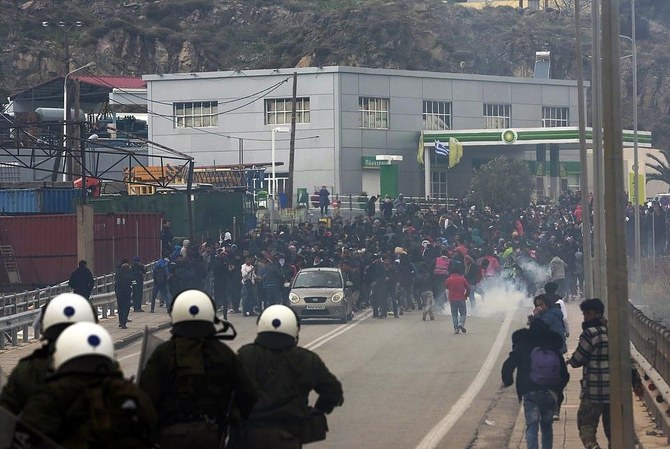
Whereas COVID-19 has yet to surface officially at the vastly overcrowded camp of Moria, five people have been murdered in knifings since the start of the year, including a woman and a young boy. Ten others have been injured.
Two of the attacks were carried out in the central square of the port capital of Mytilene.
“The situation gets worse every day,” says Muhammad, a Syrian stuck at Moria with his pregnant wife and their little girl for the past seven months.
“We fear for our children. Every day there is unrest, and every night they fight with knives,” he told AFP.
Tension between Afghanistan’s ethnic Hazaras and Tajik are a frequent source of violence, says Nazifa, a teacher from that country.
“Yesterday, people came to our tent asking if we are Hazara or Tajik. We are neither, so both sides now consider us foes,” she said.
Originally imposed on March 18, the lockdown in island camps has been extended three times, most recently to June 21.
Doctors Without Borders (MSF) this week criticized the lockdown extension as “discriminatory” and “counter-productive.”
“The extension of movement restrictions imposed on asylum seekers who are living in the Greek reception centers will further reduce their already limited access to basic services and medical care,” the group’s field coordinator on Lesbos, Marco Sandrone, said in a statement.
“In the current phase of the COVID-19 epidemic, it is absolutely not justified from a public health point of view,” he said.
“This population doesn’t represent a risk. They are at risk,” Sandrone said, noting that people were trapped in overcrowded camps with limited access to water and sanitation, and where social distancing measures were “just impossible” to apply.
The Greek government had planned to relocate to the mainland over 2,300 asylum seekers from island camps — including many elderly and ailing persons — but the operation has been delayed by the pandemic.
The UN refugee agency had also urged last month that the exceptional measures be lifted “as soon as possible.”
Ibrahim, a former mechanic from Kabul, says the restrictions are preventing him from obtaining food for his family.
“We can no longer go to town and we have to buy supplies at the camp store,” he said.
“We tried to go once, but the police turned us back.”
He agrees that the biggest concern in Moria is public safety.
“There are 100 police for 20,000 residents,” he said.
The migration ministry has said that small groups of camp residents are allowed out at regular intervals to obtain supplies, under police supervision.
Fardeen, a 17-year-old Afghan, has been stranded at the camp for nine months.
He says that other residents, who were allowed into Mytilene for medical appointments, saw no Greeks wearing masks on the street.
“(The locals) don’t seem to care much about the virus. Are these measures only for migrants? Am I different?” he asks.
“Today the police turned us away from the beach. Swimming is one of the few things that helps us forget about living in Moria,” he said.
Dozens of Africans last month marched out of a hotel near the Peloponnese town of Kranidi to protest against a total lockdown imposed in April after over 150 people at the facility tested COVID-19 positive.
Authorities extended the Kranidi hotel lockdown to June 14 after three more cases were discovered in May.
More than 31,000 asylum seekers live in the five camps on the Aegean islands, with a total capacity of 6,095 people.
Nearly 17,000 live in Moria.
The migration ministry has recently stepped up asylum procedures, sorting through more than 6,000 requests in May.
Hundreds of refugees who have secured asylum have been queueing daily at the port of Mytilene, and over 500 have boarded ferries to Piraeus since last week, local news website StoNisi said.


![]()

Knife crime looms larger than virus in Greek refugee camp
Short Url
https://arab.news/b66ay
Knife crime looms larger than virus in Greek refugee camp
- Whereas COVID-19 has yet to surface officially at the vastly overcrowded camp of Moria, five people have been murdered in knifings
- Tension between Afghanistan’s ethnic Hazaras and Tajik are a frequent source of violence


Latest updates


© 2026 SAUDI RESEARCH & PUBLISHING COMPANY, All Rights Reserved And subject to Terms of Use Agreement.