Unemployed Filipina feeds other jobless migrants in Dubai

Feby Cachero Baguisa Dela Pena of Laguna, Philippines, hands out free food to those who need it in Dubai. (AP)
Short Url
Updated 11 June 2020
Follow

Unemployed Filipina feeds other jobless migrants in Dubai

  • Her 11 housemates also chipped in
  • She offers 200 free meals each day

DUBAI: Feby Dela Peña saw her fellow Filipinos standing in line outside her building in Dubai, waiting for free food. And she was stricken — what if her family, too, had lost their income amid the COVID-19 outbreak? How would she have fed her three children?
Dela Peña is unemployed. “We’re poor, to be honest,” she said. “But it’s not a reason for me not to help, you know?”


So the next day, she pulled out the money that was supposed to feed her family of five for a month. When their 11 housemates got wind of her plan — like most migrant workers in Dubai, the family lives in a shared apartment — those who could chipped in as well.
She was able to buy about 500 dirhams, or $136, worth of groceries, including 30 frozen chickens and sacks of rice. And she began to cook.
That is how Dela Peña launched the project she calls Ayuda — help, in Filipino, a language heavily influenced by Spanish colonial rule. Each day, she offers 200 free meals to the hungry.


Migrants account for 90% of the workforce in the United Arab Emirates. The economic shutdown that came with COVID-19 has hit their communities hard.
“Life is so hard and they don’t have anyone to depend on,” said Dela Peña, 34.
Dela Peña’s a confident cook who used to sell home-made meals to friends as a way to earn extra money. She said she also has a license in food safety.
But cooking 200 meals a day is a massive undertaking, especially with a 6-year-old, a toddler and a baby at home.
The finances are dicey; Dela Peña relies on her husband’s modest income from a sales job. But when word of her efforts spread on social media, people began reaching out, dropping off cartons of eggs and bags of rice. An influential Emirati blogger gave her 10,000 dirhams ($2,700).
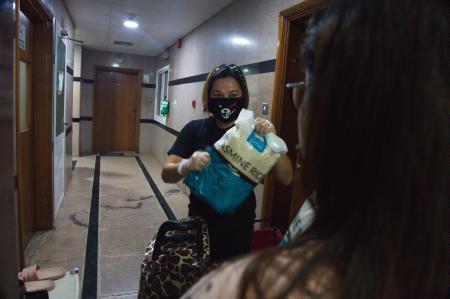
She leans on her housemates, husband and her brother-in-law, who was let go from his job in a tea shop amid the pandemic, to help with buying the groceries, thawing the meats, chopping the food and cooking. Ultimately, though, she’s in charge.
“It’s a big thing if you can help like 10 people not to sleep hungry,” she said, as she scooped up cooked rice, fried fish and boiled eggs into containers to distribute.
Her children’s wagon is used to deliver the meals each day. It is 3 p.m., and sweltering. A sign on a cardboard box announces: “FREE!!! FOOD FOR EVERYONE.”
Some people walk 45 minutes for one of Dela Peña’s meals. While most hail from the Philippines, there are also Africans, South Asians and others.
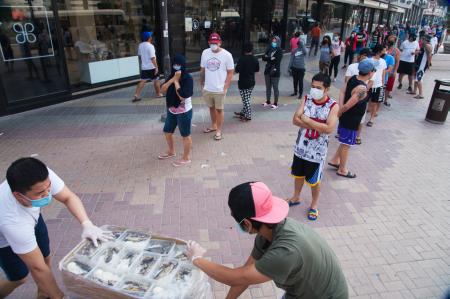
Six Filipino women, who come every day, said they haven’t worked or been paid since March when they lost their sales jobs. One of the women, Emma Moraga, said she heard about the meals on social media.
“It’s good, because they can help a lot of people,” Moraga said. “One meal a day, it’s big help.”
The crowd lines up. “Social distancing!” Dela Peña says, repeatedly. Mostly, though, people are standing apart and everyone is wearing masks, as is required by law.


Israel fires mortar into Gaza residential area, wounding at least 10

Updated 18 December 2025
Follow

Israel fires mortar into Gaza residential area, wounding at least 10

  • The attack is the latest Israeli attack since the Oct. 10 ceasefire took effect
  • Palestinian health officials have reported over 370 deaths from Israeli fire since the truce

JERUSALEM: Israeli troops fired a mortar shell over the ceasefire line into a Palestinian residential area in the Gaza Strip, in the latest incident to rock the tenuous ceasefire with Hamas. Health officials said at least 10 people were wounded, and the army said it was investigating.
The military said the mortar was fired during an operation in the area of the “Yellow Line,” which was drawn in the ceasefire agreement and divides the Israeli-held majority of Gaza from the rest of the territory.
The military did not say what troops were doing or whether they had crossed the line. It said the mortar had veered from its intended target, which it did not specify.
Fadel Naeem, director of Al-Ahli Hospital, said the hospital received 10 people wounded in the strike on central Gaza City, some critically.
It was not the first time since the ceasefire took effect on Oct. 10 that Israeli fire has caused Palestinian casualties outside the Yellow Line. Palestinian health officials have reported over 370 deaths from Israeli fire since the truce.
Israel has said it has opened fire in response to Hamas violations, and says most of those killed have been Hamas militants. But an Israeli military official, speaking on condition of anonymity in line with military protocol, said the army is aware of a number of incidents where civilians were killed, including young children and a family traveling in a van.
Palestinians say civilians have been killed in some cases because the line is poorly marked. Israeli troops have been laying down yellow blocks to delineate it, but in some areas the blocks have not yet been placed.
Ceasefire’s next phase
The Israel-Hamas ceasefire is struggling to reach its next phase, with both sides accusing each other of violations. The first phase involved the exchange of hostages for Palestinian prisoners. The second is supposed to involve the deployment of an international stabilization force, a technocratic governing body for Gaza, the disarmament of Hamas and further Israeli troop withdrawals from the territory.
The remains of one hostage, Ran Gvili, are still in Gaza, and the militants appear to be struggling to find it. Israel is demanding the return of Gvili’s remains before moving to the second phase.
Hamas is calling for more international pressure on Israel to open key border crossings, cease deadly strikes and allow more aid into the strip. Recently released Israeli military figures suggest it hasn’t met the ceasefire stipulation of allowing 600 trucks of aid into Gaza a day, though Israel disputes that finding.
Humanitarian groups say the lack of aid has had harsh effects on most of Gaza’s residents. Food remains scarce as the territory struggles to bounce back from famine, which affected parts of Gaza during the war.
The toll of war
The vast majority of Gaza’s 2 million people have been displaced. Most live in vast tent camps or among the shells of damaged buildings.
The initial Hamas-led Oct. 7, 2023, attack on southern Israel killed around 1,200 people and took 251 hostages. Almost all hostages or their remains have been returned in ceasefires or other deals.
Israel’s two-year campaign in Gaza has killed more than 70,660 Palestinians, roughly half of them women and children, according to the territory’s Health Ministry, which does not distinguish between militants and civilians in its count. The ministry, which operates under the Hamas-run government, is staffed by medical professionals and maintains detailed records viewed as generally reliable by the international community.