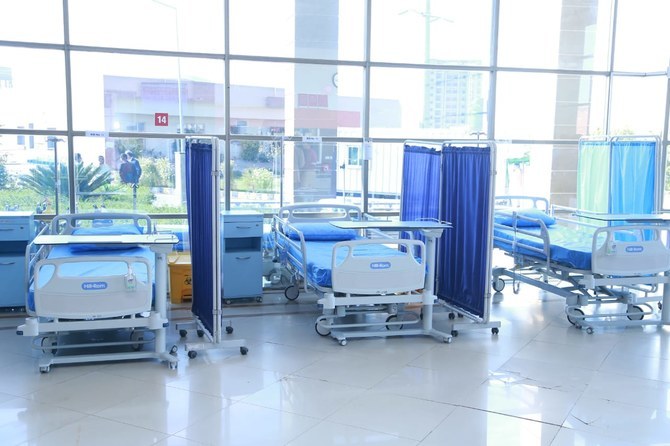
LAHORE: Lahore’s hospitals are filled to capacity with doctors working round-the-clock to treat coronavirus patients while one government-designated facility runs out of beds for new patients, hospital officials told Arab News on Sunday.
“The number of COVID-19 patients has spiked in the last three weeks,” Tazeen Qureshi, spokesperson for Pakistan Kidney and Livery Institute (PKLI) said. “All beds of the PKLI are full, and we are unable to accept any more patients.”
The facility is one of the 13 public and 19 private sector hospitals designated by the government of COVID-19 patients.
However, following the reported spike in infections in the eastern city and the capital of the populous Punjab province, authorities said that the facilities are insufficient to treat the massive influx of coronavirus cases.
As of Sunday, the number of infections reached 98,943 across the country, with Punjab – which comprises 36 districts – taking the top spot with 37,090 cases. Out of these, 18,161 are from Lahore alone with 253 deaths out of the total count of 683 reported from the province as of Sunday.
Qureshi attributes the uptick in infections to the relaxed restrictions a few weeks ahead of and after Eid in Pakistan on May 23.
“One week before Eid, we had one-third of our capacity’s empty beds. But soon after Eid, the patients’ numbers were increasing every day, and today (Sunday) we are unable to accommodate even one more patient,” he added.
However, a surge in infections and limited facilities are not the only issues concerning residents with several complaining of the exponential costs associated with the treatment of the deadly disease which varies from Rs 30,000 to Rs300,000 per day depending on the location and quality of services provided.
“My father was admitted to a private hospital with the (coronavirus) disease, and the hospital charged Rs391,705 from us for nine days. My father died after nine days, but the hospital charged us another Rs14,000 for preparing and handing over the dead body,” Nargis, a resident of Lahore told Arab News.
Hospital officials, for their part, said they are waiting to exhale.
“In the beginning, we were getting patients with low intensity, but now the patients approaching the hospitals are in serious conditions because they spend many days at home with symptoms. So far, we have a capacity of accommodating those patients, but the increasing numbers may cause difficulties,” Dr. Asad Aslam, Chief Executive of Mayo Hospital told Arab News.
According to a report submitted to Punjab Chief Minister, Sardar Usman Ahmad Khan Buzdar, on June 1 by the provincial government ‘s health department, which made rounds in local media, the number of infections are expected to cross the 700,000 mark by the end of June.
It added that not a single area in the province was “disease-free,” urging CM Buzdar to impose a complete lockdown for at least four weeks.


Lahore hospitals stretched to capacity as virus cases continue to surge
https://arab.news/ys33v
Lahore hospitals stretched to capacity as virus cases continue to surge

- Scarcity follows spike in infections due to eased restrictions before Eid, officials say
- Residents complain of inflated cost of treatment at private hospitals

Sindh assembly passes resolution rejecting move to separate Karachi
- Chief Minister Shah cites constitutional safeguards against altering provincial boundaries
- Calls to separate Karachi intensified amid governance concerns after a mall fire last month
ISLAMABAD: The provincial assembly of Pakistan’s southern Sindh province on Saturday passed a resolution rejecting any move to separate Karachi, declaring its territorial integrity “non-negotiable” amid political calls to carve the city out as a separate administrative unit.
The resolution comes after fresh demands by the Muttahida Qaumi Movement (MQM) and other voices to grant Karachi provincial or federal status following governance challenges highlighted by the deadly Gul Plaza fire earlier this year that killed 80 people.
Karachi, Pakistan’s largest and most densely populated city, is the country’s main commercial hub and contributes a significant share to the national economy.
Chief Minister Syed Murad Ali Shah tabled the resolution in the assembly, condemning what he described as “divisive statements” about breaking up Sindh or detaching Karachi.
“The province that played a foundational role in the creation of Pakistan cannot allow the fragmentation of its own historic homeland,” Shah told lawmakers, adding that any attempt to divide Sindh or separate Karachi was contrary to the constitution and democratic norms.
Citing Article 239 of Pakistan’s 1973 Constitution, which requires the consent of not less than two-thirds of a provincial assembly to alter provincial boundaries, Shah said any such move could not proceed without the assembly’s approval.
“If any such move is attempted, it is this Assembly — by a two-thirds majority — that will decide,” he said.
The resolution reaffirmed that Karachi would “forever remain” an integral part of Sindh and directed the provincial government to forward the motion to the president, prime minister and parliamentary leadership for record.
Shah said the resolution was not aimed at anyone but referred to the shifting stance of MQM in the debate while warning that opposing the resolution would amount to supporting the division of Sindh.
The party has been a major political force in Karachi with a significant vote bank in the city and has frequently criticized Shah’s provincial administration over its governance of Pakistan’s largest metropolis.
Taha Ahmed Khan, a senior MQM leader, acknowledged that his party had “presented its demand openly on television channels with clear and logical arguments” to separate Karachi from Sindh.
“It is a purely constitutional debate,” he told Arab News by phone. “We are aware that the Pakistan Peoples Party, which rules the province, holds a two-thirds majority and that a new province cannot be created at this stage. But that does not mean new provinces can never be formed.”
Calls to alter Karachi’s status have periodically surfaced amid longstanding complaints over governance, infrastructure and administrative control in the megacity, though no formal proposal to redraw provincial boundaries has been introduced at the federal level.


