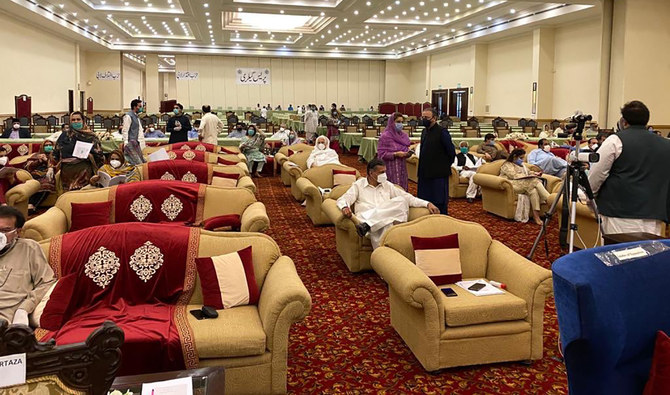
LAHORE: For the first time in history, the provincial assembly of Pakistan’s most densely populated province of Punjab held a session out of its historic building on Friday, choosing a local hotel for the purpose to ensure social distancing among its members amid growing coronavirus infections.
The assembly building was constructed in 1937 and has a small chamber to accommodate all lawmakers. Its foundation stone was laid in 1935 and it was inaugurated in November 1937 by Sardar Jogendra Singh who served as the agriculture minister back in the day.
The building was originally constructed to cater to the needs of 140 members of the united province of Punjab. After the division of the region into two separate countries in August 1947, the structure was continued to be used for the sessions of the Punjab provincial assembly. Later, it also catered to the needs to the West Pakistan assembly.
After 2002, the number of Punjab Assembly members was raised to 371. The construction of a new assembly building with the capacity of 500 legislators was initiated in 2005 by the former chief minister of the province, Chaudhry Pervaiz Elahi, but the idea has not materialized until now, even though the construction project was scheduled to be implemented in two years.
“The COVID-19 pandemic has gripped the whole world and the situation requires social distancing to save people from the disease,” Elahi, who is now the assembly’s speaker, said in his opening remarks at the beginning of the session. “It was not possible to maintain that distance in the assembly building due to insufficient space. We were, therefore, forced to change the venue of the meeting to this place.”
The session began Friday afternoon and was attended by a large number of politicians on both sides of the political divide. Some members criticized Federal Minister for Science and Technology Chaudhry Fawad Hussain during the debate since he undermined the idea of a physical session while advocating a virtual meeting.
“Holding the assembly session is a constitutional requirement and we can only deplore the thoughts of those who insist on calling virtual meetings,” leader of the opposition in the Punjab Assembly Hamza Shahbaz said in his comments.
Pakistan Peoples Party (PPP) legislators raised the issue of farmers during the session, accusing the government of “snatching wheat” from the growers against their will.
“The government is harassing the farmers, snatching their wheat on cheaper rates than they are likely to get in open market. Locust swarm has already ruined the produce. Now the government is adding to the miseries of farmers,” PPP leader Hasan Murtaza said.
Before the session began, leaders of various political factions in the House held a meeting at the speaker’s chamber and reviewed the COVID-19 situation.
Special precautionary measures were also taken to prevent the spread of the virus as a disinfection gate was installed at the entry point and assembly members were requested to wear masks and gloves.


![]()

In a first, Punjab Assembly holds session in hotel to prevent virus spread
Short Url
https://arab.news/9wxhx
In a first, Punjab Assembly holds session in hotel to prevent virus spread
- The assembly speaker says social distancing was not possible in the small chamber of the building
- The assembly building was constructed in 1937 for 140 members
Latest updates


© 2026 SAUDI RESEARCH & PUBLISHING COMPANY, All Rights Reserved And subject to Terms of Use Agreement.