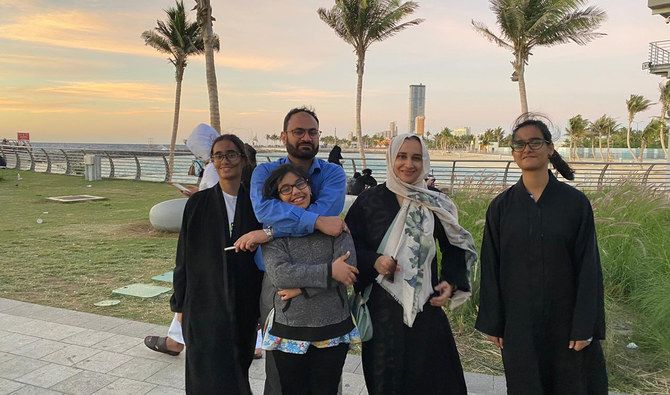
ISLAMABAD: Pakistan’s diaspora community and medical professionals in Saudi Arabia have paid rich tribute to a Pakistani general surgeon, Dr. Naeem Khalid Chaudhry, who became the first medic in the kingdom to have lost his life to the coronavirus disease, COVID-19, two days ago in Makkah where he worked in the General Surgery Department at the Hira General Hospital.
Chaudhry was 46 years old and belonged to the northeastern district of Narowal in Pakistan’s Punjab province. He moved to Saudi Arabia in 2014 with his family to work as a surgeon in Islam’s holiest city. He is survived by his wife and three daughters who also live in Makkah.
Tooba Chaudhry, the wife of the deceased doctor who also works at the Hira General Hospital as a Radiologist, said that her husband kept on performing his duties throughout the pandemic and showed mild symptoms of the disease on May 14.
“He had mild fever and complained of fatigue on May 14, and it was established that he was suffering from COVID-19 after a medical test that was performed the same day. We started treating him and he showed signs of improvement until the beginning of this month. Then suddenly his condition deteriorated which also proved fatal,” she told Arab News on Friday.
“My three daughters and I have also tested positive for COVID-19, but we are now stable. Our symptoms have disappeared, but the hospital has not called us for a second test,” she added.
“Pakistan’s ambassador to Saudi Arabia and officials at the consulate general in Jeddah called me and assured full support to my family,” she continued. “The Saudi officials also allowed me to bid farewell to my husband in a fully protective outfit.”
Consul General of Pakistan in Jeddah Khalid Majid said the deceased doctor would be remembered as an indefatigable philanthropist for his illustrious contributions to the fields of medicine and social work.
“He was an important member of the medical team fighting against COVID-19 in the Makkah region. Pakistani community in Saudi Arabia has indeed lost a sincere compatriot who served humanity with zeal and sincerity,” he told Arab News on Friday.
Saudi Ambassador to Pakistan Nawaf bin Said Al-Malki also prayed for the Pakistani surgeon while recognizing his services to the kingdom.
“I offer my condolences and prayers for the family of the Pakistani surgeon Naeem Khalid Chaudhry, who moved to the mercy of Allah Almighty due to his infection with the virus COVID-19, while performing his duty on the frontline against pandemic at Hira General Hospital in Makkah,” he said in a Twitter post.
Dr. Muhammad Irfan, Chaudhry’s colleague and close friend, told Arab News that his coworker performed his duties tirelessly and with utmost dedication.
“I was with him in the surgical department for the last six years. He was a close friend and very good surgeon. He never showed a sign of hesitation while treating the COVID-19 patients,” he said while requesting the Pakistani diplomatic mission and the Saudi authorities to look after his family.
“The whole hospital is in a state of shock since Dr. Chaudhry was very popular due to his professionalism,” Dr. Muhammad Saleem, ICU (Intensive Care Unit) specialist, at the Hira hospital told Arab News while confirming that his late colleague had contracted the virus during the course of his work.
“He [Chaudhry] got COVID-19 infection two weeks back while performing hospital duties. We used best possible hospital resources for his recovery but unfortunately he could not survive,” he added.
Dr. Asad Ullah Roomi, president of the Pakistan Doctors’ Group (PDG) in the kingdom, said all Pakistani medical professionals were in the forefront of this fight against the coronavirus pandemic along with their Saudi colleagues.
“Dr. Chaudhry was a very hardworking and skillful surgeon. He was also academically involved in the training of his juniors,” he told Arab News, adding: “He was also an active contributor to a Pakistani doctors’ charity initiative and provided free medical services to the underprivileged individuals in the Makkah region.”
Dr. Zia Ullah Dawar, a public health specialist at the Saudi ministry of health in Jeddah, remembered Chaudhry in these words: “He was a thorough professional who had never hesitated from his duty despite all its dangers.”
He also revealed that the Pakistani surgeon served about five times in the southwestern border city of Jazan on the request of the Saudi health ministry.
“Chaudhry used to help the Pakistani community in Makkah and provided free services to the deserving people,” Dawar continued. “He was about to be promoted in about a month from a surgical specialist to a consultant.”


Pakistani doctor who died of COVID-19 applauded as hero in Saudi Arabia
https://arab.news/m2spk
Pakistani doctor who died of COVID-19 applauded as hero in Saudi Arabia

- Dr. Naeem Khalid Chaudhry will be remembered for his illustrious contributions to the fields of medicine and social work — Pakistan’s Consul General
- Colleagues say he never hesitated while treating COVID-19 patients

Pakistan orders four-day workweek, shuts schools to save fuel amid Middle East oil crisis
- The development comes as ongoing US-Israeli strikes on Iran disrupt oil supplies in Strait of Hormuz, push prices past $119 a barrel
- Islamabad bans government purchases, cuts fuel allocation for vehicles as well as workforce in public and private offices by 50 percent
ISLAMABAD: Prime Minister Shehbaz Sharif on Monday announced austerity measures, including a four-day work week, cuts in government expenditures and closure of schools, to offset the impact of rising global oil prices due to an ongoing conflict in the Middle East.
Global fuel supply lines have been disrupted in the Strait of Hormuz, which supplies nearly a fourth of world oil consumption, after Tehran blocked it following United States-Israeli strikes on Iran and counterattacks against US interests in the Gulf region.
Oil prices surged more than 25 percent globally on Monday to $119.50 a barrel, the highest levels since mid-2022, as some major producers cut supplies and fears of prolonged shipping disruptions gripped the market due to the expanding US-Israeli war with Iran.
In his televised address on Sunday night, Sharif said global oil prices were expected to rise again in the coming days but vowed not to let the people bear their brunt, announcing austerity measures to lessen the impact of fuel price hikes.
“Fifty percent staff in public and private entities will work from home,” he announced, adding this would not be applicable to essential services. “Offices will remain open for four days a week. One-day additional off is being given to conserve oil, but it would not be applicable to banks.”
Sharif didn’t specify working days of the week and the government was likely to issue a notification in this regard.
He said a decrease of 50 percent was being made in fuel allocation for government vehicles immediately for the next two months, but they would not include ambulances and public buses.
“Cabinet members, advisers and special assistants will not draw salaries for the next two months, 25 percent salaries of parliamentarians are being deducted, two-day salaries of Grade 20 and above officers, or those who are paid Rs300,000 ($1,067) a month, are being deducted for public relief,” he said.
Similarly, there will be 20 percent reduction in public department expenses and a complete ban on the purchase of cars, furniture, air conditioners and other goods, according to the prime minister.
Foreign trips of ministers and other government officials will also be banned along with government dinners and iftar buffets, while teleconferences and online meetings will be given priority.
“All schools will be off for two weeks, starting from the end of this week, and all higher education institutions should immediately begin online classes,” he said.
Sharif’s comments were aired hours after Pakistani authorities said the country had “comfortable levels” of petroleum stocks and the supply chains were functioning smoothly, despite intensifying Middle East conflict.
Petroleum Minister Ali Pervaiz Malik said three oil shipments were due to reach Pakistan this week, state media reported.
Meanwhile, Pakistan Navy (PN) launched ‘Operation Muhafiz-ul-Bahr’ to safeguard national energy shipments, the Pakistani military said on Monday, amid disruptions to critical sea lanes due to the conflict.
The navy is conducting escort operations in close coordination with the Pakistan National Shipping Corporation (PNSC), according to the Inter-Services Public Relations (ISPR), the military’s media wing. It is fully cognizant of the prevailing maritime situation and is actively monitoring and controlling the movement of merchant vessels to ensure their safe and secure transit.
“With approximately 90 percent of Pakistan’s trade conducted via sea, the operation aims to ensure that vital sea routes remain safe, secure, and uninterrupted,” the ISPR said on Monday. “Currently, PN ships are escorting 2 x Merchant Vessels, one of which is scheduled to arrive Karachi today.”