Tunisians emerge from lockdown into mosques and cafes

1 / 2
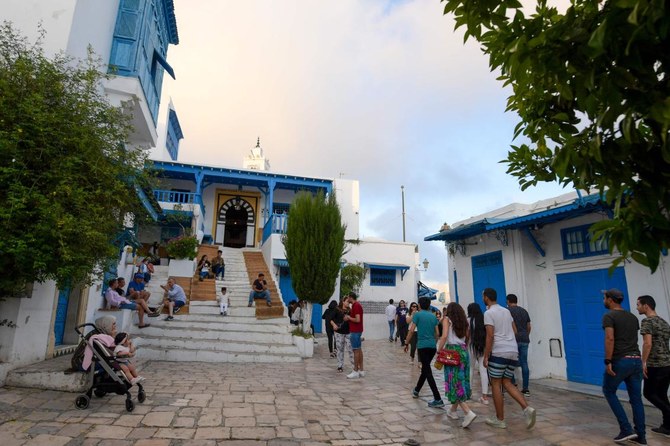
Tunisians cooks sell a local version of the donut in the village of Sidi Bou Said, some 20 kilometers northeast of Tunis, on May 30, 2020, after shops reopened following a 3 month shutdown. (AFP)
2 / 2
Tunisians walk in a street in the village of Sidi Bou Said, some 20 kilometers northeast of Tunis, on May 30, 2020, after shops reopened following a 3 month shutdown due to COVID-19. (AFP)
Short Url
Updated 04 June 2020
Follow

Tunisians emerge from lockdown into mosques and cafes

  • Schools will stay closed to most students until the start of the new academic year in September
  • The government still restricts social gatherings at homes and urges the wearing of masks

TUNIS: Tunisians returned to mosques and cafes on Thursday as the country ended most lockdown restrictions after largely containing the spread of the novel coronavirus for now.
Sitting with friends at the Brazil coffeeshop in the Ibn Khaldoun district of Tunis, schoolteacher Nizar Jamal said he was glad to resume his daily chats with friends.
“We are again breathing the air of life. We missed the smell of coffee a lot,” he said.
Tunisia in March closed its international borders, stopped all movement between towns and cities, shuttered mosques, shops, schools, cafes and restaurants, imposed a nightly curfew and stopped people leaving homes at day for most reasons.
It has recorded 1,048 cases of the coronavirus and 48 deaths, compared with nearly 10,000 cases in neighboring Algeria. The only recent cases came from people arriving into quarantine from abroad.
Schools will stay closed to most students until the start of the new academic year in September and the government still restricts social gatherings at homes and urges the wearing of masks. International borders will reopen fully in late June.
In another Tunis district, Menzah 9, a cafe owner who gave only his first name, Mahmoud, said he was relieved to have reopened.
“This cafe provides work for 20 families. We have suffered a lot from stopping work for three months and we hope to make up for it soon,” he said.
Tunisia’s government has announced compensation measures to help businesses and needy families with the economic effects of the lockdown and has agreed a package of financial assistance from the International Monetary Fund.


January settler attacks cause record West Bank displacement since Oct 2023: UN

A photograph shows Israeli flags and a Gush Etzion council flag at the newly built Israeli settler outpost of “Yatziv.”
Updated 49 min 22 sec ago
Follow

January settler attacks cause record West Bank displacement since Oct 2023: UN

  • At least 694 Palestinians were forcefully driven from their homes last month, according OCHA figures
  • OHCHR said in late January that settler violence has become a key driver of forced displacement in the West Bank

RAMALLAH: Israeli settler violence and harassment in the occupied West Bank displaced nearly 700 Palestinians in January, the United Nations said Thursday, the highest rate since the Gaza war erupted in October 2023.
At least 694 Palestinians were forcefully driven from their homes last month, according to figures from the UN’s humanitarian agency OCHA, which compiles data from various United Nations agencies.
The UN Human Rights Office (OHCHR) said in late January that settler violence has become a key driver of forced displacement in the West Bank.
January’s displacement numbers were particularly high in part due to the displacement of an entire herding community in the Jordan Valley, Ras Ein Al-Auja, whose 130 families left after months of harassment.
“What is happening today is the complete collapse of the community as a result of the settlers’ continuous and repeated attacks, day and night, for the past two years,” Farhan Jahaleen, a Bedouin resident, told AFP at the time.
Settlers in the West Bank, which Israel has occupied since 1967, use herding to establish a presence on agricultural lands used by Palestinian communities and gradually deny them access to these areas, according to a 2025 report by Israeli NGO Peace Now.
To force Palestinians out, settlers resort to harassment, intimidation and violence, “with the backing of the Israeli government and military,” the settlement watchdog said.
“No one is putting the pressure on Israel or on the Israeli authorities to stop this and so the settlers feel it, they feel the complete impunity that they’re just free to continue to do this,” said Allegra Pacheco, director of the West Bank Protection Consortium, a group of NGOS working to support Palestinian communities against displacement.
She pointed to a lack of attention on the West Bank as another driving factor.
“All eyes are focused on Gaza when it comes to Palestine, while we have an ongoing ethnic cleansing in the West Bank and nobody’s paying attention,” she told AFP.
West Bank Palestinians are also displaced when Israel’s military destroys structures and dwellings it says are built without permits.
In January, 182 more Palestinians were displaced due to home demolitions, according to OCHA.
Excluding Israeli-annexed east Jerusalem, the West Bank is home to more than 500,000 Israelis living in settlements and outposts considered illegal under international law.
Around three million Palestinians live in the West Bank.