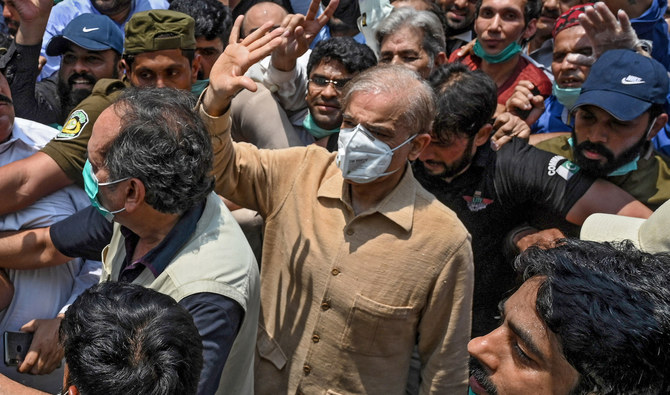
LAHORE: The Lahore High Court on Wednesday granted pre-arrest bail till June 17 to Punjab’s former chief minister Shahbaz Sharif in assets beyond means case that is being investigated by the country’s National Accountability Bureau (NAB).
The court’s division bench, headed by Justice Tariq Abbasi, heard the petition to stop the country’s anti-graft agency from making the arrest since Sharif was cooperating with the investigators.
“The court has accepted the pre-arrest bail plea of Mian Shahbaz Sharif and has restrained NAB from his arrest till June 17, 2020. The court asked the petitioner to furnish a bail bound worth half a million rupees,” Sharif’s lawyer, Azam Nazir Tarar, told Arab News after the proceedings.
The country’s anti-corruption body is investigating a matter related to the possession of assets beyond the politician’s stated means of income and alleged money laundering charges.
NAB summoned Sharif, who is also the leader of the opposition in the National Assembly of Pakistan, for investigation on June 2, but he did not appear before the authorities and sent a letter wherein he said that he was 69 years old and a cancer survivor and did not want to talk undue health risks during the time of coronavirus pandemic.
Sharif also requested the NAB authorities to interview him on Skype and sent a written reply to the questionnaire sent by the investigation agency through its representative.
NAB did not accept the plea and issued Sharif’s arrest warrants. A NAB team also reached his Model Town residence in Lahore on Tuesday to take him into custody, spending about 90 minutes to detain him, but it later returned to its office since the former Punjab chief minister was not found at his home.
Sharif had already filed a pre-arrest bail plea at the Lahore High Court which was fixed for a hearing on Wednesday. His lawyers submitted that NAB had been leveling allegations against their client for the last 16 months but the agency had failed to file any reference against him.
They also claimed that the proceedings of the NAB case were based on mala fide intention since the agency had summoned Sharif on June 2 while his arrest warrants had been issued on May 28.
NAB prosecutor pleaded that the anti-graft watchdog had sufficient evidence against the leader of the opposition to arrest him since he was involved in money laundering and possessing assets beyond his stated means of income. He also argued that the court had previously rejected the bail plea of Hamza Shahbaz, Sharif’s son, and two other accused in a similar case.
The court granted pre-arrest bail to Sharif till the 17th of this month, instructing him to cooperate with the agency in its investigations.
“The authorities have issued arrest warrant of Muhammad Shahbaz Sharif in the assets beyond means case. The court has granted him pre-arrest bail and told the accused to cooperate with NAB. The agency will also honor the court order,” a NAB official told Arab News.
Leaders of Sharif’s Pakistan Muslim League-Nawaz (PML-N) reacted strongly to the development, blaming the government for politically victimizing the opposition.
“The PML-N is ready for accountability. NAB should file references against us in courts instead of arresting us. We are ready to face any charges, but the government has nothing solid against us and is using unethical tactics. It has adopted a vindictive approach,” former PML-N prime minister Shahid Khan Abbasi told Arab News.


![]()

Court grants Shahbaz Sharif pre-arrest bail in assets beyond means case
Short Url
https://arab.news/5qanx
Court grants Shahbaz Sharif pre-arrest bail in assets beyond means case
- The country’s anti-graft watchdog raided his house on Tuesday to arrest him
- Sharif’s party leaders maintain the government is trying to politically victimize the opposition
Latest updates


Recommended


© 2026 SAUDI RESEARCH & PUBLISHING COMPANY, All Rights Reserved And subject to Terms of Use Agreement.