Industry experts discuss future of e-gaming in Middle East

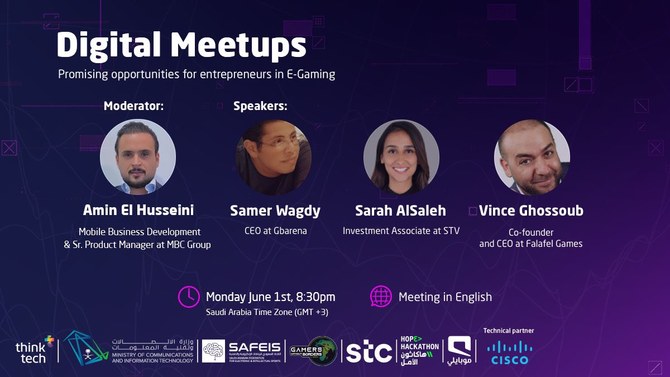
Games developers, e-sports enthusiasts and investors gathered online on Monday for a virtual “meetup” during which they discussed e-gaming opportunities in the MENA region. (Supplied)
Short Url
Updated 02 June 2020
Follow

Industry experts discuss future of e-gaming in Middle East

  • Organized by the Saudi Ministry of Communications and Information Technology’s ThinkTech project, “Promising opportunities for entrepreneurs in e-gaming” aimed to highlight the important role of e-sports

RIYADH: Games developers, e-sports enthusiasts and investors gathered online on Monday for a virtual “meetup” during which they discussed e-gaming opportunities in the MENA region.

Organized by the Saudi Ministry of Communications and Information Technology’s ThinkTech project, “Promising opportunities for entrepreneurs in e-gaming” aimed to highlight the important role of e-sports in the future of the gaming industry.

The event was moderated by Amin El-Husseini, mobile business development and senior product manager at media company MBC Group, and the speakers included Sarah Al-Saleh, an investment associate at venture capital firm STV, Vince Ghossoub, the co-founder and CEO of Lebanese web and mobile game developer Falafel Games, and Samer Wagdy, the CEO of GBarena, an Egyptian gaming platform that helps organize and manage online gaming tournaments.

Ghossoub said that developers of mobile games in the region can easily compete in the global market.

“In my opinion, our arena of competition is global” he said. “Let’s say there are three or four, or even 10, developers in the region; they are not competitors in one market, they are more like small tribes competing on the edge of a large empire dominated by multinational gaming giants.”

He gave a game that Falafel is working on as an example of how this global approach might work, especially when demand for additional languages is taken into consideration.

“One of the new multiplayer competitive games we are releasing is a trivia quiz game,” said Ghossoub. “Look up all the best word games in the world, and they don’t have Arabic as a language. And even if they did, they cannot do the content. So you can actually compete with a subpar product but better Arabic content.”

Wagdy discussed the state of e-sports in the region, and in particular how mobile games are starting to gain a foothold as most game publishers add them to their portfolios.

“There’s….data to show how it can help publishers to develop their games to get more activity,” he said.

He also spoke about how platforms such as GBarena can help games publishers to engage more with players, and how local publishers and developers could benefit from similar services.

“We can help games publishers to increase activity and reach out to more gaming communities, which helps them to get more sponsors,” he said. “Not just the big sponsors, but small sponsors who could get into the area of gaming as well.”

From an investor’s perspective, Al-Saleh spoke about the kind of investments developers can expect when pitching games.

“Gaming in particular is unique,” she said. “There’s IP (intellectual property), content, and technology. There are companies that are rolling out the game, such as developers and publishers. And there are businesses that are part of the ecosystem, such as payment companies, streaming companies, and so on. Investment requirements for those companies are different.”

She said that venture capitalists offer a way for games companies to secure funding for a project, but added that investors have high expectations in such situations.

“Venture capital is like a marathon, and the founder and the investor are on a journey,” said Al-Saleh. “It’s a long-term endeavor, which is high-risk and high-reward. A venture-capital investor who puts money in a gaming company expects it to grow exponentially to justify the risk they take at the beginning of the journey. But not all companies are suited for that kind of investment; it really depends on the fund requirement.”

ThinkTech’s goal is to foresee the future of and spread digital awareness about emerging technologies, to create a stimulating digital environment.


Makkah’s urban shift enhances the city’s quality of life

Updated 08 February 2026
Follow

Makkah’s urban shift enhances the city’s quality of life

  • By harmonizing its religious heritage with modern urban development, Makkah is proving that a city can honor its past while vigorously embracing the future

MAKKAH: Islam’s holiest city is currently witnessing a qualitative urban shift, one that seamlessly blends its profound spiritual sanctity with a modern, vibrant lifestyle. By integrating cultural, educational, and entertainment initiatives, Makkah is redefining the visitor experience and significantly enhancing the quality of life for its residents, directly supporting the goals of Saudi Vision 2030.

The city’s transformation was recently highlighted by the success of the Makkah winter season. The event attracted approximately 400,000 visitors — over 60% of whom were locals — demonstrating a strong domestic demand for high-quality public spaces.

The season revitalized community interaction, driving a 35% increase in visits to recreational sites and creating more than 1,200 temporary jobs for the local workforce.

Central to this urban renaissance is the Hira Cultural District. Since opening its doors in January 2023 near the historic Mount Hira, the district has become a definitive landmark that bridges Islamic history with contemporary identity.

Makkah’s Hira Cultural District has become a definitive landmark that bridges Islamic history with contemporary identity. (SPA photo)

Far from being a static monument, the district has cultivated a thriving creative economy. Its craftsmanship program, which features over 100 artisans, has generated up to SAR 3 million in sales and attracted 130,000 visitors to live workshops. These interactive spaces allow visitors to engage directly with the region’s heritage, moving beyond passive observation to active participation.

A living legacy 

The shift extends to Makkah’s broader ecosystem of museums and cultural sites, which are now positioned as key pillars of cultural tourism. Facilities like the Revelation Exhibition use cutting-edge technology and multilingual content to narrate the story of the Holy Quran’s revelation, offering an immersive experience that complements the spiritual journey of pilgrims.

These efforts align with the “Makkah: A Living Legacy” campaign, which seeks to document the city’s historical narrative and preserve its collective memory. Recent months have seen a surge in educational workshops for university students and tour guides, ensuring that the human element of Makkah’s history is conveyed with accuracy and depth.

City’s transformation recently highlighted by the success of the Makkah winter season. (SPA photo)
 

Economic and social impact 

The results of this integrated approach are tangible. Specialized museums and restored historic sites now attract up to 1.6 million annual visitors. Crucially, this cultural enrichment is encouraging pilgrims to linger longer, increasing the average duration of stay by 18%.

By harmonizing its religious heritage with modern urban development, Makkah is proving that a city can honor its past while vigorously embracing the future, offering a holistic experience that nourishes both the soul and the community.