

From Jeddah to Jerusalem, the faithful return to their mosques

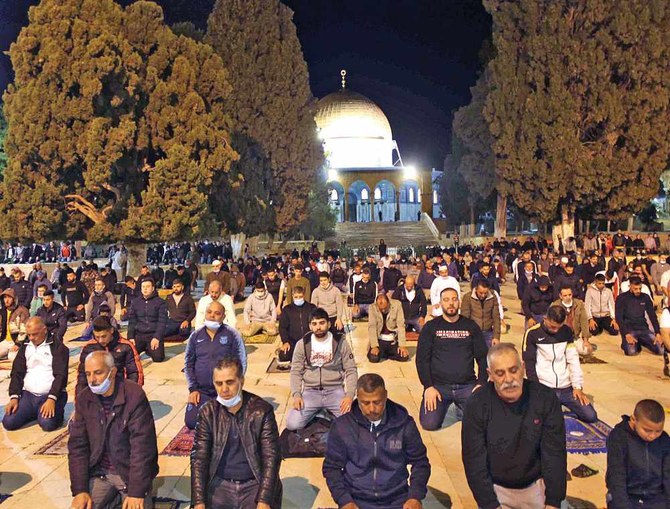
Jerusalem’s Al-Aqsa Mosque compound reopened on Sunday after a more than two-month lockdown aimed at containing the coronavirus crisis. (Supplied)
Short Url
Updated 01 June 2020
Follow

From Jeddah to Jerusalem, the faithful return to their mosques

  • Doors open again after virus lockdown
  • Internal flights resume from Saudi airports

JEDDAH/AMMAN: It began at dawn. As the first light appeared on the horizon and the call to Fajr prayer rang out, Muslims from Riyadh to Madinah and Jeddah to Jerusalem returned to their mosques on Sunday after a two-month break that for many was unbearable.

More than 90,000 mosques throughout Saudi Arabia were deep cleaned and sanitized in preparation for the end of the coronavirus lockdown. Worshippers wore face masks, kept a minimum of two meters apart, brought their own prayer mats and performed the ablution ritual at home.

“My feelings are indescribable. We are so happy. Thank God we are back in His house,” said Abdulrahman, 45, at Al-Rajhi mosque in Riyadh, where worshippers had their temperatures checked before entering.

Television screens inside the mosque displayed written instructions, including the need to maintain a safe distance from others to prevent the spread of COVID-19.

In Jerusalem, at 3:30 a.m. thousands crowded outside three gates assigned to be opened to allow Muslims to enter Al-Aqsa Mosque. Young and old, men and women, many with their phone cameras on, chanted religious songs as they waited to return for the first time since the virus lockdown began.

“Those wishing to pray were checked for their temperature and those without a mask were given one by Waqf staff. All were asked to stay a safe distance from each other when they prayed,” Mazen Sinokrot, a member of the Islamic Waqf, told Arab News.

Wasfi Kailani executive director of the Hashemite Fund for the Restoration of Al-Aqsa Mosque told Arab News that enabling Muslims to pray in large numbers and according to health requirements had gone smoothly.

“People cooperated with the local Muslim authorities and followed the regulations.” The people of Jerusalem had shown a high degree of responsibility, he said.

Israeli police spokesman Miky Rosenfeld told Arab News that extra police units had been  mobilized in the old city of Jerusalem for the reopening of Al-Aqsa. 

“People arrived in the areas scheduled according to health and security guidelines,” he said.

Khaled Abu Arafeh, a former Minister for Jerusalem in the Ismael Haniyeh government in 2006, said people were happy to be able to pray once more at Islam’s third-holiest site.

“It is time to open a new page in cooperation with local institutions and with Jordan to regain all that has been lost over the years,” he told Arab News.

“The Waqf council has done a good job in dealing with the contradictions and pressures that they are under, which is like walking on a knife’s edge as they deal with the occupiers on the one hand and the health situation on the other, while also trying to be responsive to the desires of worshippers.”

Elsewhere in Saudi Arabia, commercial flights took to the air again, office staff returned to work and restaurants resumed serving diners as life began a gradual return to normal after the coronavirus lockdown.

Eleven of the Kingdom’s 28 airports opened on Sunday for the first time since March 21. “The progressive and gradual reopening aims at controlling the crowds inside airports because we want to achieve the highest health efficiency,” civil aviation spokesman Ibrahim bin Abdullah Alrwosa told Arab News.

No one without an e-ticket will be allowed into an airport, face masks must be worn and safe distancing observed, and children under 15 may not travel unaccompanied.


Sudanese paramilitary forces kill at least 28 people in an attack in Darfur, medical group says

Updated 6 sec ago
Follow

Sudanese paramilitary forces kill at least 28 people in an attack in Darfur, medical group says

  • At least 39 people, including 10 women, were wounded in the attack, the medical group said
  • Emergency Lawyers said RSF fighters torched many houses in the town, forcing people to flee to nearby villages

CAIRO: An attack by Sudanese paramilitary forces on a stronghold of a Darfur tribal leader left at least 28 people dead, a doctors group said Tuesday, the latest in a devastating war with no resolution in sight.
The paramilitary Rapid Support Forces on Monday rampaged through the town of Misteriha in North Darfur province, according to the Sudan Doctors Network, which tracks the country’s ongoing war.
The town is a stronghold of Arab tribal leader Musa Hilal who also hails from the Rizeigat Arab tribe as the majority of the members of the paramilitary RSF.
At least 39 people, including 10 women, were wounded in the attack, the medical group said.
There was no immediate comment from the RSF and motives for the attack were not immediately known.


Sudan’s war erupted in 2023 after tensions between the Sudanese army and the rival RSF escalated into fighting that began in Khartoum, the country’s capital, and spread nationwide. The conflict has killed thousands and triggered mass displacement, disease outbreaks and severe food insecurity. Aid workers have been frequently targeted.
The medical group said RSF shelling hit the town’s health care center on Monday, after which the paramilitary fighters assaulted medical staff and detained at least one of them.
The RSF fighters had begun their offensive on the town over the weekend with drone strikes that hit Hilal’s guesthouse. On Monday, they launched a major ground offensive and took over the town.
Emergency Lawyers, an independent group documenting atrocities in Sudan, said RSF fighters torched many houses in the town, forcing people to flee to nearby villages.
The seizure of Misteriha would likely assert RSF control of Darfur. However, it risks escalating tribal tensions in an area long known for violence and war.
Monday’s attack came four months after the RSF overran el-Fasher, the provincial capital of North Darfur after 18 months of siege. The paramilitaries killed more than 6,000 people between Oct. 25 and Oct. 27 in the city. The attack was marked by atrocities that UN-backed experts said bore ” the hallmarks of genocide.”
The war has created the world’s largest humanitarian crisis, with over 14 million forced to flee their homes. It has fueled disease outbreaks and pushed parts of the country into famine that still spreads as fighting shows no sign of abating.
The latest report by the Integrated Food Security Phase Classification earlier this month warned that severe acute malnutrition, the most dangerous and deadly form of malnutrition, is expected to increase to 800,000 cases, up 4 percent from 2025.
Aid groups have long struggled to meet the growing needs of displaced people across the country and called for a ceasefire to secure aid delivery to remote areas in Darfur and Kordofan — another hotbed in the war.
“The main thing that needs to happen is, of course, a ceasefire,” said Zia Salik, interim UK director of Islamic Relief, an aid group working in Sudan. “Ultimately, that is what’s causing the pain and the difficulty for all of the civilians that are caught in the crosshairs.”