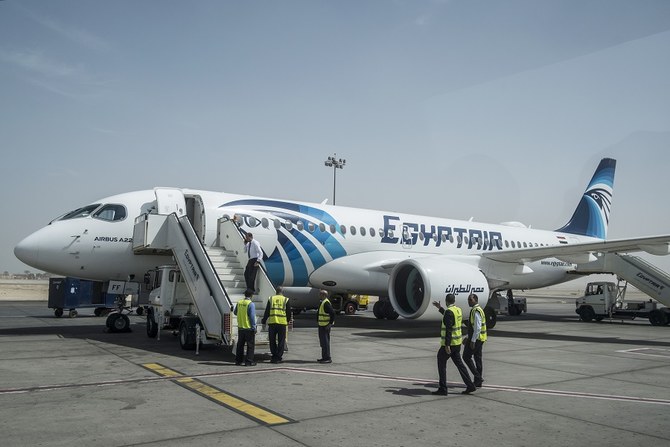
DUBAI: Egypt continues to repatriate stranded citizens from coronavirus hotspots at the country’s Marsa Alam International Airport, local daily Egypt Today reported.
The airport has received over 10,000 citizens and operated more than 60 flights by EgyptAir and Air Cairo airlines since operations began in April.
Repatriated Egyptians arrived from more than 36 countries globally after coordination between ministries and the tourism industry, and provided hotels to host the Egyptians for a one-week quarantine, a source said.
Over 8,000 Egyptians left hotels after completing their obligatory quarantine period, and after the duration was lowered to one week, more citizens were discharged, medical sources said.
Earlier on Thursday, the airport received a repatriation flight arriving from Abu Dhabi, carrying 245 citizens.
Meanwhile, Egypt has prepared plans to reopen churches in the country amid the coronavirus outbreak while following precautionary measures to prevent the virus spread, Head of the Evangelical community in Egypt Andrea Zaki said.
The committee is expected to submit its proposal during the council’s next available meeting, she added.

Egypt receives more stranded citizens amid coronavirus pandemic
https://arab.news/7jp2b
Egypt receives more stranded citizens amid coronavirus pandemic
- The airport has received over 10,000 citizens and operated more than 60 flights
- Egypt has prepared plans to reopen churches in the country
‘No good actors’ in Sudan war, says Trump’s Middle East adviser
- Resolving conflict a ‘deeply felt concern’ of US president, Massad Boulos tells UN Security Council
- ‘Today, Sudan faces the biggest and gravest humanitarian catastrophe in the world’
LONDON: A senior adviser to US President Donald Trump on Thursday criticized Sudan’s warring factions as he warned that no military solution could resolve the civil war.
Massad Boulos, Trump’s senior adviser on African, Arab and Middle Eastern affairs, was speaking at a ministerial-level UN Security Council briefing on Sudan.
A UN fact-finding mission has determined that the paramilitary Rapid Support Forces’ siege of the city of El-Fasher likely constituted genocide.
Resolving the almost three-year-long war in Sudan is a “deeply felt concern” of Trump, Boulos told the briefing, which was chaired by UK Foreign Secretary Yvette Cooper.
“Under President Trump and Secretary (of State Marco) Rubio’s leadership and close direction, I am helping to spearhead US efforts to achieve peace in Sudan,” he said.
“Today, Sudan faces the biggest and gravest humanitarian catastrophe in the world. After more than 1,000 days of needless conflict between the Sudanese Armed Forces and the Rapid Support Forces, the toll is staggering.”
In the eyes of the US, “there are no good actors in this conflict,” Boulos said, criticizing both factions for carrying out “serious human rights violations and abuses.”
He highlighted apparent efforts by coordinated Islamist networks to regain political influence in the fractured Sudanese state.
“Let me be clear: Efforts by Islamist networks or any extremist political movement to manipulate this conflict, derail a civilian transition, or reassert authoritarian control will not be tolerated by the US,” Boulos said.
“We will use the tools at our disposal — including sanctions and other measures — to hold accountable those who enable violence, undermine democratic governance, or threaten regional stability.”
His remarks came as the US announced fresh sanctions on RSF commanders, citing their record of “human rights violations, including ethnic killings, torture, starvation tactics and sexual violence.”
The paramilitary figures are now “subject to asset freezes, arms embargoes and travel bans,” Boulos said, adding: “We are working closely with partners in this room — including the United Kingdom, Egypt, Saudi Arabia and the UAE, and several others — to press for an immediate humanitarian truce, and without preconditions.
“Such a truce must guarantee sustained, unhindered humanitarian access across conflict lines and borders.”
He urged the international community to support five pillars of engagement to resolve the crisis: achieving an immediate humanitarian truce; coordinated efforts to ensure sustained humanitarian access; a phased approach for negotiating a permanent ceasefire; a structured political process that leads to a civilian-led transitional government and democratic elections; and a robust reconstruction and recovery effort.
“The US remains committed to working with all of you to end this tragic conflict and to support a peaceful, civilian future for Sudan,” Boulos said.


