

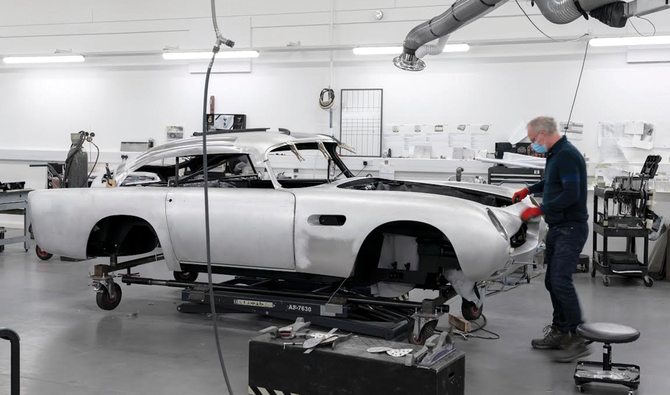
Production of Aston Martin DB5 resumes after 55 years

Each of the 25 new cars is being built using a blend of Sir David Brown-era old world craftsmanship, with the application of modern engineering advancements and performance enhancements.
Short Url
Updated 31 May 2020
Follow

Production of Aston Martin DB5 resumes after 55 years

Dubbed “the most famous car in the world” and renowned as being among the most sought-after classic Aston Martin models, the DB5 has become a byword for timeless style and sports car desirability. Fewer than 900 saloon examples were built by the brand between 1963 and 1965, with by far the most famous of the original owners being the world’s best-known secret agent — James Bond — who first drove the car that is today inextricably linked with him in the 1964 film, Goldfinger.

Now, 55 years after the last new DB5 rolled off the production line at Aston Martin’s then-global manufacturing base in Newport Pagnell, Buckinghamshire, work is once again underway there on a strictly limited number of new DB5 models. Created in association with the producers of the James Bond films, EON Productions, and featuring a broad suite of working gadgets first seen on screen in the 1964 film, the Aston Martin DB5 Goldfinger Continuation cars are history in the making.

Each DB5 Goldfinger continuation car is priced at 2.75 million euros ($3.05 million), plus taxes.

The DB5 Goldfinger Continuation construction process — which takes around 4,500 hours per car — is being undertaken at Aston Martin’s Heritage Division headquarters in Newport Pagnell, Buckinghamshire.

Each of the 25 new cars is being built using a blend of Sir David Brown-era old world craftsmanship, with the application of modern engineering advancements and performance enhancements, alongside the integration of cutting-edge gadgets developed in association with Chris Corbould OBE, the special effects supervisor who has worked on more than a dozen Bond films.

Clive Wilson, Heritage program manager, said: “Seeing the first customer car move painstakingly through the intricate production process we have created really is quite a thrill.

“Obviously we have not, as a business, made a new DB5 for more than 50 years, so to be involved in the building of these cars, which will go on to form part of Aston Martin’s history, is something I’m sure all of us will be telling our grandkids about!”

Paul Spires, president of Aston Martin Works where the original DB5 was built and the new cars are also being created, said: “We are making, perhaps, some of the most desirable ‘toys’ ever built for 25 very lucky buyers worldwide.

“Creating the DB5 Goldfinger Continuation cars and working with EON Productions and special effects supervisor, Chris Corbould, is something truly unique and a real career highlight for everyone involved here at Aston Martin Works.”

First deliveries of the DB5 Goldfinger Continuation to customers will commence in the second half of 2020.


Aramco Digital to launch National Industrial Network on 450 MHz band

Updated 12 January 2026
Follow

Aramco Digital to launch National Industrial Network on 450 MHz band

Aramco Digital, the digital and technology arm of Aramco, is preparing to launch its National Industrial Network operating on the 450 MHz spectrum, a network designed to enable secure, resilient, and high-reliability industrial communications across Saudi Arabia. The network has been engineered as a mission-critical industrial infrastructure to deliver high levels of security, flexibility, and reliability to meet the needs of industrial sectors. It provides wide-area coverage with advanced protection standards, supporting operational environments that require continuous performance and dependable connectivity for critical facilities and assets.

“The National Industrial Network has been designed to support the advanced operational requirements of modern industrial environments, aimed at enhancing efficiency, strengthening business continuity, and enabling a new class of highly reliable industrial communications. Together with next-generation mission-critical smart radios, the network aims to help build a future-ready industrial infrastructure that enables real-time data insights, supports industrial digital transformation, and aligns with the ambitions of Saudi Vision 2030,” said Nabil Al-Nuaim, Aramco Digital CEO.

Unlike public networks, the National Industrial Network has been purpose-built for industrial environments, enabling connectivity for critical assets, supply chains, logistics operations, and autonomous mobility systems. The network seeks to elevate smart industrial services, supporting real-time monitoring, automation, enhanced safety, and higher operational efficiency across industrial sectors.

As part of the launch, Aramco Digital plans to introduce an integrated portfolio of industrial digital solutions powered by the 450 MHz network. These include specialized connectivity packages tailored to diverse sector needs, along with a new generation of mission-critical smart radios designed specifically for industrial operations. The devices combine rugged high-performance design and industrial safety compliance with advanced artificial intelligence capabilities, enhanced sensing technologies, extended battery life, and real-time on-device data processing, helping improve accuracy, safety, and operational continuity in complex environments.

The network has also been designed to support a wide spectrum of industrial IoT applications, including asset condition and performance monitoring, fleet tracking, air-quality and environmental sensing, intelligent video monitoring, smart metering, lighting and infrastructure control, as well as mobility and fleet-management solutions. These capabilities enhance operational transparency, automation, and efficiency across both industrial and public sectors.

The National Industrial Network aims to help establish a strong technological foundation for Saudi Arabia’s next industrial phase, contributing to the objectives of Vision 2030 by delivering highly reliable, nationwide industrial connectivity that enables automation, intelligence, and advanced digital services across vital sectors. By developing connectivity solutions aligned with the needs of modern industrial operations, Aramco Digital is helping shape the future of mission-critical digital infrastructure in the Kingdom, moving beyond traditional telecommunications to enable continuous interaction between devices, machines, and AI-powered systems, and strengthening real-time decision-making through edge processing.

The 450 MHz National Industrial Network represents more than an improvement in coverage or performance. It is a strategic step toward smarter, more autonomous, and technology-driven industrial ecosystems that enhance operational excellence and set a new benchmark for advanced digital infrastructure in Saudi Arabia.

With the accelerating pace of digital transformation in the Kingdom, secure and reliable connectivity has become a fundamental pillar in supporting operational requirements and driving economic growth. Organizations across various sectors— including industrial sectors and those enabling future economies — are increasingly relying on advanced connectivity solutions and technologies to enhance safety and reliability, improve operational efficiency, and unlock new horizons for sustainable economic development.