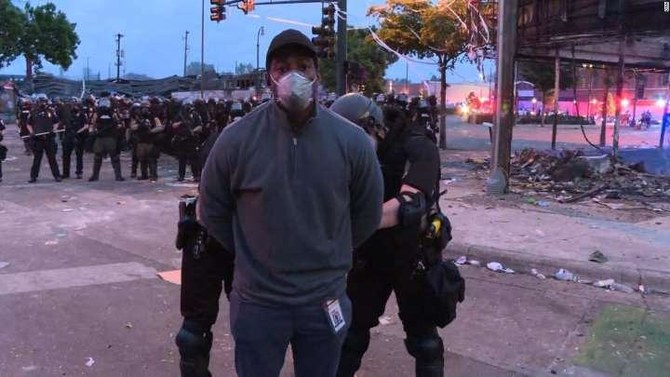
WASHINGTON: Police in Minneapolis released a CNN reporter who was led off in handcuffs along with his film crew while reporting live on television early Friday morning during violent protests in the city.
Officers gave no explanation as they escorted reporter Omar Jimenez away. He had just shown a protester being arrested when about half a dozen police officers in gas masks surrounded him. More than an hour later, the crew was released.
“What gave me one bit of comfort was that it happened on live TV,” Jimenez told viewers after he was released. “You don’t have to doubt my story it’s not filtered in any way; you saw it with your own eyes.”
The striking footage of the arrest could add to racial tension in the city and across the country, where sympathy protests have taken place. Jimenez is black, while most of the police officers who arrested him appeared to be white.
Thursday marked a third night of arson, looting and vandalism in Minnesota over the death of a black man, George Floyd, seen on video gasping for breath while a white police officer knelt on his neck.
“A CNN reporter and his production team were arrested this morning in Minneapolis for doing their jobs, despite identifying themselves — a clear violation of their First Amendment rights. The authorities in Minnesota, including the governor, must release the three CNN employees immediately,” CNN wrote on Twitter before the crew were released.
CNN anchor John Berman told viewers about an hour after the arrest that CNN President Adam Zucker had spoken with Minnesota Governor Tim Walz, who said he “deeply apologizes” and was working to have the crew released immediately.
Jimenez said the crew had been standing on a street for about an hour and a half before police activity kicked up. They moved onto a corner to get out of the way, he said.
On air, Jimenez told the officers wearing gas masks and face shields that he wanted to know where to move to get out of their way and explained he was a member of the press.
“This is among the state patrol unit that was advancing up the street, seeing and scattering the protesters at that point for people to clear the area. And so we walked away,” Jimenez said before being told he was under arrest and handcuffed by two officers. “Why am I under arrest, sir?“
Walz, expected to have a press conference later on Friday, has declared a state of emergency in Minnesota and ordered the National Guard activated. President Donald Trump suggested in a tweet that looters would be shot. Twitter hid Trump’s tweet with a warning for “glorifying violence.”
Protests also erupted in other major cities around the country, including Louisville, Kentucky, where police said seven people had been shot.

Police free CNN reporter arrested live on TV covering Minneapolis protests
https://arab.news/nyz7y
Police free CNN reporter arrested live on TV covering Minneapolis protests
- Omar Jimenez had just shown a protester being arrested when about half a dozen police officers in gas masks surrounded him
- Thursday marked a third night of arson, looting and vandalism in Minnesota State over the death of George Floyd while in police custody
WEF report spotlights real-world AI adoption across industries
DUBAI: A new report by the World Economic Forum, released Monday, highlights companies across more than 30 countries and 20 industries that are using artificial intelligence to deliver real-world impact.
Developed in partnership with Accenture, “Proof over Promise: Insights on Real-World AI Adoption from 2025 MINDS Organizations” draws on insights from two cohorts of MINDS (Meaningful, Intelligent, Novel, Deployable Solutions), a WEF initiative focused on AI solutions that have moved beyond pilot phases to deliver measurable performance gains.
As part of its AI Global Alliance, the WEF launched the MINDS program in 2025, announcing its first cohort that year and a second cohort this week. Cohorts are selected through an evaluation process led by the WEF’s Impact Council — an independent group of experts — with applications open to public- and private-sector organizations across industries.
The report found a widening gap between organizations that have successfully scaled AI and those still struggling, while underscoring how this divide can be bridged through real-world case studies.
Based on these case studies and interviews with selected MINDS organizations, the report identified five key insights distinguishing successful AI adopters from others.

It found that leading organizations are moving away from isolated, tactical uses of AI and instead embedding it as a strategic, enterprise-wide capability.
The second insight centers on people, with AI increasingly designed to complement human expertise through closer collaboration, rather than replace it.
The other insights focus on the systems needed to scale AI effectively, including strengthening data foundations and strategic data sources, as well as moving away from fragmented technologies toward unified AI platforms.
Lastly, the report underscores the need for responsible AI, with organizations strengthening governance, safeguards and human oversight as automated decision-making becomes more widespread.
Stephan Mergenthaler, managing director and chief technology officer at the WEF, said: “AI offers extraordinary potential, yet many organizations remain unsure about how to realize it.
“The selected use cases show what is possible when ambition is translated into operational transformation and our new report provides a practical guide to help others follow the path these leaders have set.”
Among the examples cited in the report is a pilot led by the Saudi Ministry of Health in partnership with AmplifAI, which used AI-enabled thermal imaging to support early detection of diabetic foot conditions.
The initiative reduced clinician time by up to 90 percent, cut treatment costs by as much as 80 percent, and delivered a 10 time increase in screening capacity. Following clinical trials, the solution has been approved by regulatory authorities in Saudi Arabia, the UAE and Bahrain.
The report also points to work by Fujitsu, which deployed AI across its supply chain to improve inventory management. The rollout helped cut inventory-related costs by $15 million, reduce excess stock by $20 million and halve operational headcount.
In India, Tech Mahindra scaled multilingual large language models capable of handling 3.8 million monthly queries with 92 percent accuracy, enabling more inclusive access to digital services across markets in the Global South.
“Trusted, advanced AI can transform businesses, but it requires organizing data and processes to achieve the best of technology and — this is key — it also requires human ingenuity to maximize returns on AI investments,” said Manish Sharma, chief strategy and services officer at Accenture.