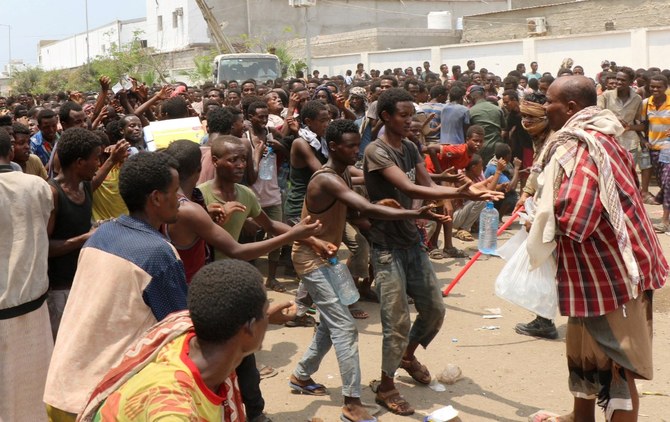
DUBAI: Information Minister Muammar Al-Iryani warned on Wednesday against the escalation of the Houthi militia's recruitment of African refugees and illegal immigrants to fight in the war that threatens the security and stability of Yemen and the region.
The Minister of Information stated that confessions of Somali refugees who were recruited by the Houthi militia after they were captured by the Yemeni army reveal the way the militia recruits African refugees by threatening and torturing them.
The Houthis using African migrants to carry out logistical and espionage activities, and force them to fight alongside them and smuggling contraband, the minister said.
Al-Iryani said the Houthi militia’s exploitation of refugees and illegal immigrants from the Horn of Africa in military actions against the national army is a war crime and a crime against humanity. He added that these practices are a clear indication of their depletion of Houthi fighters and their inability to recruit more fighters from the tribes.
Al-Iryani called on the United Nations and the International Organization for Migration to explicitly condemn these crimes and violations committed by the Houthi militia against African refugees and migrants in violation of international laws.


![]()


Yemen minister warns of Houthi recruitment of African refugees
Short Url
https://arab.news/y5f85
Yemen minister warns of Houthi recruitment of African refugees
- Confessions of Somali refugees who were recruited by the Houthis after they were captured by the Yemeni army reveal the way the militia recruits African refugees using threats

Lebanon, Jordan seek solutions after Damascus bans non-Syrian trucks
- Lebanon and Jordan are seeking a solution with Syria after the latter barred foreign trucks from entering its territory, officials from both countries told AFP on Tuesday.
BEIRUT: Lebanon and Jordan are seeking a solution with Syria after the latter barred foreign trucks from entering its territory, officials from both countries told AFP on Tuesday.
Damascus had issued a decision on Saturday stipulating that “non-Syrian trucks will not be allowed to enter” the country, and that goods being imported by road must be unloaded at specific points at border crossings.
The decision exempts trucks that are only passing through Syria to other countries.
Dozens of trucks unable to enter the country were lined up on the Lebanese side of the Masnaa border crossing on Tuesday, an AFP photographer saw.
Ahmad Tamer, head of land and maritime transportation at the Lebanese transport ministry told AFP that discussions were underway with Damascus over the decision.
He said the issue was not specifically targeting Lebanon — which is trying to reset ties with Damascus after the fall of Bashar Assad — adding that he hoped to hold a meeting with the Syrian side soon.
Lebanon sends around 500 trucks to Syria per day, according to Tamer.
In Jordan, also affected by the decision, transport ministry spokesperson Mohammed Al-Dweiri told AFP that “discussions are currently underway, and we are awaiting a response from the Syrian side regarding allowing foreign trucks to enter and cross.”
Dweiri said that Jordanian trucks were continuing to unload their cargo at the free zone at the Nassib border crossing with Syria despite some “confusion.”
Around 250 Jordanian trucks travel to Syria daily, according to him.
A source in the Syrian General Authority for Ports and Customs told AFP that the decision aimed to “regulate the movement of cargo through the ports.”
Representatives of unions and associations in Lebanon’s transport sector denounced the decision on Tuesday and warning of “negative repercussions,” according to the state-run National News Agency.
Syria is the only land route Lebanon can use to export merchandise to wealthy Gulf markets.
As part of continued attempts to rekindle ties, the two countries signed an agreement on Friday to hand around 300 Syrian convicts over to Damascus.
Damascus had issued a decision on Saturday stipulating that “non-Syrian trucks will not be allowed to enter” the country, and that goods being imported by road must be unloaded at specific points at border crossings.
The decision exempts trucks that are only passing through Syria to other countries.
Dozens of trucks unable to enter the country were lined up on the Lebanese side of the Masnaa border crossing on Tuesday, an AFP photographer saw.
Ahmad Tamer, head of land and maritime transportation at the Lebanese transport ministry told AFP that discussions were underway with Damascus over the decision.
He said the issue was not specifically targeting Lebanon — which is trying to reset ties with Damascus after the fall of Bashar Assad — adding that he hoped to hold a meeting with the Syrian side soon.
Lebanon sends around 500 trucks to Syria per day, according to Tamer.
In Jordan, also affected by the decision, transport ministry spokesperson Mohammed Al-Dweiri told AFP that “discussions are currently underway, and we are awaiting a response from the Syrian side regarding allowing foreign trucks to enter and cross.”
Dweiri said that Jordanian trucks were continuing to unload their cargo at the free zone at the Nassib border crossing with Syria despite some “confusion.”
Around 250 Jordanian trucks travel to Syria daily, according to him.
A source in the Syrian General Authority for Ports and Customs told AFP that the decision aimed to “regulate the movement of cargo through the ports.”
Representatives of unions and associations in Lebanon’s transport sector denounced the decision on Tuesday and warning of “negative repercussions,” according to the state-run National News Agency.
Syria is the only land route Lebanon can use to export merchandise to wealthy Gulf markets.
As part of continued attempts to rekindle ties, the two countries signed an agreement on Friday to hand around 300 Syrian convicts over to Damascus.
Latest updates


Recommended


© 2026 SAUDI RESEARCH & PUBLISHING COMPANY, All Rights Reserved And subject to Terms of Use Agreement.