

Airbus team arrives in Pakistan for PIA plane crash probe
Airbus team arrives in Pakistan for PIA plane crash probe/node/1679851/pakistan
Airbus team arrives in Pakistan for PIA plane crash probe
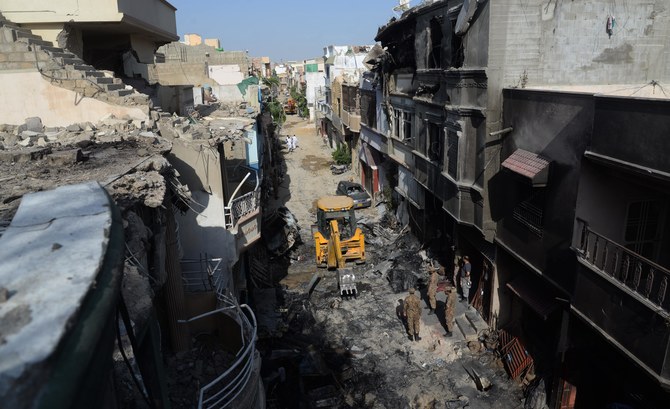
Pakistan army personnel remove debris from a residential street where a Pakistan’s International Airlines’ jet crashed on Friday. May 23, 2020 (AN Photo by S.A. Babar)
KARACHI: An Airbus team of investigators arrived in Karachi on Tuesday to probe the reasons for a plane crash involving a Pakistan International Airlines' (PIA) flight five days ago, a PIA spokesman told Arab News.
"The team arrived at Karachi airport at 5:38 am and will visit the spot of the accident after a briefing later during the day,” Abdullah Khan said.
The A320 Airbus was carrying 99 passengers from Lahore on PK 8303 when it crashed in a densely-populated residential area of Karachi, near the Jinnah International Airport, on Friday, just 22 minutes before landing.
The 11-member team of french experts, representing the European aircraft manufacturer, will assist the Pakistani side in investigating the incident.
Two passengers miraculously survived the tragic incident which claimed the lives of 97 people on board. No fatalities were reported on the ground, however, where several houses were damaged in a narrow street.
“The (Airbus) team will visit the (crash) site in the Model Colony area of the city as shifting of the plane’s debris from the site has also been stopped,” Radio Pakistan reported.
Pakistan’s seven-member team has already started investigating the incident.
It was the second PIA plane crash in less than four years. In 2016, a domestic flight of the national air career from Chitral to Islamabad crashed in a hilly area in which all 47 passengers and crew members lost their lives.
Federal Minister for Aviation Ghulam Sarwar Khan said after the crash that “Captain Sajjad Gull (who was flying the plane) was senior most A320 pilot with extensive flight experience.” He added that “the aircraft involved in the crash was 16 years old and was in a very good condition.”
According to the minister, the A320 joined the PIA fleet on dry lease six years ago and underwent its major A-check in March 2020.
“The aircraft carried out eight flights since 21st March, 2020, when the domestic and international flights were suspended in view of efforts to control the spread of COVID-19,” he informed.
ISLAMABAD: Muzaffar Hussain Shah bends down, picks up a brick from the rubble and cleans it with a hammer. Until a few weeks ago, the brick had been part of a home where Shah had lived for nearly five decades, since his birth.
The house in an informal settlement in Islamabad, which came to be known as Muslim Colony, was demolished in an anti-encroachment drive. Shah said he has spent past three weeks sleeping under the open sky and has been collecting the last remaining bricks to get by for a few more days.
Shah, 48, is one of nearly 15,000 people evicted by the Capital Development Authority (CDA) from the settlement, which was established in the 1960s to house laborers who built Pakistan’s capital of Islamabad, during a drive that began in November.
The decades-old settlement, located near the prime minister’s official residence and the Diplomatic Enclave, a specially designated area within the city that houses foreign embassies, high commissions and international missions, has now been reduced to a 712-kanal (89-acre) stretch of dust and debris.
“It feels as if there is neither a sky over our heads nor anyone behind our backs,” Shah told Arab News on Tuesday, surrounded by the rubble of his demolished home. “Nor is there anything ahead of us. We cannot see anything at all.”
Man collecting rubble from a demolished colony in Islamabad, Pakistan, on December 30, 2025. (AN photo)
While evacuated residents recount a tale of what they described as broken political promises and affiliation with the place, authorities say there were “obviously security concerns”, and that claims to the land were settled two decades ago.
During an interview with Arab News, Dr. Anam Fatima, director of municipal administration at the Islamabad Metropolitan Corporation, showed satellite images of the “informal settlement” from 2002.
The images showed significant population growth over the years, which she said indicated that most current residents arrived after 2002, when the government negotiated the resettlement of original residents in return for compensation.
“In 2002, it was decided that these people will be compensated, and they were accordingly compensated,” Fatima said.
“Seven hundred and fifty [residents] were found eligible. They were given plots in Farash Town,” she said about a neighborhood on Islamabad’s outskirts. “Some of them moved, some of them did not, but the original settlement was not removed, unfortunately.”
Man cutting tree trunk in Islamabad, Pakistan, on December 30, 2025. (AN photo)
The official attributed the survival of the settlement and its subsequent growth to “enforcement failure” and “changing policies” over the years, insisting that all legal formalities were met before the latest operation.
“Notices were given first to vacate and then after the evacuations had been done... people had completely moved their belongings, only then bulldozers were sent into the area,” Fatima said.
For the evacuated residents, the historical and emotional costs outweigh the legal arguments, they say. Many claim their families moved there more than six decades ago and were promised permanent housing in exchange for their labor.
Muhammad Hafeez, whose father arrived in 1972, lamented that the ones who had helped built Islamabad were being rewarded in the form of eviction from the same city.
“Allah will definitely question you about this,” he said.
Man collecting rubble from a demolished colony in Islamabad, Pakistan, on December 30, 2025. (AN photo)
Muhammad Khalil, 62, another evictee, blamed CDA officials for allowing the settlement not just to exist but also to grow over the years.
“We did not bring these houses down from space and place them here. CDA officials were present here, they were aware of the developments taking place every single minute, every moment,” he said.
“Their vehicles would come daily. We built these houses right in front of them.”
As bulldozers cleared the land this month, many residents of Muslim Colony said they felt abandoned by the city they once helped build.
“All of this Islamabad that has been built was built by our elders,” Shah said. “Laborers used to live here. And today, after having built Islamabad, today, we have become illegal.”
Authorities, however, say the evictees had been residing illegally and had been compensated, maintaining that they had to be relocated.
“It was entirely illegal because whatever right that they had, it was already compensated in 2003 by the authority,” Dr. Fatima said.