

Washington accuses Beijing of blocking US flights to China

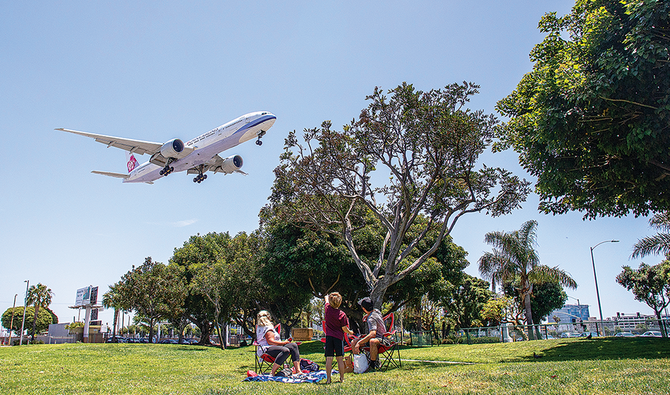
A China Airlines plane lands in Los Angeles on Friday. The US government has accused the Chinese government of stopping US airlines flights to China. (AFP)
Short Url
Updated 24 May 2020
Follow

Washington accuses Beijing of blocking US flights to China

  • The administration of President Donald Trump stopped short of imposing restrictions on Chinese air carriers

WASHINGTON: The US government has accused the Chinese government of making it impossible for US airlines to resume service to China and ordered four Chinese air carriers to file flight schedules with the US government.

The administration of President Donald Trump stopped short of imposing restrictions on Chinese air carriers but said that talks with China had failed to produce an agreement.

The US Transportation Department, which is trying to persuade China to allow the resumption of US passenger airline service there, earlier this week briefly delayed a few Chinese charter flights for not complying with notice requirements.

In an order posted on a US government website, the department noted Delta Air Lines and United Airlines want to resume flights to China in June, even as Chinese carriers have continued US flights during the COVID-19 pandemic.

The order said that Air China, China Eastern Airlines Corp, China Southern Airlines Co, Hainan Airlines Holding Co. and their subsidiaries must file schedules and other details of flights by May 27. The department warned it could find Chinese flights “contrary to applicable law or adversely affect the public interest.”

United declined to comment. The other US and Chinese carriers, the Civil Aviation Authority of China (CAAC) and China’s foreign ministry did not immediately respond to requests for comment.

The department said it it has “protested this situation to the Chinese authorities, repeatedly objecting to China’s failure to let US carriers fully exercise their rights and to the denial to US carriers of their right to compete on a fair and equal basis with Chinese carriers” and called the situation “critical.”

On Jan. 31, the US government barred from entry most non-US citizens who had been in China within the previous 14 days but did not impose any restrictions on Chinese flights. Major US carriers voluntarily decided to halt all passenger flights to China in February.

Delta and United are flying cargo flights to China. Delta had requested approval for a daily flight to Shanghai Pudong airport from Detroit and Seattle, while United had asked to fly daily to Shanghai Pudong from San Francisco and Newark airport near New York and between San Francisco and Beijing.

The number of weekly scheduled combination flights operated between the two countries by US and Chinese carriers fell from 325 in January to 20, by just the four Chinese carriers, in mid-February, before the carriers increased them to 34 in mid-March, the US order said.

The CAAC in late March said that Chinese airlines could maintain just one weekly passenger flight on one route to any given country and that carriers could fly no more than the number of flights they were flying on March 12, according to the US order.


Saudi POS spending jumps 28% in final week of Jan: SAMA

Updated 06 February 2026
Follow

Saudi POS spending jumps 28% in final week of Jan: SAMA

RIYADH: Saudi Arabia’s point-of-sale spending climbed sharply in the final week of January, rising nearly 28 percent from the previous week as consumer outlays increased across almost all sectors. 

POS transactions reached SR16 billion ($4.27 billion) in the week ending Jan. 31, up 27.8 percent week on week, according to the Saudi Central Bank. Transaction volumes rose 16.5 percent to 248.8 million, reflecting stronger retail and service activity. 

Spending on jewelry saw the biggest uptick at 55.5 percent to SR613.69 million, followed by laundry services which saw a 44.4 percent increase to SR62.83 million. 

Expenditure on personal care rose 29.1 percent, while outlays on books and stationery increased 5.1 percent. Hotel spending climbed 7.4 percent to SR377.1 million. 

Further gains were recorded across other categories. Spending in pharmacies and medical supplies rose 33.4 percent to SR259.19 million, while medical services increased 13.7 percent to SR515.44 million. 

Food and beverage spending surged 38.6 percent to SR2.6 billion, accounting for the largest share of total POS value. Restaurants and cafes followed with a 20.4 percent increase to SR1.81 billion. Apparel and clothing spending rose 35.4 percent to SR1.33 billion, representing the third-largest share during the week. 

The Kingdom’s key urban centers mirrored the national surge. Riyadh, which accounted for the largest share of total POS spending, saw a 22 percent rise to SR5.44 billion from SR4.46 billion the previous week. The number of transactions in the capital reached 78.6 million, up 13.8 percent week on week. 

In Jeddah, transaction values increased 23.7 percent to SR2.16 billion, while Dammam reported a 22.2 percent rise to SR783.06 million. 

POS data, tracked weekly by SAMA, provides an indicator of consumer spending trends and the ongoing growth of digital payments in Saudi Arabia.  

The data also highlights the expanding reach of POS infrastructure, extending beyond major retail hubs to smaller cities and service sectors, supporting broader digital inclusion initiatives.  

The growth of digital payment technologies aligns with Saudi Arabia’s Vision 2030 objectives, promoting electronic transactions and contributing to the Kingdom’s broader digital economy.