Pakistan’s ‘honor killings’ show women need digital skills, says Facebook oversight board member

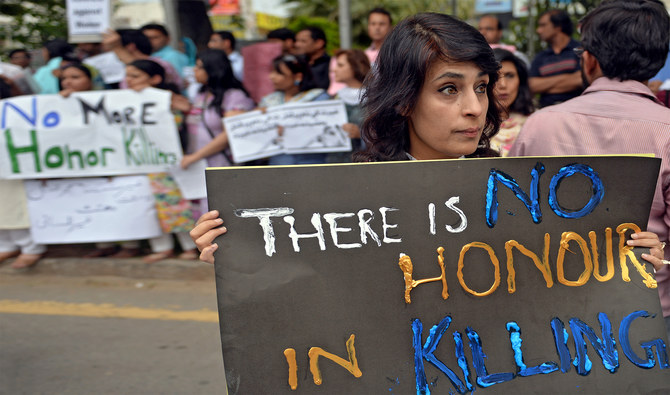
In this file photo, Pakistani human rights activists hold placards during a protest in Islamabad on May 29, 2014 against the killing of Farzana Parveen by members of her own family for marrying a man of her own choice in Lahore. (AFP)
Short Url
Updated 21 May 2020
Follow

Pakistan’s ‘honor killings’ show women need digital skills, says Facebook oversight board member

  • Two teenage sisters were shot dead in Pakistan’s North Waziristan last week after they appeared in a video with a man
  • The murder has sparked debate in Pakistan around women’s digital safety

KARACHI: The latest “honor killing” of two teenage girls in Pakistan after a video of them with a man surfaced online shows women need better control over their digital presence, said an activist appointed to Facebook’s new oversight board this month.
The sisters were shot dead last week in Pakistan’s remote North Waziristan, the latest victims of a conservative honor code which has led to hundreds of deaths, including the 2016 strangling of social media star Qandeel Baloch by her brother.
“The Waziristan killings highlight how the Internet can be used against women, especially in a patriarchal society like Pakistan’s,” said Nighat Dad, a Pakistani lawyer who founded the country’s first cyber-harassment helpline.
“Because more and more people are getting access to technology, its dark side is also becoming visible, with the onslaught of the entire spectrum of harassment brought into the virtual world.”
Dad has achieved global prominence for her work to protect women online in a country where their modesty is prized and they are often not allowed to work outside the home, fraternize with men or choose their own husbands.
After winning recognition as one of Time magazine’s next generation of leaders in 2015 and a Human Rights Tulip award in 2016, this month Dad joined what some have dubbed Facebook’s “Supreme Court” to rule on whether certain content is allowed.
Most of the calls to the Digital Rights Foundation advocacy group, which Dad founded in 2012 with a focus on protecting women online, are about revenge porn — the blackmail of women by ex-partners or boyfriends over online posts of intimate images.
“There are pockets of people on the Internet that find and leak footage of women without their consent,” the 39-year-old told the Thomson Reuters Foundation.
“This online activity has very severe consequences for women ... in some segments of Pakistani society, a woman’s worth is measured using her ‘honor’, and the moment she ‘dishonors’ her family, she is often made to pay with her life.”
The murder of the two teenage girls has sparked debate in Pakistan around women’s digital safety, with the women who shared news of the killings also coming under fire online.
Dad said women needed the autonomy to control their own digital presence, rather than being stopped from using the Internet at all, which many men tried to do after social media star Baloch’s murder in 2016.
“There was a real fear that (women) could be killed for their online activities, even for so much as owning a phone,” Dad said, adding that distress calls to her charity surged by 50% in the wake of the killing.
“There needs to be work done on laws and implementation, as well as building better channels of reporting content against women on social media platforms and the Internet,” she said.


ADB approves $381 million for climate-resilient agriculture, social services in Punjab

Updated 8 sec ago
Follow

ADB approves $381 million for climate-resilient agriculture, social services in Punjab

  • Support will upgrade Punjab’s education and nursing systems, improving learning outcomes and health care capacity
  • Package includes $124 million for agriculture, $107 million for STEM schooling and $150 million for nursing reforms

KARACHI: The Asian Development Bank (ADB) said on Saturday it approved $381 million in financing for Pakistan’s Punjab province to modernize agriculture and strengthen education and health services, with a major focus on building climate resilience after monsoon floods this year caused widespread destruction across the country’s most populous province.

The package includes concessional loans and grants for farm mechanization, STEM education, and nursing sector reforms.

ADB said the investments are intended to help Punjab, home to more than half of Pakistan’s population and a key contributor to its economy, recover from climate shocks and transition toward more sustainable and resilient development.

“Investing in education, health, and agricultural mechanization will play a transformative role in driving the growth of Punjab, a vital pillar of Pakistan’s economy,” said ADB Country Director for Pakistan Emma Fan. “These strategic investments will modernize agriculture, enhance human capital, and significantly improve livelihoods for millions of people across Punjab.”

The bank approved $120 million in concessional loans and a $4 million grant for the Punjab Climate-Resilient and Low-Carbon Agriculture Mechanization Project, which will support 220,000 rural farm households.

The program aims to reduce climate vulnerability by shifting farmers toward modern, low-emission machinery, provide alternative livelihoods for agricultural workers and train 15,000 women in new skills. It will also introduce a financing model to help small farmers access advanced equipment.

Punjab produces most of Pakistan’s wheat, rice, and maize but still relies on outdated machinery, contributing to grain losses and routine burning of crop residues, a major source of air pollution, said ADB.

It noted the new project will promote modern mechanization, including rice harvesters, to address these issues.

ADB also approved $107 million for the Responsive, Ready, and Resilient STEM Secondary Education in Punjab Program, including a $7 million grant from the Asian Development Fund.

The results-based program aims to modernize secondary schooling by expanding inclusive STEM education, improving access and quality across the province.

A further $150 million concessional loan was approved for the Punjab Nursing and Health Workforce Reform Program, which will upgrade nursing curricula, develop disaster-resilient training facilities, strengthen workforce governance, and introduce digital human-resource systems.

The program seeks to expand the pool of qualified nurses to strengthen health service delivery and meet rising national and global demand.

Key components include the establishment of three centers of excellence in Lahore, Multan and Rawalpindi, equipped with simulation labs, digital learning platforms, and gender-responsive hostels.

ADB said it remains committed to supporting climate-resilient and inclusive development across Asia and the Pacific through innovative financing tools and partnerships.