

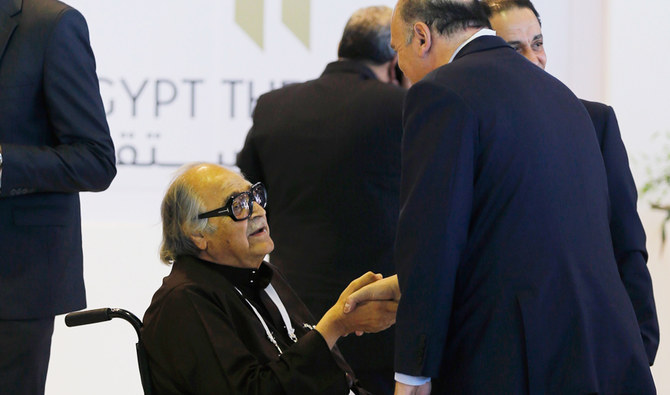

CAIRO: Egyptians have been paying tribute to Saudi businessman Saleh Kamel who died in Jeddah on Monday after suffering a heart attack.
Members of the country’s business, political, religious, and entertainment communities joined in mourning the passing of the prominent figure.
Offering condolences to his family, Al-Azhar’s Grand Imam Sheikh Ahmed Al-Tayeb described Kamel, who was 79, as “a pioneer in charity activities.”
Billionaire businessman Naguib Sawiris said he had lost a father and a brother, and added: “Arab nations, and Egypt especially, have lost a man who was a great philanthropist.”
Kamel, who was the chairman and founder of the Dallah Al-Baraka Group, one of the Middle East’s largest conglomerates, established part of his economic empire in Egypt including Arab Radio and Television (ART), and Al-Baraka Bank. He also used the ART Institution to fund charity projects throughout Egypt.
Egyptian actor Mohamed Sobhy recalled Kamel’s role in producing his most famous TV series, “Wanees’s Diaries,” describing him as a friend, father, and mentor.
Posting on Facebook, Sobhy said: “You were a loving person. I tell you how much I love you and give you credit for producing the best Arab family series that was broadcast on ART. You loved Egypt and you gave it a lot of devotion.”
Egyptian member of parliament, Mohamed Abou El-Enein, said Kamel was one of the pioneers of the Arab economy. “He shouldered the responsibility of spreading the multi-investment approach and opening economic borders among Arab states.
“His investments brought good and welfare to the Arab world at large and contributed in creating international partnerships on the private-sector level.
“His investments further paved the way for more fruitful cooperation between businessmen in all investment fields,” he added.
HIGHLIGHT
Members of Egypt’s business, political, religious, and entertainment communities joined in mourning the passing of the prominent figure.
He pointed out that Kamel was also the pioneer of Arab media in its modern form through his ART project. “He was the first to bring Arab peoples to watch one screen that melted languages and cultural differences as well as sports fanaticism.
“He unified Arabs on one goal, joint ambitions, and rich cultures. The Arab nation will never forget the good deeds of Sheikh Saleh Kamel and he will always be remembered.”
Abou El-Enein noted that Kamel started out as an entrepreneur “who utilized his study of commerce as a way toward brilliance and success,” and said his journey should be highlighted in business and economic studies. He added that the Arab youth should follow his lead in order to achieve success.
He also praised Kamel’s charity activities which he said had left a scientific legacy for students from around the world to benefit from.
He established the Saleh Kamel Center for Islamic Economics at Al-Azhar University in Egypt, the Jeddah Science and Technology Center, and the Center for Islamic Economics Research at Jeddah’s King Abdul Aziz University.
“His charity activities were not only in Saudi Arabia but in all Arab countries. He was known for his love of pure Arab nationalism and his passion for his second country Egypt,” added Abou El-Enein.
Kamel had always been a strong supporter of Egypt and in March 2015 headed a delegation of 100 businessmen and investors at a major conference in Sharm El-Sheikh aimed at boosting the Egyptian economy.
In one of his most famous quotes about Egypt, Kamel said: “If Egypt was infected with the flu, Muslims in Saudi Arabia and Pakistan would sneeze.”


