

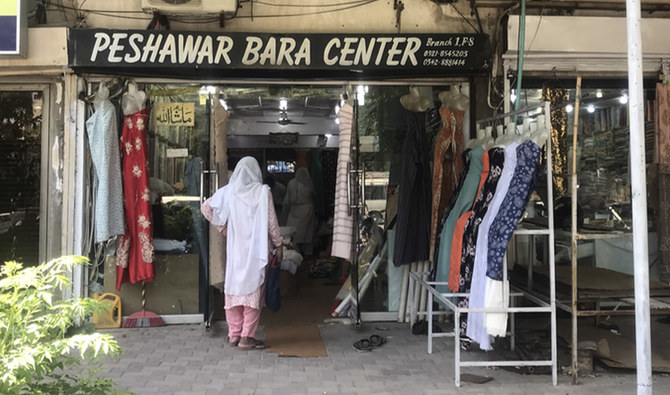

ISLAMABAD: Naveed Khan will remember marking this year’s Eid for several reasons, but mostly because it’s the first time he has struggled to keep the business afloat for his 19-year-old tailoring shop in Islamabad’s F6-2 Markaz market.
“Eid used to be so busy that our workers would be working all night until sehri time, and then head right back to the shop just to make sure we finished in time,” Khan, 34, told Arab News over the phone.
Today, he said, “the business has nearly come to a standstill.”
To limit the spread of the coronavirus outbreak, Pakistan began imposing strict social distancing measures nearly two months ago.
However, in compliance with a Supreme Court directive and to boost the economy, the government eased the restrictions on Monday, allowing the resumption of train and public transport services, and opening of all malls and shopping centers across the country.
Khan said the measures taken are too little, too late because the last few days before Eid Al-Fitr “aren’t enough to make up for losses incurred in the past two months.”
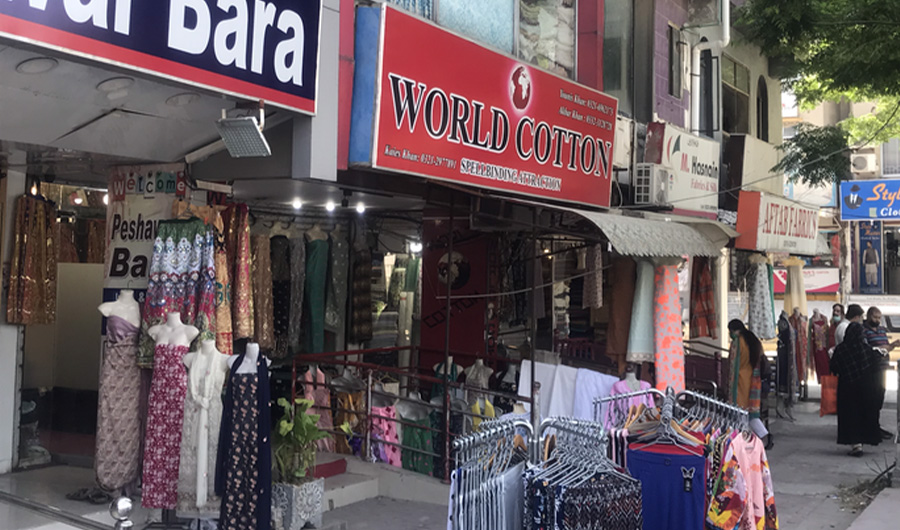
Fabric shops showcase their wares in Islamabad's F10 market on May 18, 2020. (AN Photo)
“I used to have four kaarigars (craftsmen) working round-the-clock with me during Ramadan and Eid, but now I only have two. It doesn’t help that people can only shop for a few hours before we close since we are also closed on Saturdays and Sundays,” Khan said.
The restrictive hours allow shops to remain open until 5 p.m. from Monday to Friday, which Khan said: “is not enough time for customers to choose and buy fabric at all.”
“Earlier, this market used to be so busy that customers would fight for parking space. It’s just not the same anymore,” he said, expressing frustration at how the “crisis was being handled.”
“Had they locked down properly at first, maybe by now, we would be in a much better place. Ramadan and Eid are an important time for tailors and our families. It’s been very hard for us,” he said.
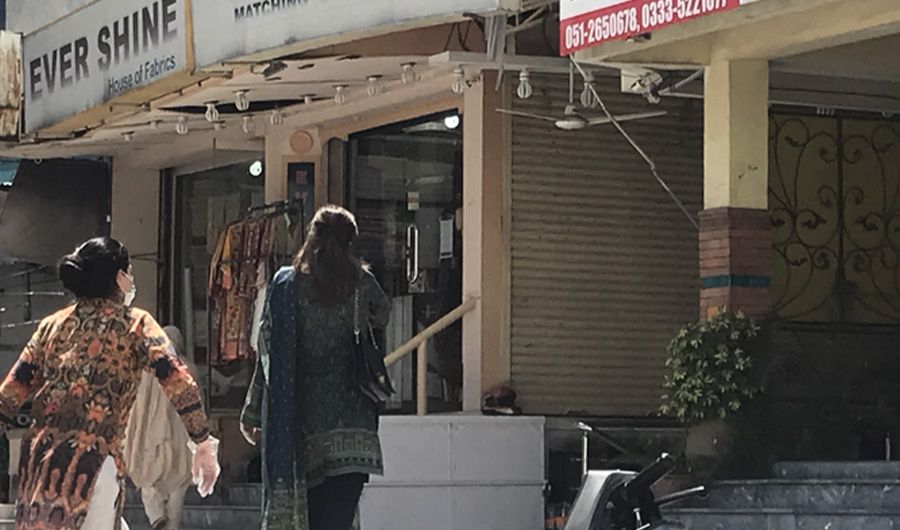
Two shoppers in masks head to the Evershine button and braid shop in Islamabad's F7 market. Customers often bring embellishments to their tailors to create a customised ensemble for special occasions. (Arab News)
In the neighboring F7-1 market area, Amanat Khalil whose shop has been in business for 35 years, shared Khan’s frustration, saying it’s unbelievable how much losses he’s incurred despite “Eid being a heavy income season.”
“The work is minimal compared to what it used to be. Normally in Ramadan, there would be so much work, my workers would stay back in the store to finish it. This year, I had to send some home because there just wasn’t enough work,” he said.
A poll conducted by Arab News showed that only 10 percent of those who took part in the survey said they would have new clothes stitched for Eid this year.
A majority said it’s because the celebrations will be muted due to the “strange times we are living in.”
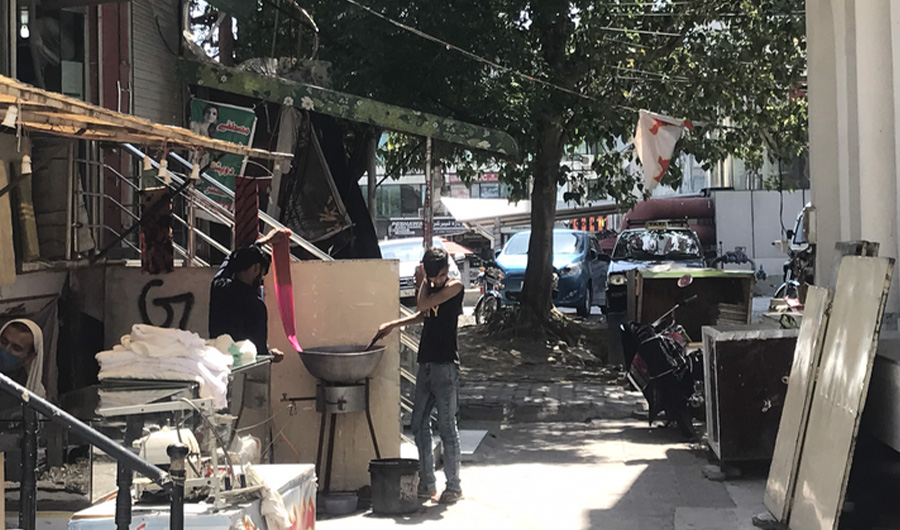
An alleyway in Islamabad's F7 market is lined with bundles of fabric and accessories on May 18, 2020. Usually, an entire team of workers can be seen dyeing fabric on-demand, but only two were present this year. (Arab News)
“It’s been miserable to think we’ll dress up and just stay at home. So, I bought simple lawn cloth which can double up as summer wear too. It’s practical and celebratory,” Sehrish Amjad, 25, who took part in the survey, told Arab News over the phone from Islamabad.
Others said they were repurposing old clothes with a snip here and a tuck there.
“We will only break distancing to visit our Nani as part of the Eid tradition. We are repurposing older garments with her long-time seamstress to help her and her family this Eid. Our Nani is happy, and so is the tailor. It keeps the festive spirit alive, ” Zainab Tariq, a 31-year-old resident of Lahore, told Arab News over the phone.


