

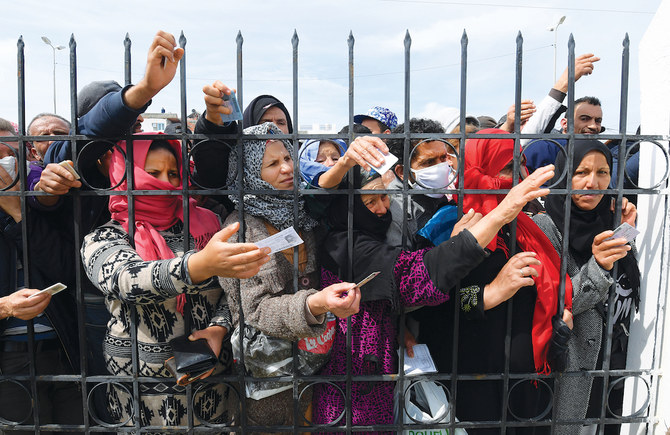


DUBAI: The peaceful demonstrations demanding political change in Algeria have been silenced. Another fight now keeps the country preoccupied — the coronavirus threat.
On March 17, President Abdelmadjid Tebboune announced that there would be a ban on all marches in order to combat the pandemic and, on March 24, the country officially began its lockdown.
Every Friday since Feb. 22, 2019, members of the Hirak movement had marched peacefully demanding regime change, social justice and popular sovereignty.
But today, Algeria’s streets are empty. The cries for change are ghosts of the recent past.
“Now the Hirak gathers digitally to discuss the country’s future through their computers and phones,” Algerian journalist Faycal Metaoui told Arab News.
“There is still desire for change and President Tebboune has said that there will be change. But we do not know when this coronavirus will end, or in what state the country will be in after the next three to four months.”
The crisis has hit oil-dependent Algeria, which also has strong ties with China, particularly hard. The collapse of crude oil prices could send the country reeling into economic and social turmoil.
Algeria’s lockdown has been extended three times, with the current restrictions set to expire on May 30.
The socio-economic challenges confronting Algeria are emblematic of the situation in all the Maghreb countries as they grapple with the deadly coronavirus pandemic.
The precautionary measures taken so far are bound to exact a harsh toll on the already feeble economies of North Africa.
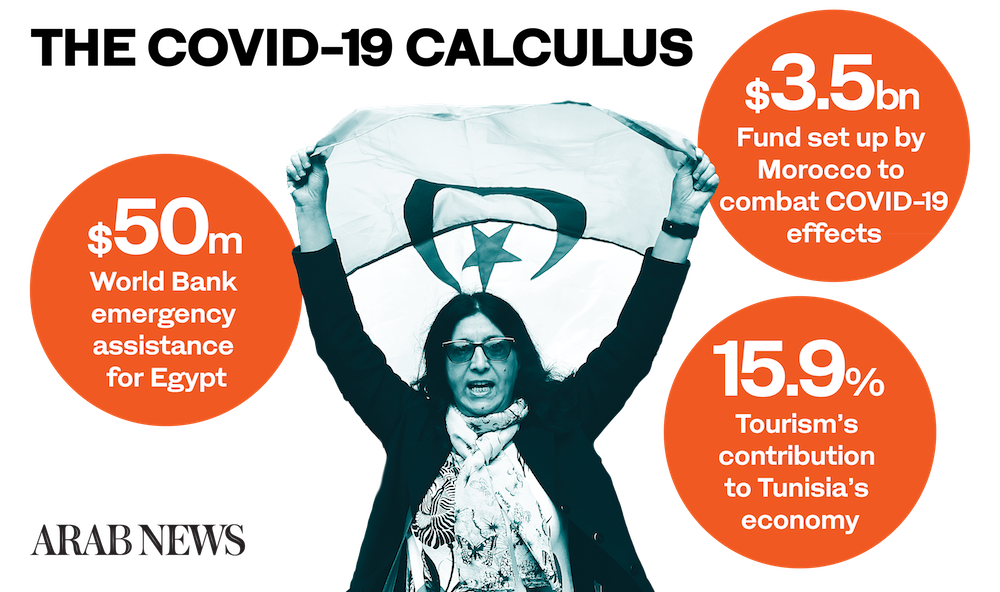
In Morocco and Tunisia, tourism contributes 19 percent and 15.9 percent respectively to GDP.
Algeria’s energy-dominated economy has never been dependent on tourism or trade, but the country is likely to take a major economic hit due to the collapse of oil prices.
“The differences between the Maghreb countries, especially between Algeria, Morocco and Tunisia, have long been known, but faced with this global crisis the challenges are the same for all of them,” said Slim Bahrini, executive director of the Maghreb Economic Forum (MEF).
“Few COVID-19 tests and few means, coupled with an economy that is likely to worsen in the coming months or collapse after the crisis, portend unprecedented social disruption.”
One clear takeaway from the crisis, according to Bahrini, is this: “Alone, each one of these countries cannot cope with this pandemic.”
On the political front, the lockdowns across North Africa have given the ruling elites a respite from anti-government protests, particularly in Algeria. But this is temporary, say analysts.
“Many North Africans don’t believe that the Arab Spring ever ended,” said an Algerian researcher who spoke to Arab News on condition of anonymity.
“As soon as the lockdown measures are eased, people will be out on the streets again, protesting for change. The authorities will now face a new opposition. We all hope it will remain peaceful.”
For his part, Bahrini says that Maghreb countries must set aside their differences if they want to succeed in their response to the coronavirus threat.
The differences between the Maghreb countries, especially between Algeria, Morocco and Tunisia, have long been known, but faced with this global crisis the challenges are the same for all of them.
Slim Bahrini, Executive Director of the Maghreb Economic Forum (MEF)
“These countries must embark on a radical transformation of their public policies and institutional priorities to cope with the immediate crisis and its long-term impact,” he told Arab News.
“Copy-pasting measures taken by the West saves us time, but our economies will suffer the consequences of this approach in the future.
“The handling of this crisis will undoubtedly lead to a social crisis more serious than the one we know now.”
Take Morocco, the North African country with the most extensive ties to Europe.
Although it has had a relatively low rate of case numbers in comparison with its European neighbors, the effects of the country’s lockdown have crippled tourism.
The National Tourism Confederation (CNT) estimates the projected losses across Morocco for 2020 to be about $34.1 billion in overall tourism revenue and $14 billion for the hotel industry alone.
CNT predicts a 98 percent drop in tourists visiting the country, which will put 500,000 jobs and 8,500 businesses at risk.
“The only hotels that are not closed in Morocco are those that have been given freely from their owners to the government to lodge either health care workers or those in quarantine after they have finished their treatment at the hospital,” said Jalil Benabbes-Taarji, president of the National Association of Tourism Investors.
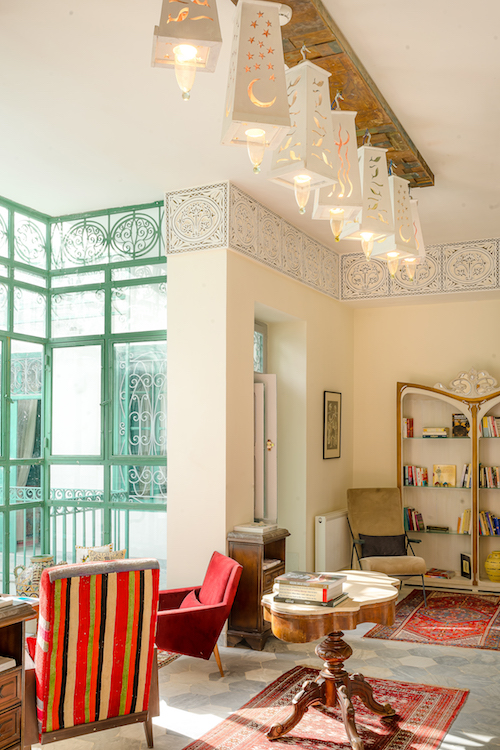
Dar Ben-Gacem, a 17th-century boutique hotel in the heart of Tunis’s medina, has teamed up with Tunisia's Red Crescent. (Supplied)
There was already high unemployment in Morocco before the pandemic hit. At the end of 2019, close to 1.1 million people were unemployed. To address the crisis, the Moroccan government has created a fund that has now reached more than $3.5 billion.
“The state has indicated that it will support vulnerable sectors and has begun compensating some of the most defenseless affected citizens,” Bahrini said.
While not officially part of the Maghreb, Egypt is one of the North African countries most vulnerable to the pandemic’s fallout.

Egypt is one of the North African countries most vulnerable to the pandemic’s fallout. (Credit: Samy Iverson)
The World Bank will provide $50 million for Egypt as an emergency response under the World Bank Group’s new Fast Track COVID-19 Facility — a global effort to help strengthen the COVID-19 response and shorten the time of recovery.
“The socio-economic turmoil will continue to be a part of the politics of the region until some really systemic change can happen,” said Timothy Kaldas, a nonresident fellow at the Tahrir Institute for Middle East Policy.
“Poverty in Egypt has increased in the past decade. Millions of people have fallen into poverty since the 2016 bailout from the IMF. The tension is there but the question we are all asking is, what is the breaking point?”
The ability to “stay home” in North Africa, like in other parts of the world and even in North America, says Kaldas, is limited to the affluent and not the working class.
“One third of the population in Egypt lives in poverty. Many are getting up each day and going to work because they don’t have a choice.”
“I don’t have much hope,” he told Arab News. “Egypt is likely to continue to muddle along with no massive breakthroughs but no complete collapse either.”
Against this grim background, Tunisia offers a glimmer of hope.
The Tunisian government has put in place a $860 million fund to support businesses, using money previously earmarked for government projects under the 2019 national budget.
However, Tunisia’s already high unemployment level, unchecked public-sector spending and anemic GDP growth rate are likely to aggravate the economic situation.
On the bright side, as the lone surviving Arab Spring democracy, Tunisia can perhaps count on the resilience and capacity-building skills of civil society groups and individuals to cope with the fallout of the coronavirus shock.
A role model in this regard is Leila Ben-Gacem, who has founded Blue Fish, a consultancy firm that promotes cultural diversity through socio-economic development, and Dar Ben-Gacem, a 17th-century boutique hotel in the heart of Tunis’s medina.
“For the first time I had to close the hotel,” the social entrepreneur told Arab News from the capital.
“Instead we collaborated with the Red Crescent, which had a long list of people who had lost their jobs and were unable to feed their families.”
Ben-Gacem has transformed her house into a kitchen, with a team preparing up to 120 meals a day for suffering medina residents.
“I’ve told myself that this is not the year for business,” she told Arab News.
“This is the year to make sure everyone around me is in good health. And when business comes back, it will come back.”








