

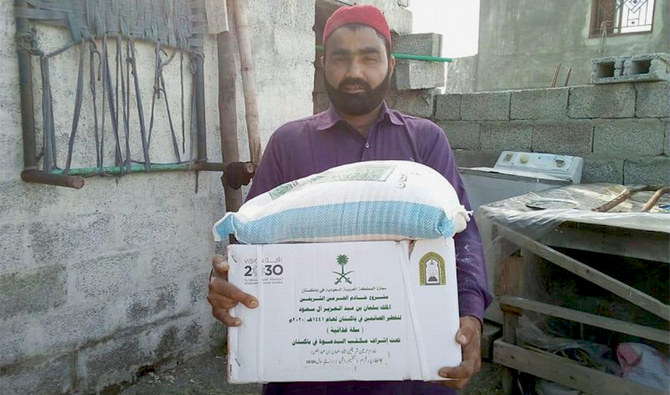
KSRelief distributes Ramadan food aid in Rawalpindi

A KSRelief beneficiary receives a Ramadan food package on May 17, 2020. (SPA)
Short Url
Updated 18 May 2020
Follow

KSRelief distributes Ramadan food aid in Rawalpindi

  • $1 million food assistance program for Punjab started on April 23
  • Pakistan is the fifth-largest recipient of aid from the Saudi-based international agency

ISLAMABAD: King Salman Humanitarian Aid and Relief Center (KSRelief) reached Rawalpindi with its Ramadan aid program on Sunday, Saudi Press Agency (SPA) reported.

The Saudi charity distributed 512 food packages among needy families, widows and orphans, benefiting about 5,120 individuals in the city, the SPA report said. 

According to the Saudi embassy in Islamabad, each package weighs around 30 kilograms and contains flour, rice, cooking oil, sugar, milk powder, dates and black tea.

“The campaign was launched to distribute over 22,000 food bags in Pakistan and will benefit more than 130,000 people in 10 districts of Punjab,” Saudi Ambassador Nawaf bin Said Al-Malki said as quoted in an embassy statement on May 11.

KSRelief efforts are conducted in cooperation with Pakistani authorities, in accordance with all precautionary measures laid down by the government to prevent the spread of COVID-19.

The assistance comes as Pakistan’s most populous province is facing mass job losses amid business shutdowns enforced to contain the spread of coronavirus. 

The $1 million Ramadan food aid program for Punjab was inaugurated on April 23.

KSRelief has provided humanitarian and development assistance to millions of beneficiaries in more than 49 countries. Pakistan is the fifth-largest recipient of assistance from the Saudi-based international agency and has received more than $120.2 million in aid since 2005.


Pakistan engages Saudi Arabia, China in bid to ease surging Middle East tensions 

Updated 10 March 2026
Follow

Pakistan engages Saudi Arabia, China in bid to ease surging Middle East tensions 

  • Pakistan’s foreign minister stresses need for de-escalation in conversations with Chinese, Saudi counterparts
  • Tensions in the Middle East continue to remain high as conflict between US, Israel and Iran intensifies

ISLAMABAD: Pakistan’s Deputy Prime Minister Ishaq Dar spoke to the foreign ministers of Saudi Arabia and China on Tuesday, stressing the importance of diplomatic engagement to de-escalate tensions in the Middle East as the Iran war intensifies. 

Pakistan has constantly engaged regional countries in efforts to broker a ceasefire in the Middle East, after the US and Isreal launched coordinated strikes against Iran on Feb. 28. 

Iran launched fresh attacks on Gulf countries on Tuesday morning, where it has targeted US military bases in recent weeks. In addition to firing missiles and drones at Israel and American bases in the region, Iran has also been targeting energy infrastructure which, combined with its stranglehold on the Strait of Hormuz, has sent oil prices soaring worldwide. 

Dar spoke to Saudi Foreign Minister Prince Faisal bin Farhan to discuss developments in the Middle East and ongoing deliberations at the UN Security Council, Pakistan’s foreign office said in a statement. 

“DPM/FM shared Pakistan’s perspective, underscoring the importance of continued coordination and diplomatic engagement to support de-escalation and promote peace and stability across the region and beyond,” the statement said. 

Dar, who also serves as Pakistan’s foreign minister, spoke to Chinese foreign minister Wang Yi over the telephone separately. The two discussed the evolving regional situation and broader global developments.

Dar underscored the need to ease tensions in the Middle East and the wider region during the conversation, the foreign office said. 

Yi appreciated Pakistan’s constructive efforts aimed at promoting de-escalation and stability in the region, it added. 

“The two leaders stressed the importance of de-escalation and emphasized the need to pursue dialogue and diplomacy in accordance with the principles of the UN Charter,” the foreign office’s statement said. 

The conflict in the Middle East has hit Pakistan hard as well, forcing Islamabad to hike petrol and diesel prices by Rs55 per liter last Friday. 

Pakistan’s government has also announced a set of austerity measures, which include closing schools and cutting down on government expenditures, as it evaluates petrol stocks and looks for alternative supply routes.